Force Torque Sensing in Collaborative Robot Grippers
Wrist-mounted sensors resolve the small forces that assembly and delicate handling require.
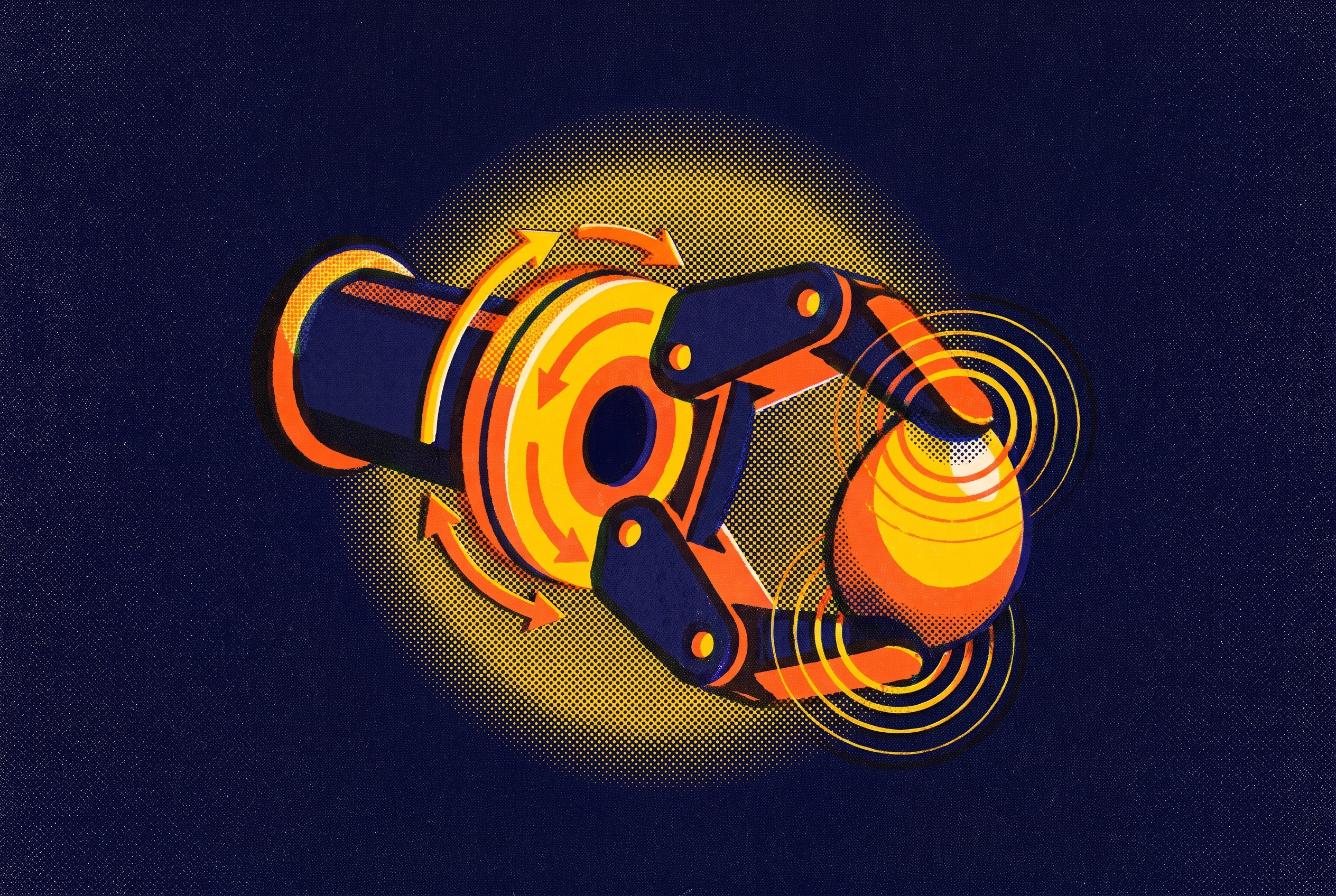
Force torque sensing in collaborative robot grippers bridges the gap between safe compliance and precise manipulation. A cobot’s ability to detect contact does not mean it can control the small forces that assembly, finishing, and delicate handling require. Effective deployment depends on matching the sensing method, its location, and its integration to the contact conditions of the task.
Why a cobot's built-in compliance is not enough for precision work
One common cobot architecture estimates joint torque from motor current and uses that estimate to infer contact force. Other approaches use dedicated joint torque sensors or wrist-mounted force/torque sensors. Current-based estimation can support collision detection, but arm posture, joint friction, and speed affect the relationship between the electrical signal and the force at the end-effector.
That distinction becomes decisive at the point of contact. Connector insertion, precision assembly, and delicate part handling require force resolution below what joint-current sensing can reliably provide. The arm can therefore detect a collision without resolving the smaller forces needed to complete an operation correctly. This is an architectural tradeoff. For tasks requiring direct, precise feedback at the tool, an additional sensing layer has to sit between the arm and the tool.
What force torque sensing measures and how the sensor produces that signal
A six-axis force/torque sensor measures three orthogonal forces, Fx, Fy, and Fz, and three orthogonal torques, Tx, Ty, and Tz, simultaneously. These channels describe both loading and twisting at the end-effector. Force alone is not the whole picture. A task can require the controller to distinguish a push from a turning load, so measuring all six axes provides the basis for controlling contact.
The central distinction is how the signal originates. A direct F/T sensor measures mechanical deformation at its sensing element instead of inferring force from motor current through the arm’s kinematic chain. Its measurement therefore avoids the posture, joint-friction, and speed effects that complicate current-based estimation. The signal originates at the tool’s mechanical interface. That directness gives the controller a more faithful basis for interpreting the forces exchanged during manipulation.
Newer sensing modalities include magnetoelastic, surface acoustic wave, optical, and magnetic-field-based designs. PaXini PX6D/PXTS magnetic-field-based sensors, showcased at CES 2026, offer potential advantages in harsh environments. The sensing method must give usable force and torque information in the conditions of the task, and where it sits determines which loads reach it.
Where in the gripper system the sensor sits, and what that placement decides
Wrist mounting places the sensor between the robot flange and the end-effector. It is the most common configuration because it is mechanically straightforward, suits retrofits, and captures the forces experienced by the tool regardless of gripper geometry. The packaging has a direct payload cost. Every kilogram of sensor and gripper mass reduces the effective payload available for the workpiece. The Robotiq FT 300 illustrates this arrangement with an IP65 rating, a ±300 N measuring range, and 500% overload capacity for collaborative assembly, quality testing, machine tending, and finishing.
Embedded sensing moves the measurement closer to the contact point. Sensors or sensing material integrated into the fingers can provide feedback where delicate or deformable objects meet the gripper. This changes both the measurement location and the gripper design. Duverney et al.’s January 2026 study in npj Robotics demonstrated a 3D-printed miniature gripper that estimated six-axis F/T from finger deformation captured by an embedded camera. Its estimates agreed well with a reference sensor under controlled laboratory conditions.
Sensors within the joints provide whole-body safety awareness along the arm. However, a fully extended arm can absorb certain force components structurally, leaving those components undetectable at the joints. Joint sensing alone cannot reliably characterize every end-effector contact. Many modern deployments therefore combine joint torque sensing for whole-body safety with wrist sensing for precise tool control, treating the two as complementary.
The tasks that become tractable once precise force feedback is available at the gripper
Contact-rich assembly exposes the limits of position control most clearly. PCB connector insertion can require actuation forces below one newton, beneath the resolution that motor-current sensing can reliably deliver. Dedicated F/T sensing becomes a prerequisite in that case. The OnRobot RG2-FT combines force/torque and proximity sensing for delicate handling, insertion, and assembly. SCHUNK’s FT AXIA 80 provides force resolution of 1/10 N and torque resolution of 1/200 Nm on its SI-200-8/SI-500-20 calibration variant across all six axes, supporting precision insertion and quality detection where coarse sensing fails.
Surface finishing depends on sustained contact. Consistent contact force is the quality variable, and real-time F/T feedback allows the robot to compensate for surface irregularities or tool wear. Position control alone cannot give the robot that force feedback. The OnRobot HEX 6-Axis Force/Torque Sensor is designed for sanding, assembly, insertion, and quality tasks. Its HEX-E and HEX-H variants meet different needs for sensitivity and torque capacity.
Delicate handling places a different demand on the same feedback loop. A rigid gripper without F/T feedback cannot adapt its gripping force to fragility or surface variation through measured contact force. Closed-loop force control gives it that feedback. The Duverney gripper demonstrated handling of miniature gears through visual servoing and delicate redcurrants through force thresholding, using the embedded F/T estimate for soft-object handling. During assembly, force measurements can also reveal a part’s presence, seating, or resistance, providing in-process quality data without a separate inspection station.
FACTR 2 from Carnegie Mellon and Waseda University uses force information to distinguish free-space, pre-contact, and contact phases, then up-samples the contact-critical phases during training. Robotiq’s FT-300-S is listed as a Physical AI-capable wrist sensor, while the RG2-FT is positioned for Physical AI model training and validation.
Connector insertion, precision assembly, and delicate part handling require force resolution below what joint-current sensing can reliably provide.
How sensorless estimation and vision-based alternatives compare to dedicated hardware, and where each belongs
Dedicated hardware is not necessary for every force-aware system. Standard joint-current estimation is fast, adds no cost for sensing hardware, and allows gross collision detection and basic safety compliance. More advanced estimation can go substantially further. FACTR 2 introduces NEXT, a data-driven method that estimates external joint torques from only ten minutes of free-motion data. It achieves quality comparable to dedicated joint-torque sensors on high-end arms and enables force-feedback teleoperation on low-cost arms such as the AgileX Piper without additional hardware.
That result gives sensorless estimation a credible deployment role. It is particularly relevant when retrofitting a wrist sensor is impractical or would cost more than the arm itself. The comparison still has a boundary. NEXT estimates torque at the joint level, so it inherits the structural blind spot that affects joint sensing when an extended arm absorbs certain force components.
Vision-based tactile sensing offers a different kind of advantage. It can capture surface deformation, texture distribution, and incipient slip, information a wrist F/T sensor cannot provide. Its value is not simply lower hardware cost. The Duverney study achieved agreement with a reference sensor using minimal training data, but the result remained a controlled-laboratory proof of concept. Earlier vision-based systems that used wrist-mounted cameras and neural-network estimation reported meaningful relative force errors, and they needed calibration again and again when lighting varied or objects were nonuniform.
Changing the sensor type or task can require collecting new data and retraining vision-based networks, creating a substantial burden where objects and operations change frequently. Dedicated wrist sensing remains the reliable production standard where resolution, latency, and repeatability are non-negotiable. Sub-newton insertion, finishing, and quality detection have those needs. Sensorless estimation works well on low-cost platforms, while camera-based grippers give more information about contact and offer a platform for further research.
What to weigh when choosing and integrating an F/T sensor for a cobot gripper
The choice should weigh force resolution, the payload budget, the environmental rating, and how much work integration will take. A strong specification in one area cannot compensate for a mismatch elsewhere. Resolution should come from the task first. The sensor’s resolution floor must lie below the smallest force the robot needs to distinguish. Sub-newton insertion can call for specifications such as 0.05 N force resolution and 0.002 Nm torque resolution.
The FT 300’s measuring range and overload specification describe its load-handling envelope, while force resolution describes its ability to discriminate small contact events. These specifications should not be treated as interchangeable. The HEX choice between higher-sensitivity HEX-E and higher-torque-capacity HEX-H illustrates the tradeoff between task profiles. The AXIA 80’s stated precision likewise belongs to its specified calibration variant, because other variants differ.
The mechanical check should account for the complete sensor-gripper assembly against the cobot’s rated payload. Embedded or integrated sensing can reduce the payload penalty relative to stacking a separate wrist sensor behind a full gripper. That saving can involve a compromise. Integrated designs may give lower sensing quality or need more complex software, and extra filtering to improve the signal adds latency. Environmental suitability belongs in the same decision, with the HEX’s IP67 rating relevant to wet, dusty, or washdown conditions.
Shared software interfaces can reduce programming demands and the time required to put the system into service. The Robotiq Hand-E integrates with the FT 300 and Wrist Camera through plug-and-play installation and programming on the robot’s touchscreen. The system is designed to let workers without robotics experience deploy it.
Other ecosystems organize that integration around tooling breadth or robot compatibility. SCHUNK’s gripping system kit combines electric and pneumatic grippers, quick-change modules, and F/T sensors tailored to Universal Robots arms. Its EGU series supports interfaces for Universal Robots, KUKA, Fanuc, ABB, Yaskawa, Dobot, and Kassow Robots. OnRobot places the RG2-FT and HEX within a unified tooling and software ecosystem across cobot brands. The relevant choice is the interface that reduces integration overhead on the intended robot without compromising the task’s sensing requirements.
How F/T sensing at the gripper connects to the broader shift toward force-aware robot intelligence
Data collected during manipulation can also shape how a policy learns to handle contact, including the phases where failures concentrate. FACTR 2 demonstrates this with estimated force signals. Across five long-horizon, contact-rich tasks, its training with force information showed a 17% improvement in task progress over prior force-aware policies.
The RG2-FT’s training and validation positioning connects its manipulation function to policy development. Software access becomes part of the sensing decision. Robotiq’s work on the TSF-85 tactile sensor, together with its published ROS 2 packages and open-source C++ SDK for adaptive grippers, reflects the convergence of sensing hardware, software interfaces, and simulation assets into a Physical AI development stack.
Miniaturization is also loosening the constraints on sensor placement. Sub-10 mm six-axis sensors, camera-equipped 3D-printed fingers, and gram-scale sensing elements broaden the options for locating sensitivity near the contact that needs measurement. For deployers, the practical implication is to integrate F/T sensing cleanly into both control and data pipelines and to choose systems with open software interfaces. That approach helps with today’s precision tasks and gives learned manipulation policies force data they can use.
Sources
- Affordable 3D-printed miniature robotic gripper with integrated camera for vision-based force and torque sensing
Provided details on the 3D-printed miniature gripper that estimates six-axis F/T from finger deformation via an embedded camera, including its handling of miniature gears and redcurrants.
- FACTR 2: Learning External Force Sensing for Commodity Robot Arms Improves Policy Learning
Provided the FACTR 2 and NEXT methodology details, including the ten-minutes-of-free-motion training approach and the 17% improvement in task progress figure.