Cobot Deployment for Order Packing in 3PL Warehouses
Multi-client warehouses need cobots built for chaos, not uniformity.
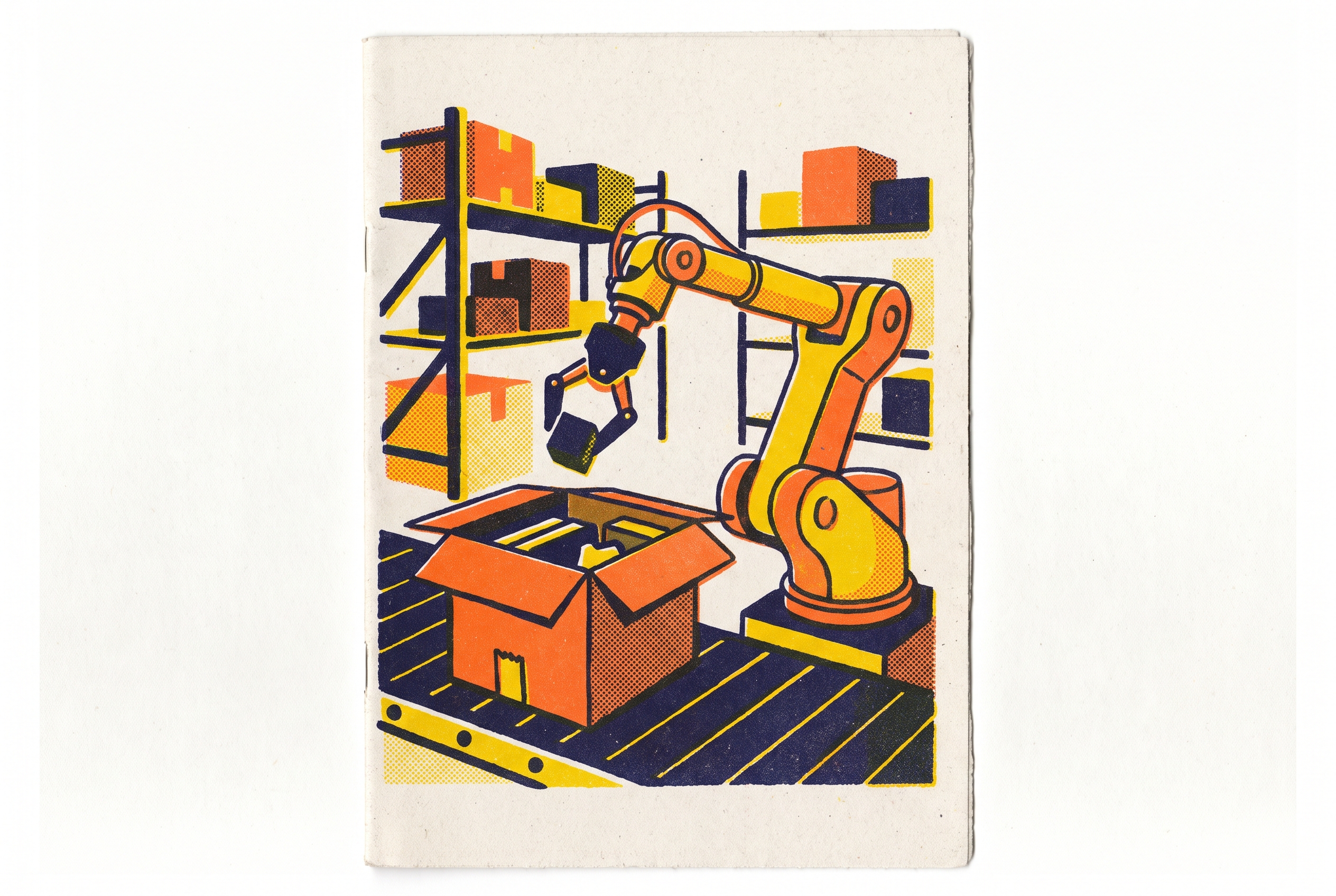
A 3PL packing floor runs under constraints that a captive, single-client warehouse never has to deal with, and that gap is the reason so many off-the-shelf cobot deployments underperform once they leave the pilot stage. A single-client distribution center has one product catalog, one packaging spec, one label format to answer to. A third-party logistics operation answers to several clients at once, each with its own SKU mix, its own carton and poly-bag requirements, its own label rules, and its own service-level agreement, all moving through the same floor space and the same labor pool on the same shift. A cobot cell tuned to handle one client's uniform cartons can turn out to be nearly useless the moment the next client's irregular poly-bag assortment comes down the line.
The asymmetry runs deeper than product mix. A captive distribution center can redesign its inbound product flow around whatever automation it buys. It can ask suppliers to standardize packaging, consolidate SKU counts, or shift order patterns to suit the machine. A 3PL has no such leverage. It has to fit the automation to whatever its clients bring it, not the other way around, and clients don't coordinate their shipping specs with each other or with the 3PL's equipment roadmap.
Order composition variability sharpens this further. When a warehouse management system serves multiple clients on shared infrastructure, it has to keep routing rules and order data segmented by client even while physical totes, conveyors, and labor move across all of them without distinction. That segmentation logic has to live in the automation layer from day one. A cobot cell bolted on after the fact, with segmentation treated as a software afterthought, inherits a data problem it was never built to handle.
Seasonal demand compounds all of it. Volume swings tied to Black Friday or holiday peaks don't follow a schedule you can set per client. A 3PL rarely knows in advance which client's orders will spike and by how much, so the packing system has to absorb surge without that foresight. Size a cobot fleet for average throughput and it becomes the bottleneck the moment one client's peak hits. Size it for peak throughput and it sits idle for most of the year, burning capital the rest of the time. Neither option is free, and general automation guidance rarely accounts for either, because it's built around single-client assumptions. Strategic robotics deployment in a multi-client environment has to preserve room for human judgment in quality control and exception handling, a requirement that gets treated as secondary in most generic automation playbooks but functions as load-bearing in a 3PL.
What cobots actually do in a packing cell, and what they cannot yet do reliably
Scoping a cobot deployment correctly starts with an honest account of what the machine handles on its own and where it still needs a person standing nearby. Cobots do well on uniform, repeatable work. Picking consistent items from a known feed position, with an end-effector matched to that item's geometry, is a task cobots perform reliably and at a steady pace. Label application is another strength: cobots apply labels with a precision that doesn't drift over a shift, and they keep that accuracy across long runs without the fatigue-driven error creep that affects human pickers late in a shift.
The limits appear quickly in cells handling high SKU variety. Irregular, soft, or fragile items are the hardest category for a cobot to handle well, because gripper selection becomes a genuinely difficult engineering problem the moment product shape stops being predictable. No single end-effector covers the full SKU range a mid-size 3PL's client roster typically contains, so gripper choice has to be revisited every time the client mix changes. Exception handling is the second major gap: damaged packaging, mislabeled items, and short-picks still need a person to catch and resolve them, and cobot deployment shifts human labor toward quality checks, complex returns, and customer service. Client onboarding is the third limit. Adding a new client with an unfamiliar SKU profile usually means reprogramming or retraining the cell, a cost that recurs every time the client roster changes.
Physical footprint works in the cobot's favor in space-constrained 3PL facilities. Unlike traditional industrial robot cells, which require caged, dedicated zones to keep humans clear of moving machinery, cobots are built to share floor space with workers directly, cutting the need for that dedicated perimeter. Standard Bots' Core cobot illustrates the practical upside: it ships within 6 weeks, deploys quickly for straightforward applications, and uses no-code programming that lets operators configure new routines in hours. For a 3PL onboarding a new client under time pressure, that kind of lead time matters as much as the robot's picking accuracy.
The technology is also moving past rigid, pre-programmed pick patterns. Better sensing and more autonomous motion planning are driving a new generation of cobot installations that adapt to variation in real time rather than requiring a fixed, pre-scripted path for every SKU. That shift expands the category of tasks cobots can take on, but it doesn't eliminate the gap between what a cobot handles unattended and what still needs a human eye on it, particularly in the exception cases a 3PL runs into daily.
How WMS integration determines whether a cobot deployment succeeds or fails
Warehouse management system integration is the central risk factor in a 3PL deployment, and treating it as secondary is how projects that looked solid on paper stall out on the floor. A cobot in a packing cell depends on real-time inventory data to know what to pick, in what order, for which client, at what service level the contract promises. Without a reliable feed from the WMS, throughput doesn't degrade gracefully. It collapses back to manual fallback, with the cobot sitting idle or working from stale data while workers handle orders by hand.
Every scan and every movement in a packing cell triggers a cascade: inventory counts update, tasks get assigned, billing records get generated. The cobot sits inside that transaction chain as one more node generating and consuming data, not as a piece of equipment running alongside the system unaffected by it. That embeddedness is what makes 3PL integration harder than a single-client deployment. Client data has to stay segmented even when it runs on shared infrastructure. A cobot cell packing orders for one client can't draw on another client's inventory counts or billing rules, even when both clients' products move through the same zone on the same conveyor.
Legacy WMS platforms frequently lack the APIs that robot control software needs to pull and push data in real time, and closing that gap often requires custom middleware that costs more than either side of the deployment originally budgeted for. That cost gets underestimated often enough that you need to address it before a vendor contract gets signed, not after. Data latency is the other recurring failure mode: a robot that's working off inventory data even a few seconds stale will mispick, misapply labels, or trigger chargebacks from clients whose service-level agreements don't tolerate those errors. Format mismatches between the WMS and the robot's control system sometimes require a translation layer in between, and that layer introduces its own latency on top of whatever the WMS and robot already have.
The practical move before signing with a cobot vendor is a direct audit: can the existing WMS expose real-time order and inventory data to an outside system through a standard API. If the answer is no, the integration cost can end up rivaling the cost of the robot itself, which changes the economics of the entire deployment before a single unit arrives on the floor. Operations that have built AI into their WMS report measurable gains in order accuracy, pick rates, and equipment utilization that older rule-based systems don't produce. In that kind of setup, the cobot functions as one coordinated node in an AI-driven system, not as a standalone machine bolted onto whatever software the warehouse already had.
That segmentation logic has to live in the automation layer from day one.
How SKU Variability Shapes a Cobot Packing Cell's Physical Design
SKU variability across a 3PL's client roster is the single biggest driver of how a cobot cell gets physically designed, and underestimating that variability is the most common reason a cell misses its throughput targets after go-live. What you decide before procurement, more than what you adjust afterward, determines the cell's performance.
End-effector selection carries the most weight of any early decision. A gripper built for rigid, uniform cartons will mishandle poly bags, fragile goods, or anything with an irregular shape, so a single gripper rarely covers a mixed client roster. Multi-tool changers, which let one cobot arm swap end-effectors mid-run, add flexibility but also add cycle time and mechanical complexity that has to be weighed against the throughput gain. The right gripper setup comes out of a client-by-client SKU audit done before procurement starts, not a fix applied after the cell underperforms.
Cell layout follows from the same variability. High SKU variability tends to favor bringing items to a fixed cobot station over routing a mobile cobot out to shelving locations, because a fixed station concentrates the unpredictable part of the job at one feed point. That's also where human assistance or vision systems can catch exceptions, rather than spreading that variability across the whole floor where it's harder to monitor.
Dynamic slotting raises the same design considerations. Automation makes it possible to move high-demand seasonal items physically closer to packing stations as demand shifts. A cell designed without that slotting flexibility will see its performance erode as client order profiles change through the year, since a layout fixed for one season's SKU mix won't serve the next season's mix as well.
Onboarding cost belongs in the same design conversation. Standard Bots' Core cobot offers no-code programming, so operators can configure new routines in minutes, and that cuts friction substantially for 3PLs that add clients on a regular basis. If a cobot needs specialist programming for every new SKU profile, it carries a hidden recurring cost, because every new client triggers another round of programming work.
Space is a binding constraint on top of all of this. Most 3PL facilities can't absorb a full redesign to fit a new cobot cell, so the cell has to work within the floor plan that already exists. Compact cobot arms that can safely share space with human workers cut the need for dedicated safety perimeters, which preserves aisle width and keeps multi-use zones available for other work, something a caged industrial robot cell could not do in the same footprint.
The RaaS Financing Model for Mid-Size 3PLs
For most mid-size 3PLs, the obstacle standing between a sound technical case and an actual deployment is capital structure, not conviction that cobots would help. Robotics-as-a-Service turns that obstacle into a procurement decision instead of a balance-sheet commitment, which changes who can realistically act on the case laid out in the sections above.
Under a RaaS arrangement, the 3PL subscribes to robotic capacity and leaves purchasing the equipment to the provider. The provider handles software updates, maintenance, and scaling, and a large capital expenditure turns into a predictable monthly operating cost instead. That shift puts AMR and goods-to-person systems within reach of smaller operations that the upfront capital requirement would otherwise have locked out.
The fit between RaaS and the 3PL business model runs deeper than financing convenience. RaaS lets robotic capacity scale with client volume the same way a 3PL's labor and space already do. A 3PL can add robots for peak season and scale the subscription back down once volume drops, getting from its automation vendor the same flexibility it already sells its own clients. With subscription-based robotics, a 3PL can respond to demand spikes like Black Friday without running the hiring and training cycle a temporary labor surge would otherwise require. The DSV and Locus Robotics RaaS partnership is a working example of this model letting a 3PL serve multiple clients with different seasonal demand curves without owning permanent overcapacity that sits unused most of the year.
RaaS also redistributes a risk that purchased equipment leaves entirely with the 3PL: technology obsolescence. Under a subscription model, that risk stays with the vendor, so the 3PL isn't stuck holding depreciating hardware when a better system reaches the market two years later.
The case against RaaS is cost over time. Measured across a multi-year horizon, subscription payments can add up to more than an outright purchase would have cost, particularly for a deployment running at stable, high utilization the whole time. For a 3PL with a variable client roster and real seasonal swings, which describes most mid-size operators, the flexibility RaaS buys is worth its premium. For a large operation running predictable, steady volume, owned equipment may be the better financial outcome. Which model fits depends on the 3PL's own volume profile, not on a universal answer that applies regardless of scale.
The labor transition that cobot deployment actually requires
Converting order pickers into supervisors who can monitor automated cells, troubleshoot faults, and escalate problems without becoming robotics engineers is harder than deploying the cobots themselves.
That upskilling requirement gets underestimated routinely. 3PL operators running collaborative palletizing robots report that the real operational challenge is retraining warehouse associates, people used to repetitive manual work, into a supervisory role that looks nothing like their previous job. The shift isn't only a matter of learning new skills. It changes how workers measure their own performance: someone who spent years tracking picks per hour now has to track cell uptime and how quickly exceptions get resolved, a different metric tied to a different kind of attention.
Safety trust has to come before any of that productivity gain is possible. A failure to address safety concerns among order pickers and other employees working within robotized systems can greatly erode their trust and willingness to collaborate, a dynamic that undercuts the automation's output no matter how capable the hardware is. When cobots share floor space with people, they need visible safety validation built into their introduction. Workers need to see the force-limiting behavior and the stop response in action before they'll work alongside the system with any confidence, and that validation has to happen before the cell goes into full production, not after an incident forces the issue.
Bringing workers into the deployment early is a factor that determines whether the deployment succeeds. Warehouses that succeed with this kind of rollout assess their needs, choose the right technology, and involve employees from the start so the implementation goes smoothly. Workers who take part in designing and testing the cell are positioned to catch exception scenarios that an engineering team, working without daily floor experience, would otherwise miss until the cell was already live and the mistake was already costing the client money.
Sources
- Full article: Deploying pickers and robots in cobot-based collaborative order picking systems
Provided technical grounding for how cobot-based collaborative order picking systems deploy pickers and robots together, informing the article's discussion of cell design and human-robot task allocation.
- The Future of Warehouse Cobots in Logistics
Supplied context on cobots sharing floor space with workers and the elimination of safety perimeters, supporting the article's points about physical footprint advantages in space-constrained 3PL facilities.
- WMS Integrations for 3PL Warehouses and Fulfillment
Informed the article's discussion of WMS integration challenges, including API requirements, data segmentation by client, and the cascade of transactions triggered by each scan and movement in a packing cell.
- The Future of 3PL & Warehousing Solutions: 2026 Trends
Contributed to the article's coverage of AI-driven WMS improvements and their measurable gains in order accuracy and equipment utilization.
- Warehouse Robotics in 2026: What's Actually Working
Supported the article's coverage of RaaS financing, seasonal scaling, and the DSV and Locus Robotics partnership as a working example of subscription-based robotics in 3PL operations.
- Future-Ready Logistics AI Automation: 3PL Technology Trends
Informed the article's discussion of AI automation trends in 3PL, including dynamic slotting and AI-driven WMS coordination with cobot deployments.
- Collaborative or substitutive robots? Effects on workers’ skills in manufacturing activities
Provided research basis for the article's discussion of how cobot deployment shifts human labor toward supervisory roles and quality checks, changing the skills workers need.
- Warehouse Automation Trends 2026: AI, Robotics & Orchestration
Contributed to the article's treatment of worker involvement in deployment rollouts and the importance of assessing needs and involving employees from the start.