Hand Guiding and Lead-Through Programming for Cobots
Operators can teach cobots by hand, but gravity compensation and careful setup determine what works.
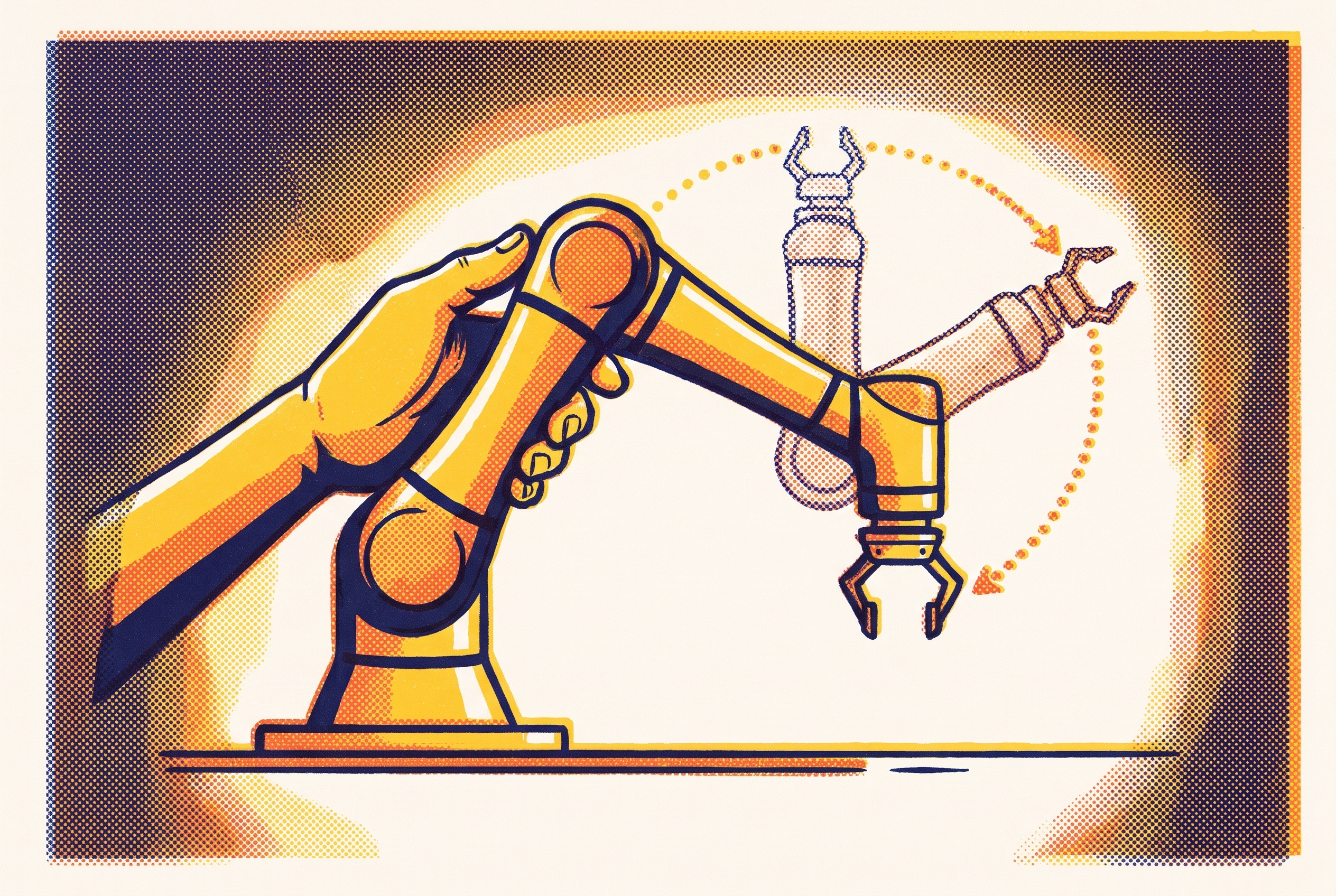
Hand guiding and lead-through programming let an operator teach a cobot by moving its arm by hand. Their usefulness depends on understanding what the controller compensates, what it records, and what physical teaching cannot supply. Used with suitable tooling, program logic, and application-level safety assessment, the method gives operators a direct route from process knowledge to a runnable robot program.
What hand guiding and lead-through programming are, and why cobots can do them
A cobot can accept physical teaching because its controller provides a compliant, gravity-compensated mode. Gravity compensation continuously calculates and counteracts the weight of the arm and tool at each joint angle, so the operator does not have to support their static weight. Compliant control serves a different purpose. It lets the arm yield to an external push or pull. Without these mechanisms working together, moving the robot by hand would be unsafe or impractical.
Manufacturers use terms including “freedrive” and “hand-guiding mode” for the underlying state in which the robot accepts physical input and holds position when released. The interface is physical, but the enabling work is in the controller. The International Federation of Robotics position paper identifies hand guiding, called “lead-though teach,” as an ease-of-use feature that distinguishes cobots from traditional industrial robots. That accessibility is especially useful to companies without engineering experts, because an operator can demonstrate a required position rather than first expressing it through a programming interface.
How the robot senses and responds to the operator's physical input
The controller must distinguish an operator’s guiding force from gravity, inertia, friction, and measurement noise. That distinction determines the quality of the response. Wrist-mounted force-torque sensors measure the forces and torques right at the end-effector. Once the tool’s weight and inertia are compensated, the residual signal represents the operator’s input. Adaptive, learning-based, and model-based controllers can use that signal to infer the intended motion.
Robots that have integrated elastic joint torque sensors can use a dynamic robot model to estimate external forces without a separate wrist sensor. Separating motor-side friction from link dynamics makes the estimate useful for interpreting human input. Wrist sensors improve intent inference but remain costly relative to the cobot platform, which motivates development of observer-based methods that avoid the extra sensor.
The RHOAS paper explains that industrial implementations typically compensate for gravity while leaving the operator to initiate and direct motion against the robot’s inertia. Static support is not the same as dynamic assistance. For redundant manipulators with more than six degrees of freedom, the operator must also manage the arm’s nullspace configuration while directing the tool center point. That adds a configuration task to the physical task of guiding the tool.
The two modes of recording a taught path: waypoint capture and continuous recording
Waypoint capture stores selected poses. The operator moves the arm to a required position and presses a button to save it as a named waypoint. Fairino’s guide recommends descriptive names such as “PickApproach” and “PlaceDrop,” which remain useful when a program is revisited months later. The grip point alone is not enough. Approach and retreat points should also be taught, so the saved sequence includes the movements into and out of the working position.
Continuous recording saves positions automatically as the operator guides the arm through the motion. It suits work such as welding torch paths and complex surface traces, where the trajectory itself is part of the task. The record preserves more than the endpoints. However, its dense position list is harder to edit offline or adapt to a shifted fixture.
The motion command then sets how the robot moves between the recorded points. Joint moves take the fastest path through joint space, so the tool follows a curved path that suits open transfers. Linear moves keep the tool center point on a straight Cartesian line. That distinction is essential for path-sensitive work such as welding seams and dispensing. Recording a position and defining the route to it are separate parts of programming.
What happens during a lead-through session in practice, from setup to saved program
Repetitive, low-mix, forgiving work, including loading parts, stacking, and transfers between fixed positions, provides a suitable first application. Work that calls for fine judgment or has randomly presented parts is a less suitable place to start. The real tooling must already be mounted and wired because the gripper defines the tool center point. If the operator teaches without it, the positions must be taught again once it is fitted.
Part presentation needs the same early attention as tooling. A cobot can repeat taught positions accurately only when the part appears in the expected location, so a locating fixture or indexed tray removes a large source of programming complexity. Fairino’s guide says that every hour spent on part presentation saves several hours of programming and troubleshooting later. Stable presentation simplifies the teaching session itself. It allows the operator to capture the required sequence against fixed physical references.
The operator then activates freedrive, typically by holding a dedicated button on the wrist or pendant, and moves the arm to a required position. Releasing the button leaves the arm holding that pose, which is saved with a descriptive name before the sequence continues. Gripper-close commands, vacuum activation, and a cycle-complete signal to a PLC are inserted between moves on the pendant. Loops, counts, and conditional branches come last, after the physical path is confirmed. For welding, the direct benefit is that a skilled welder can demonstrate a torch path rather than define it entirely through the programming interface, although that speed advantage does not remove the need for geometric control.
The interface is physical, but the enabling work is in the controller.
Where lead-through programming reaches its limits: precision, density, and operator fatigue
With passive compliant control, large, sweeping movements are easy, but precise linear movements are hard to make by hand. For a tight straight-line seam or close-tolerance placement, the arm must do more than move freely. Hand steadiness becomes part of the recorded result. The RHOAS paper argues that general passivity-based architectures unnecessarily increase operator effort and restrict the range of demonstrable motions without providing the intended stability guarantees in active interaction.
Continuous recording preserves the geometry of the demonstrated path. A dense list may replay the guided motion accurately while remaining difficult to revise offline or reuse across fixture variants. More recorded points do not resolve that distinction. In welding, even a torch path that was quick to teach by hand may need linear move commands to keep it straight where the work calls for it. Lead-through alone is a poor fit for tasks that need dozens of fine waypoints, tolerances tighter than a steady hand can meet, or paths that must be verified or certified offline.
Fatigue also affects the quality of the teaching data. The research identifies progressive degradation in demonstration quality and consistency during extended sessions, making operator effort more than an ergonomic concern. This matters even more for imitation learning datasets, which may need many hours of demonstrations. Redundant-arm configuration adds to that burden. Better wrist sensing can reduce the guiding force required, but its cost makes high-quality kinesthetic teaching at scale more expensive.
Active support and observer-based methods that address the precision and fatigue problem
Active support changes the controller’s role from yielding to motion to assisting the motion the operator intends. RHOAS, developed by researchers from KUKA and Technische Universität Braunschweig and accepted at the 2026 IEEE RO-MAN conference, treats hand guiding as an actively controlled interaction initiated by the human. Its design combines model-based external torque estimation, internal joint torque sensing, and redundant robot kinematics. No wrist force-torque sensor is required. The assistance supplements gravity compensation within the human interaction frequency bandwidth.
Making that approach useful requires more than amplifying an estimated force. The research addresses unmodeled joint elastic dynamics, measurement noise in the feedback path, reduced estimation accuracy near kinematic singularities, and static gravity compensation errors. These are practical control problems. Its user study on a KUKA LWR iiwa found statistically significant reductions in physical effort, improved maneuverability for precise and agile tasks, and clear user preference. Those findings support the approach, but RHOAS remains research-stage rather than a capability that can be assumed in any deployed cobot.
A patent-level approach also uses active control during lead-through to make precise linear motion possible where passive compliance cannot reliably do so. It addresses the difficulty of making precise linear movements through controller assistance, reducing reliance on steadier handling by the operator. The distinction is important when evaluating a teaching workflow. Passive compliance and active assistance offer different capabilities, and these developments show that engineering can address effort and precision constraints while leaving open whether every current implementation has overcome them.
Safety requirements that govern hand guiding as an operation mode
Hand guiding is a defined collaborative operation mode. Its hardware, speed, and force requirements sit within the safety of the whole application, including the robot, end-effector, workpiece, operating speed, and layout. Robot certification alone cannot show that the cell is safe. A cell-level risk assessment is required, and the integrator bears responsibility for meeting the application’s requirements. In an SME deployment, that integrator may be the end user.
Programming-mode hand guiding and production-mode hand guiding also need to be distinguished. During physical teaching, positions are recorded outside automatic mode, before the program runs. During production, collaborative hand guiding takes place in automatic mode, and the operator controls the motion directly, for example while supporting a heavy workpiece. Different procedural rules govern these two uses. Treating them as the same activity overlooks the operational boundary between creating a program and controlling a robot during production.
The IFR paper states that cobots most often require no additional safety measures on the factory floor. That statement describes the possibility of fenceless operation. The surrounding equipment and work remain part of the assessment. For a team planning deployment, the relevant question is therefore not only whether the robot supports hand guiding, but whether the complete cell and intended operating mode meet their safety requirements.
Where hand-guiding fits in a real deployment: which tasks it handles well and what to combine it with
Lead-through works well as the primary position-teaching method for machine tending and part transfer between fixed, well-presented locations. It also supports rapid reteaching after a fixture change when only a handful of waypoints need to be recorded again. Welding offers another strong use case. In high-mix, low-volume shops, a skilled welder can transfer process knowledge directly through the torch path, provided that the program supplies the path control the work requires. These applications benefit from physical demonstration without demanding that it solve every programming problem.
The practical recommendation is to combine hand-guided positions with pendant-based or scripted control where the task requires it. Conditional logic, PLC handshakes, error handling, and loop structures cannot be defined by moving the arm. Fairino’s guide frames the full program as hand-guided positions plus I/O actions and logic added at the pendant.
The IFR paper identifies companies without engineering experts and high-mix, low-volume production environments as key beneficiaries of accessible cobot programming. That accessibility depends on understanding the physical teaching layer, including gravity compensation, freedrive, waypoint capture, the tool center point, and payload settings. Ease of use makes those responsibilities available through a more direct interface. With that understanding, and with the cell’s safety responsibilities addressed, an operator can own a deployment from teaching through program completion without specialist programming support.
Sources
- Enabling Scalable Kinesthetic Teaching via Observer-based Hand-guiding with Active Support
Provided technical details on the RHOAS active hand-guiding system, including its observer-based torque estimation, user study results on the KUKA LWR iiwa, and arguments about passivity-based architectures increasing operator effort.
- Collaborative Robots - How Robots Work alongside Humans - International Federation of Robotics
Provided the IFR's characterisation of hand guiding as a cobot ease-of-use feature and its statement that cobots most often require no additional safety measures on the factory floor.
- Method for controlling an industrial robot during lead-through programming of the robot and an industrial robot
Informed the discussion of patent-level active control during lead-through programming to enable precise linear motion where passive compliance cannot reliably do so.