Mobile Cobot Platforms Combining AMR and Cobot Arms
Combined systems demand careful integration of positioning, safety and workflow timing.
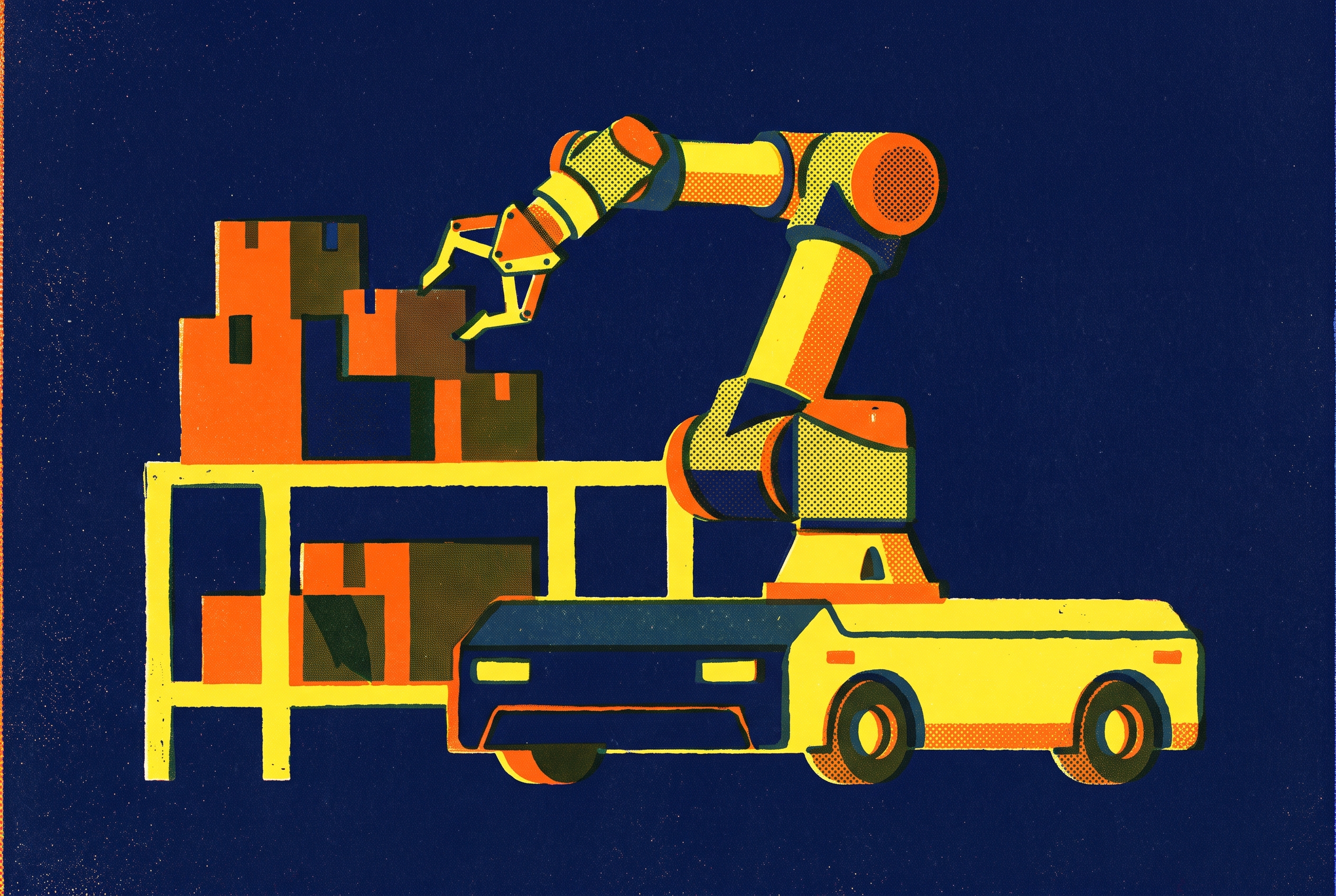
Mobile cobot platforms bring together an autonomous mobile robot’s navigation and a collaborative arm’s dexterity so they can both move materials and work on them. They are useful because they can do both jobs across multiple workstations. For manufacturers, success depends on evaluating the combined system’s positioning, safety and production integration, rather than selecting a capable base and arm in isolation.
Why material transport and manipulation have historically required two separate systems
A machinist walks parts from a cart to a machine, loads the next workpiece and returns when machining finishes. The walking consumes time without transforming the part. Yet automating that workflow has historically required two separate capabilities, with mobile platforms moving materials and stationary arms handling them. A fixed collaborative robot can load a machine but cannot travel to another station, while a transport robot can deliver parts but cannot load them at its destination.
That division leaves manufacturers with an expensive choice. They can install a fixed arm at every station or retain a human handoff between transport and manipulation. The first approach ties up money at each workstation, while the second leaves production relying on people for routine material handling. FANUC’s mobile tending article says fixed automation cannot always address labor shortages and demand for low-volume, high-mix machining at a cost that makes sense. Equipment that can move with the work is also a better fit when products have shorter life cycles and line configurations change.
What a mobile cobot platform actually is and how its two subsystems combine
An autonomous mobile manipulator robot, or AMMR, combines an autonomous mobile robot, or AMR, with a collaborative robot arm. The base provides locomotion through simultaneous localization and mapping, known as SLAM, with autonomous path planning and real-time obstacle avoidance. It can navigate to workstations without fixed navigation infrastructure. The arm supplies the physical action at the destination, including picking, placing, loading, unloading, fastening and inspecting. Supervisory software coordinates the handoff by dispatching the platform, scheduling tasks and passing task parameters to the arm controller.
Force and speed limiting, sensor monitoring, rounded edges and collision detection let the robot work near people without traditional safety fencing when the task allows it. This enables shared-space applications that a conventional industrial arm cannot provide in the same way on a mobile platform. It does not, however, establish that every combined application is safe without additional protection.
The defining distinction is where the manipulation happens. An arm mounted on a guided vehicle follows fixed paths, offering higher positional accuracy but not dynamic rerouting. A stationary-arm system instead uses AMRs to deliver work to the arm. FANUC’s mobile robots page describes both the traveling manipulator and stationary-arm configurations, which address different facility constraints.
The positioning precision problem that determines whether the arm can do useful work
A mobile manipulator that misses a machine chuck by 25 mm can damage tooling or drop parts. Arm repeatability alone cannot prevent that error. Even an arm with sub-millimeter repeatability starts from the wrong reference if its base stops tens of millimeters away from the expected position. Integration therefore requires securely mounting the arm and establishing its actual relationship to the workstation before manipulation begins.
A two-stage positioning stack bridges that gap. SLAM navigation brings the platform into the workstation vicinity, after which visual fiducial markers, 3D camera registration or mechanical guides refine alignment to within ±1–2 mm. Uneven floors can also cause errors because base tilt changes the tool-center-point position in ways wheel encoders cannot detect. Vision correction addresses the spatial relationship directly.
FANUC’s CRX-20iA/L demonstration gives a concrete example. A 2D camera reads a vision target, or calibration grid, at each station and calculates its position and orientation relative to the robot. That measurement establishes a local coordinate frame, allowing subsequent arm motion to remain as accurate as when first taught despite docking and floor variation. The relevant performance measure is consequently end-to-end accuracy at the workstation. For buyers, the lesson is to require a demonstration at representative workstation geometry.
Safety architecture for a system that moves through shared spaces while carrying a manipulating arm
A mobile manipulator combines hazards that its two subsystems do not present separately. Its safety architecture must cover both travel through spaces where people are present and an arm that can apply force beyond the base footprint. The arm’s reach changes the protected area. Layered detection zones use warning regions to slow the platform, protection regions to halt navigation and emergency stop regions at defined radii, with shapes and sizes that account for both the manipulator and the vehicle.
The interaction between base detection and arm protection is task-dependent. FANUC’s mobile tending article describes how the CRX arm’s power-and-force-limiting features work with area scanners. For low-risk manipulation tasks, the cobot can provide safe operation without scanners, while higher speeds or sharp workpieces require scanners to prevent arm motion when operators are nearby. This distinction shows why a configuration suitable for one manipulation task may be unsuitable for another, while the moving platform’s safety requirements remain in force.
Task-specific protection also creates useful deployment flexibility. The same platform can perform routine tending in a lightly guarded shared space and use a more restricted safety profile for hazardous workpieces without permanent infrastructure changes. That flexibility increases the validation burden, however, because each workstation introduces its own relationship between people, base, arm and workpiece. Deployment plans should include a documented combined-system safety assessment as well as the arm’s CE mark or the AMR’s certification.
That division leaves manufacturers with an expensive choice.
Where mobile cobot platforms deliver the strongest operational return
Mobile manipulation earns its complexity premium when work is distributed across stations and processing cycles leave time for travel. Machine tending is the clearest example of this fit. In high-mix, low-volume production, one robot can exchange parts at a CNC machine, move to another and return as machining finishes. The economic advantage comes from serving machines that would otherwise need separate fixed cobots or human tenders. When the product mix changes, software reassignment of the platform removes the need for a new fixed installation.
FANUC’s demonstration pairs the CRX-20iA/L with an OTTO 100 AMR and uses a CNC machine’s stack light as a readiness signal. The robot checks the light, swaps parts, presses cycle start and checks that machining has begun before it leaves. This follows the operator’s workflow without fixed communication infrastructure at each machine. Its usefulness depends on timing, however, because travel must fit between service demands to keep machines from waiting for the robot.
The same logic applies beyond machine tools. Kitting, shelf picking and workstation restocking need a physical handling step that transport-only AMRs cannot perform. FANUC lists part transfer, palletizing, depalletizing and assembly among mobile manipulation applications. Multi-station electronics, pharmaceutical and laboratory workflows also benefit when components or samples must move between processing and inspection steps. ABB’s 2026 cobot trends page identifies laboratories, pharmaceutical workflows and research facilities as expanding cobot applications, where compact size, quiet operation and safe design support deployment.
A fixed cobot is a better fit for a high-throughput station that is always busy because a mobile robot would add travel time without serving more work. Very heavy payloads can exceed the practical combination of base capacity and arm payload, while some tasks demand accuracy beyond the available positioning stack. Distributed work alone is not enough to establish a sound application.
Fleet coordination and integration with existing facility systems
A single mobile manipulator functions as a flexible workcell. A coordinated fleet requires software that connects that flexibility to production demand. Fleet management schedules tasks, dispatches robots, manages traffic and tracks battery availability. When a CNC machine signals that it needs service, the fleet manager can select the nearest available robot with suitable end-of-arm tooling and enough charge. FANUC’s tending article also describes how a signal sent before a machining cycle finishes lets dispatch start before the machine becomes idle.
Proprietary communication protocols have historically required separate management systems, leaving robots from different suppliers without common orchestration. VDA 5050 provides a vendor-neutral communication interface through which one fleet manager can coordinate robots from multiple manufacturers. For a facility buying bases from two vendors, its practical purpose is shared dispatch and traffic coordination rather than parallel, disconnected fleets.
Connecting fleet management to legacy warehouse management systems, manufacturing execution systems and enterprise resource planning systems can require months of engineering and experienced integrators. Production-aware dispatch depends on those connections, so interoperability between robots does not by itself establish integration with the factory.
How batteries are managed affects whether the robots can keep to that schedule. The FANUC/OTTO demonstration uses a charged replacement AMR while a UPS lets the cobot finish its current cycle so work can continue. FANUC also states that it works with all AMR manufacturers on mobile applications, giving facilities scope to select the base and arm separately. That choice makes the integration boundary an explicit part of the system design.
What the 2026 cobot capability expansion means for what AMMRs can now attempt
Improvements in cobot capability expand the work a mobile platform can perform after it arrives. Cobots can take on harder tasks as they gain higher payload capacities, longer reach, faster cycles and better accuracy. ABB’s 2026 trends page says manufacturers expect cobots to have industrial durability, precision motion control and long-term reliability so they can do work such as precision electronics assembly, high-precision dispensing and quality inspection.
Real-time machine vision can interpret a scene, while adaptive path adjustments compensate for variation in workpiece position. Intelligent object handling supports less structured picking, and predictive error detection can reduce dependence on perfectly repeatable conditions. These capabilities supplement the positioning stack. ABB’s Autonomous Versatile Robotics (AVR™) vision describes generative AI enabling autonomous learning, adaptation and multi-task execution beyond predefined programming.
Programming advances strengthen the redeployment case as well. Gesture-based teaching, lead-through learning, no-code interfaces and natural language interaction lower the expertise needed to establish work at a new station. That is especially useful when changing product mixes require frequent reassignment. Sub-millimeter insertion, inspection at multiple locations and adaptive handling of non-uniform parts are consequently becoming viable mobile applications as arm capability compensates for residual positioning uncertainty. Their feasibility still depends on the complete system and the particular task tolerance.
Implementation considerations for manufacturers evaluating this class of robot
Manufacturers evaluating an AMMR should treat deployment as system design before treating it as hardware procurement. The first decision is whether the work rewards mobility. Counting stations and mapping travel distances, processing cycles and dwell times establishes whether one traveling robot can serve the intended workload. Shared tending works well when machining cycles are long compared with travel time, while fixed automation is a better fit when one station needs constant service. High-mix, low-volume job shops are particularly strong candidates because redeployment has direct operational value.
Buyers should choose an alignment method that meets task tolerances and ask for end-to-end performance data from tests at representative workstation geometry. Safety assessment should happen at the same stage because arm reach, sharp parts, hazardous materials and nearby operators can change the operating profile that is allowed. Together, positioning and safety determine what the system can reliably do.
Manufacturers should work out what integration will involve before they choose hardware. An early audit of legacy production systems can identify communication gaps, candidate-platform support for interoperability standards and the engineering time required. Fleet architecture should also accommodate both the pilot and the intended deployment size. A single robot may need little orchestration, but several robots working in response to machine signals and production schedules need shared plans for dispatch, traffic and charging.
Vendor choice then becomes a question of integration responsibility. Teradyne’s portfolio brings MiR AMRs and Universal Robots cobots under one corporate parent, representing a single-ecosystem approach with validated interoperability and unified support. FANUC represents an open-integration approach through compatibility with all AMR manufacturers, allowing the facility or integrator to assemble the stack from separately chosen components. Neither philosophy removes the need to validate the application. Manufacturers should choose the arrangement that best fits their engineering skills and the support they need.