Cobot ROI in Small and Mid-Size Manufacturing Plants
Small manufacturers need different payback math than the automotive giants who pioneered cobots.
Advertisement
Collaborative robots stopped being a hedge against the future and became a line item on the shop floor. Small and mid-size manufacturers now account for the majority of new cobot installations, a reversal from the automotive and electronics giants that built the category over the last decade. That reversal breaks most of the payback math still in circulation, because a twelve-person machine shop running two shifts does not amortize a $90,000 cell the way a large automotive supplier does. Most of the ROI models still being handed to buyers were built for the wrong customer, and shops that borrow them are the ones most likely to misjudge a good deployment as a bad one.
Cobot adoption among small and mid-size manufacturers
The trade-show phase is over. For most of the last decade, a cobot on the floor was a signal, proof a company was "thinking about automation" more than a machine actually earning its keep. That era has closed, and the installation data makes the case better than any enthusiasm at a booth ever did.
Market-size estimates from different research firms disagree on the exact dollar figures and growth rates ahead, which is normal for a category where methodology and base years shift year to year. Reconciling the two numbers isn't the useful exercise. What matters is that both point the same direction: fast, compounding growth, not gradual drift.
Installation counts are the cleaner signal, since they don't depend on pricing assumptions that move every year. The IFR recorded 64,542 collaborative robots installed worldwide in 2024, up 12% year over year, with cobots now making up 11.9% of all industrial robot installations globally. The IFR calls cobots the fastest-growing segment of the robotics market by unit count, and unit count is the number that reflects actual adoption rather than sticker inflation.
The buyer has changed along with the volume. According to cobotfinder.com, small and mid-size manufacturers account for over 60% of new cobot installations in 2025 and 2026. Enterprise buyers built this category. SMEs are running it now, with a lower tolerance for downtime and a much tighter cost cushion. Borrowing an automotive-scale payback model for that buyer is a mistake, not a shortcut, and it's the first thing that needs fixing.
The wrong number to start with: the sticker price
Quote a shop owner the arm price and you've told them almost nothing. A popular cobot model lists around $25,000. A UR20 runs $85,000 or more. Neither figure says whether the project pays for itself, and shops that budget off the arm price alone are the ones who later call a perfectly sound deployment a failure.
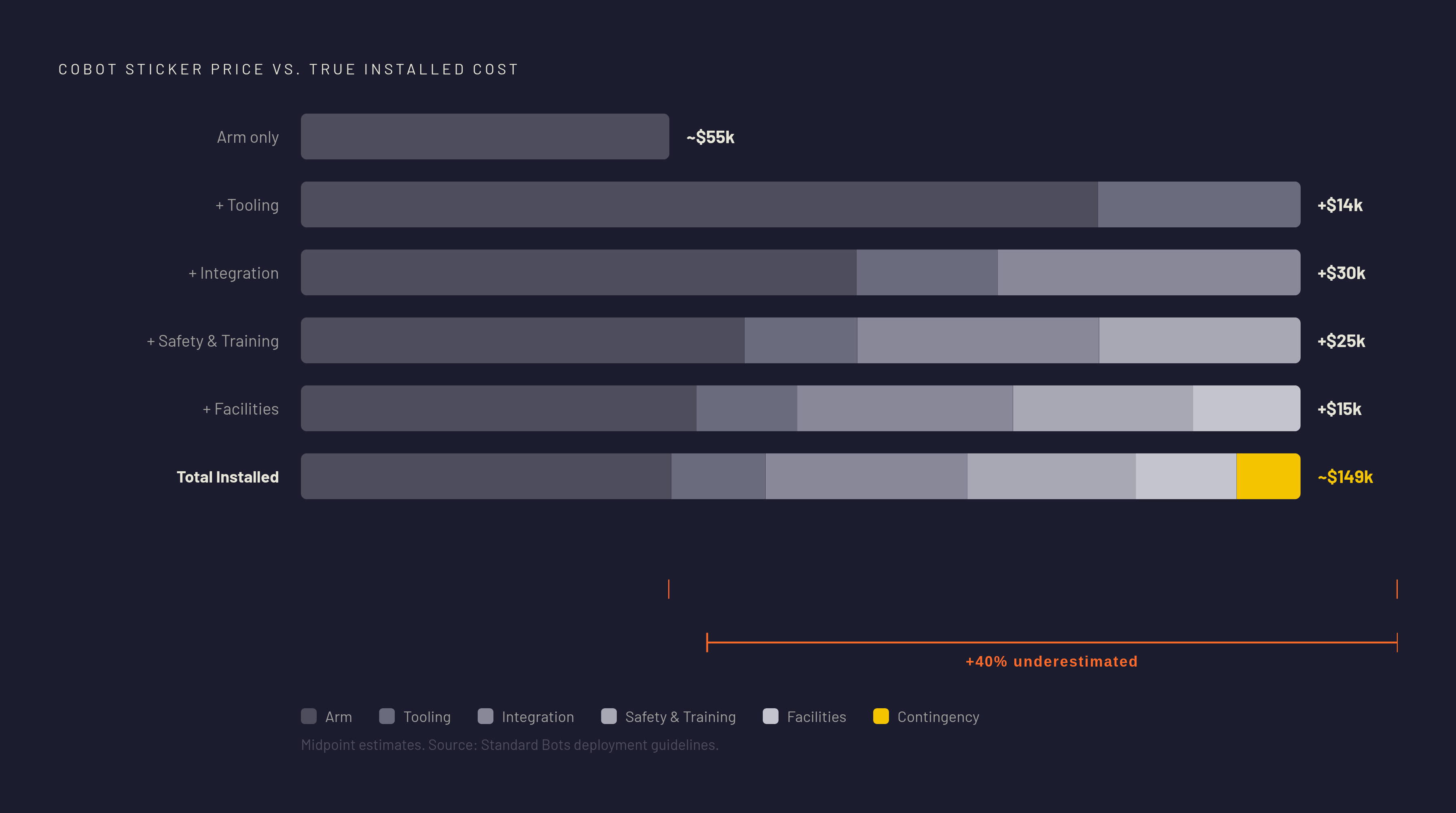
Research from ifactoryapp.com identifies the gap between quoted arm price and total installed cost as the single most common reason cobot projects blow their year-one budget. The mistake is treating the arm as the project and everything else as an afterthought. End-of-arm tooling, the grippers, torches, or sensors that let the machine actually do the job, runs $3,000 to $25,000 depending on how specialized the task is. Safety peripherals add another line. Integration engineering, the work of programming the cobot into a real production sequence, ranges from a few days of labor on a simple pick-and-place setup to weeks on a complex multi-process cell, and Standard Bots prices that range at $10,000 to $50,000. Operator training runs another two to five days and is the item most often left off the spreadsheet.
Then there's the cost nobody budgets until it appears on an invoice: air compressors, facility rewiring, network drops for data connectivity. Standard Bots recommends padding the total by 10% to 15% just to absorb those surprises, and shops that skip the padding almost always find out why it was there.
Engineers who budget for the arm alone underestimate total deployment cost by 40% or more, ifactoryapp.com reports, and that gap is large enough to sink a project that looked sound on paper. A deployment clears its payback target or gets written off often based on nothing more than that 40% miscalculation, made by someone comparing real spend against a budget that was wrong from day one.
Application fit and the ROI math before deployment begins
The application decides whether a cobot makes sense, not whether the arm happens to be the newer or shinier piece of hardware. That's the principle most frequently cited in cobot selection guidance, and it's the one buyers skip most often. Payload, cycle speed, safety requirements, and how often the product mix changes determine fit long before price enters the conversation, and buying for the application instead of the machine heads off most downstream ROI problems before they start.
A handful of questions separate a sound purchase from a mismatched one. What's the true payload, including the tooling bolted to the end of the arm, not just the part being handled? Does the plant already standardize on one controller platform, since staying put cuts training and service costs down the line? How dense is the certified integrator network in the region, since thin coverage means longer waits and higher travel bills the first time something needs adjusting? Has anyone priced the full deployment, tooling and safety and integration included, rather than just the arm on its own? Does the job actually require fenceless collaborative operation, or would a monitored-stop setup do it for less? And is there a plan to feed cycle and fault data into the plant's MES or CMMS, so the investment appears in OEE reporting instead of disappearing into anecdote?
A clear line can be drawn between where cobots win and where they lose. They fit low-to-moderate payload work, high-mix and low-volume lines where changeover happens often, tasks where people and machines share the same space, floor plans too tight for a fenced cell, and shops without dedicated automation staff. They fit poorly once payload climbs past roughly 30 kilograms, once cycle time is the entire game on a high-volume dedicated line, in harsh environments throwing off heavy spatter, or anywhere a traditional fenced cell would run long enough to amortize its higher upfront cost regardless. Buying a cobot for that last category is the wrong machine, and no amount of clever financing changes that. It's the wrong machine, and no amount of clever financing changes that.
Within the applications that do fit, payback speed still varies widely. Machine tending, loading and unloading CNC machines, is the highest-volume cobot application in deployment today and draws on the most mature integration playbooks in the industry, a point the benchmarks below unpack further. Pick-and-place and press-feeding work frees an operator from repetitive manual feeding and posts some of the fastest documented payback of any application. Palletizing carves out a niche between manual labor that becomes ergonomically unsustainable at volume and a traditional automated cell that isn't justified at that same volume, with a cobot palletizer deployable at a meaningfully lower installed cost than a traditional automated palletizing cell. Welding makes its case on more than labor cost alone, since it also avoids recruiting costs in a trade where skilled welders are scarce and cuts rework tied to inconsistent weld quality. Light assembly, quality inspection, and end-of-line packaging round out the list of strong fits, wherever the job puts a cobot working directly next to a person rather than behind a fence.
The payback calculation that reflects what happens on the floor
The formula itself is not complicated: add annual labor savings to the value of any output gain, divide by total installed cost, and the result is payback in years. Simple in form, unforgiving in practice, since a sloppy labor assumption or a missing output variable can swing the answer by months in either direction.
Labor cost is the input people get wrong first, almost always by underestimating it. Szghtech.com puts fully loaded operator labor cost, the figure that includes benefits and overtime rather than just base wage, at $20 to $28 an hour. Standard Bots offers a clean illustration of how sensitive the math is to that number: a $40,000 cobot replacing one full-time operator at $60,000 a year fully loaded pays for itself in roughly 8 to 10 months. A lower fully loaded wage stretches that window out considerably. The eight-month payback headline only holds when the labor figure reflects true fully loaded cost, not the number printed on a paycheck, and skipping that distinction builds the whole calculation on sand.
Shift count is the biggest lever in the equation, and it's the one most underused by SMEs running a first deployment. Running two shifts instead of one doesn't just add production hours. It accelerates payback proportionally, because the fixed installed cost gets divided across a much larger volume of output. One-shift deployments rarely land in the fastest payback windows the industry talks about. Multi-shift and lights-out operation is what actually makes the math work for most small and mid-size shops, and no clever vendor trick substitutes for adding hours.
Dynamic Group, a Minneapolis injection molder, shows the shift multiplier in concrete terms. Three UR10 cobots took over machine tending and kitting work that had previously required three operators across one shift, and the plant restructured down to a single operator managing all three cells. The resulting payback has been reported at two months, a number that only makes sense once you see shift consolidation and labor displacement stacking on top of each other in the same deployment.
The most commonly omitted line in the whole calculation is output gain: the extra parts a machine produces simply because it runs more continuously with a cobot tending it than it did with a human operator on a normal break-and-bathroom schedule. This variable can substantially compress actual payback relative to what the original model projected. Deployments that do capture this variable consistently report real returns that exceed the original model. Leaving output gain out of the spreadsheet throws away the most persuasive number in the entire case.
Payback benchmarks by application: what the numbers look like in practice
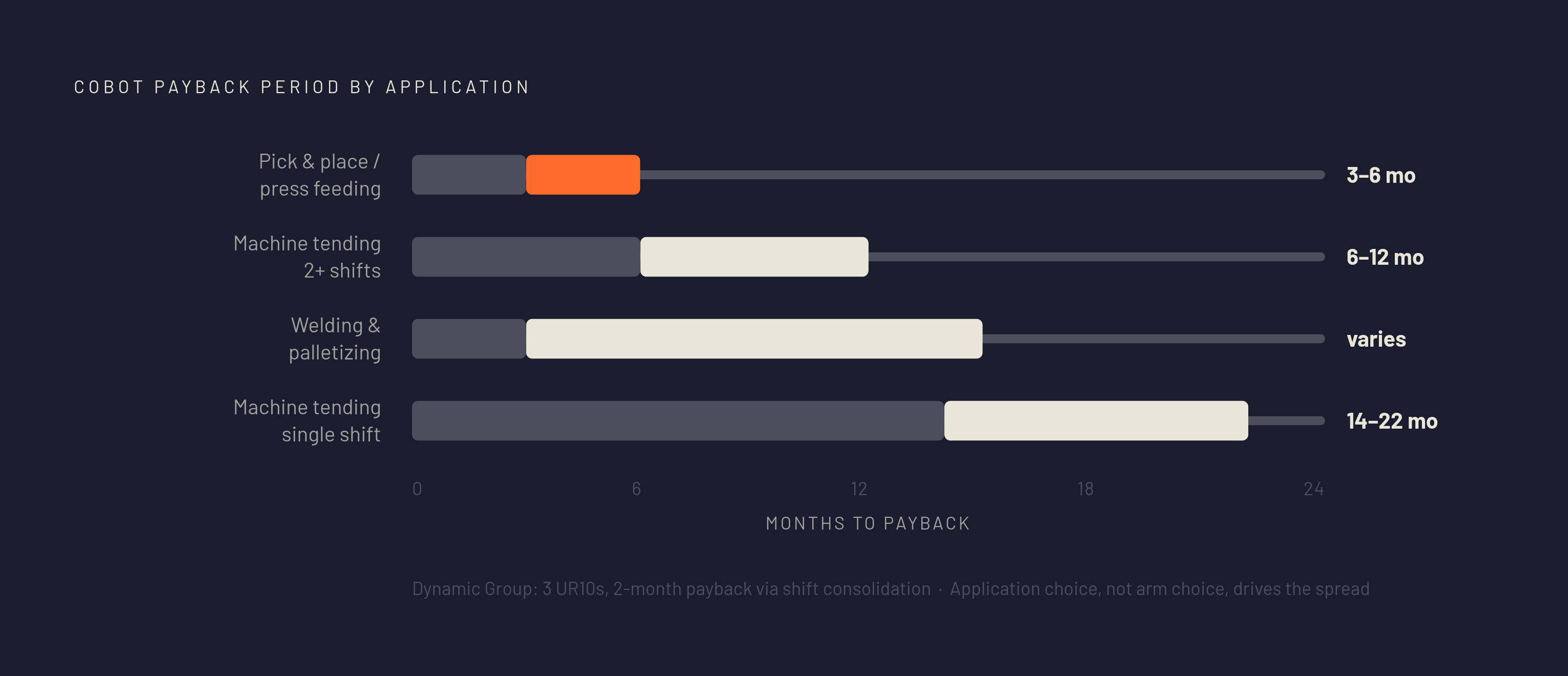
Machine tending sits at the center of the cobot market, and the numbers show why. Total installed cost typically runs $90,000 to $150,000, displacing somewhere between 0.75 and 1.5 full-time equivalents once the work spreads across shifts, with payback in the 14-to-22-month range according to amdmachines.com. It also carries the deepest bench of integration experience of any application, and that experience lowers integration risk compared with newer, less-proven use cases. Pushing a greenfield machine-tending, pick-and-place, or packaging deployment to two or more shifts compresses payback to 6 to 12 months.
Pick-and-place and press feeding move faster still. Once a cobot takes over repetitive press-feeding, the displaced operator can be reassigned elsewhere on the floor, and payback in the 3-to-6-month range has been documented for this category, the fastest of any common cobot application. Labor displacement happens on day one, and total installed cost stays low relative to more complex cells.
Palletizing occupies a narrower niche in the middle of the market. A cobot palletizer typically runs well below the cost of a traditional industrial palletizing cell on a fully installed basis. The value case is strongest for operations too large to keep palletizing by hand without ergonomic and injury risk, but too small in volume to justify the footprint and cost of a dedicated traditional cell. It has grown fast as a category and ranks among the quicker-growing cobot applications tracked in the industry.
Welding rounds out the set with payback that varies considerably by deployment, generally faster when the cell displaces overtime hours or contract welders brought in at a premium. The ROI case for welding rarely rests on labor savings alone. It usually stacks the avoided cost of recruiting for a trade where skilled welders are hard to find on top of the reduction in rework that comes from weld consistency that doesn't degrade over an eight-hour shift the way human attention does.