Total Cost of Ownership for Autonomous Mobile Robots
Purchase price is only a fraction of what it actually costs to run one.
Advertisement
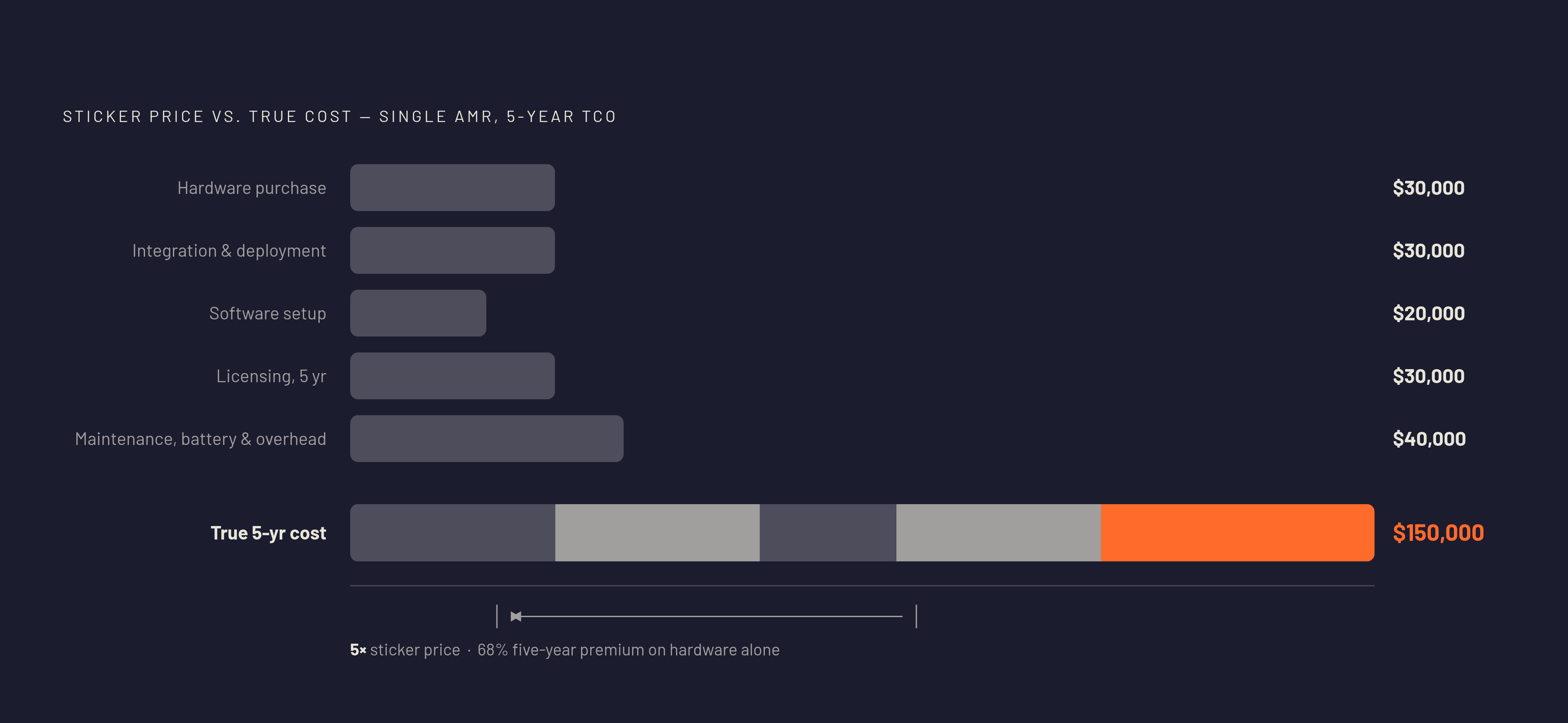
A robot that costs $30,000 to buy can cost $150,000 to actually get running on a warehouse floor. That fivefold gap is the whole story: the sticker price on an autonomous mobile robot bears almost no relationship to what the thing costs across its working life. Total cost of ownership captures the full arithmetic, procurement through decommissioning, and it splits into direct costs anyone can see on an invoice and indirect costs that become visible months later on operating budgets and maintenance logs, usually as a surprise to whoever signed the purchase order. Buying on sticker price alone means you have not actually made a purchasing decision. You have deferred one, and handed it to whoever runs the operating budget next year.
The Real Cost of an AMR Beyond Purchase Price
Budget for the robot and you have budgeted for a fraction of what deployment actually costs. That gap occurs whenever legacy integration methods get bolted onto hardware that was quoted in isolation, as if the robot would roll onto the floor and start working on its own. The robot will not simply roll onto the floor and start working on its own. Someone has to map the facility, wire the fleet management software into the WMS, certify the safety zones, and train the floor staff who will work alongside it, and none of that labor comes free just because the robot itself does what the spec sheet promised.
Purchase price is the one number every buyer can compare across vendors, so procurement teams anchor to it, understandably. Software, integration labor, facility changes, and five years of maintenance don't sit on that comparison sheet. They land on the operating budget instead, quarter after quarter, long after the purchase decision is already locked in. By the time the real cost is visible, there's no vendor left to blame and no line item left to renegotiate.
Hardware costs: what the purchase price covers
Prices vary by robot type more than most buyers expect going in. Goods-to-person AMRs run $25,000 to $75,000. Autonomous transport and towing units cost $30,000 to $80,000. Autonomous forklifts, the most mechanically complex category, run $80,000 to $150,000. Flat-platform AMRs, the usual entry point for a first deployment, cost $40,000 to $80,000.
What separates a $25,000 unit from a $150,000 one comes down to payload capacity, docking precision, the depth of the safety feature set, and how much onboard navigation intelligence the robot carries. A robot that just follows a pre-mapped path costs less than one running full SLAM (simultaneous localization and mapping) with dynamic obstacle avoidance, and that gap compounds fast once you multiply it across a fleet of twenty or thirty units rather than one demo unit on a trade show floor.
None of those purchase prices include software licensing, integration services, infrastructure changes, or training. Those live in separate line items entirely, and they carry the weight of the next four sections. Purchase price is the most visible number in the whole TCO equation. It is also, on its own, the most misleading one on the page.
Software and fleet management: the recurring cost most capital plans undercount
Software costs come in two waves, and most capital plans only budget for the first one. The setup wave runs $50,000 to $200,000 for fleet management software, $20,000 to $100,000 for WMS integration depending on how tangled the existing warehouse systems already are, and $10,000 to $50,000 for facility mapping and deployment services.
Then the recurring wave starts, and it does not stop as long as the fleet runs. Per-robot software licensing costs $200 to $800 a month. Platform licensing, scaled to fleet size, runs $2,000 to $15,000 a month. None of it is optional if the fleet is meant to keep functioning as sold, and treating it as optional is how a capital plan that looked sound on paper starts bleeding money in year two.
Vendors already know where the money lives. The AMR fleet management software market is expanding rapidly alongside the hardware market it sits on top of, which tells you where subscription revenue is being built: the software layer, not the box on wheels. Buyers who budget for the robot and forget the platform are budgeting for the wrong half of the business.
The upside comes through, though, if the platform gets paid for and actually used. Fleet management software lifts utilization from a typical 55 to 65 percent up to 80 to 90 percent, and that swing (recovered idle robot time) is what separates a fleet that pays for itself from one that sits half-used on the floor while the lease payment comes due anyway. Treat the software budget as core infrastructure. It is not an add-on tacked on after the hardware purchase order clears, whatever the sales deck implied.
Integration and deployment: the cost layer that most commonly surprises buyers
A sound TCO analysis has to account for three buckets beyond the robot itself: software for fleet control, infrastructure, and project engineering and planning. Cost in each bucket depends on how complex the application is, and complexity rarely announces itself during the sales pitch. It is visible on-site, after the contract is signed.
A representative figure: a 20-robot goods-to-person system in a mid-size distribution center runs $800,000 to $2 million all in, robots, software, integration, and deployment services combined. Hidden costs inside that number can add another 50 to 100 percent on top of the raw hardware price. Safety certification, infrastructure modification, system integration, workforce training: each is its own budget line, and each gets missed during the sales cycle because none of it appears on the robot's spec sheet.
Network infrastructure deserves particular attention here. AMRs need solid Wi-Fi coverage, managed switches, and VLAN segmentation to talk to fleet management software reliably, and older facilities often need real network upgrades just to support the fleet at all, not cosmetic ones. Charging infrastructure adds its own layer: placement, power draw, and auto-docking requirements all have to be engineered around a building that was not designed with any of this in mind. Safety zoning and layout changes come next, and workforce training belongs on the TCO sheet as its own line item, established at the outset rather than discovered mid-rollout.
Ongoing maintenance, battery replacement, and operational overhead over a five-year life
Take a single $50,000 AMR and run it five years. The five-year total cost of ownership is around $84,000 once maintenance, software licensing, energy, and operational overhead are counted, a 68 percent premium over sticker price on one robot alone. Scaling that to a fleet of ten mid-range units, the five-year commitment clears $1 million before implementation costs even get added in.
Annual maintenance contracts typically run 8 to 12 percent of annual system cost. Battery replacement costs $3,000 to $8,000 per unit, usually needed somewhere between year three and year five. Software updates and AI model refreshes add another 15 to 20 percent a year on top of the licensing fee itself. Energy consumption climbs fast for robots running multiple shifts, and unplanned downtime, the output lost while a unit sits idle waiting on a part, gets underestimated most often by organizations that bought outright rather than leasing, since a lease at least forces someone else to worry about the repair timeline.
Wear components, sensors, and spare parts do not fit neatly into a single line item, and that is why it gets missed. Preventive maintenance on a fixed schedule is consistently more cost-effective than reactive repair, and it extends the robot's working life in the bargain. Reactive maintenance means fixing what already broke. Preventive maintenance means the robot does not break on a Tuesday during peak shift, and that difference is the one that actually matters on the floor.
Hidden and indirect costs that rarely appear in vendor proposals
The deployments getting real results are the ones that priced TCO instead of sticker price from day one. The real differentiator is the software stack's ability to adapt to new tasks without triggering an expensive reprogramming project. Adaptability is its own cost category, and it only raises the bill when operations actually change, which they eventually do.
Reconfiguration is one such cost. Shifting routes or tasks means paying to reconfigure the system, and that cost scales directly with how often operations change. A facility running the same stable workflow year-round barely notices this. One that reorganizes seasonally feels it every single cycle, and the fee appears on the invoice each time.
Scaling carries its own cost too. Growing the fleet means more robots, sure, but it also means more software seat licenses and, often, another round of infrastructure upgrades that the original deployment did not need. Cybersecurity is a direct factor in all of it: AMRs connected to the facility network widen the attack surface, and cybersecurity measures belong on the books as a real indirect cost, not a hypothetical line item added for the sake of the audit.
Procurement structure: how CapEx purchase, leasing, and RaaS change what TCO looks like
How the fleet gets paid for changes the entire TCO calculation, not just the timing of the cash flow. Three models dominate the market right now, and they are not interchangeable, whatever a vendor comparing them side by side on a single slide might suggest.
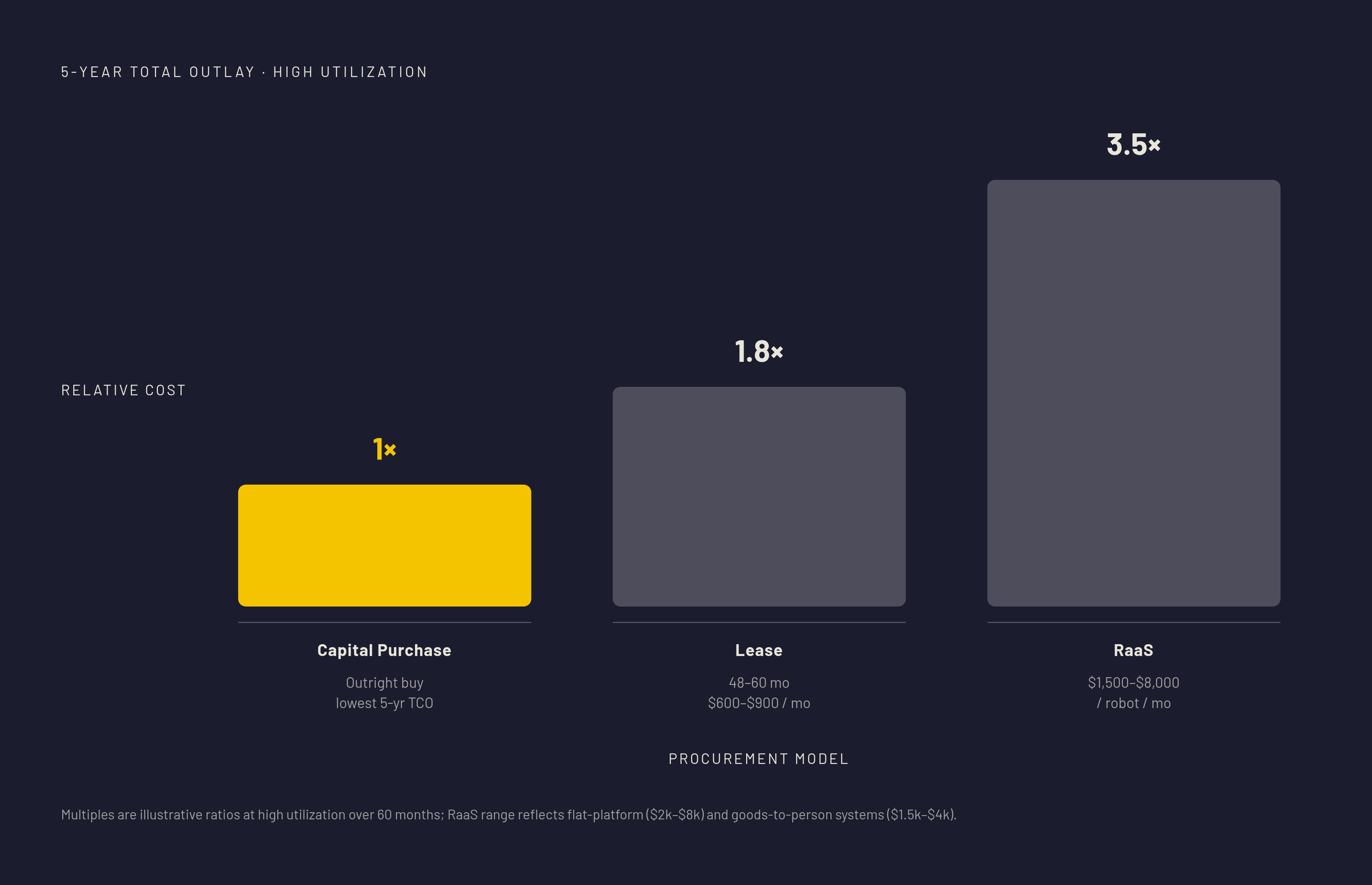
Outright capital purchase carries the highest upfront outlay and, for stable, high-utilization operations, the lowest total cost over the long run. The tradeoff: the buyer owns every bit of maintenance, software, and replacement risk alone, with no vendor cushion if a battery dies early or a controller board fails out of warranty.
Leasing changes that math. A flat-platform AMR on a 48 to 60-month lease runs $600 to $900 a month, turning a capital expense into a predictable operating line while keeping the door open to upgrade later. Robotics-as-a-Service goes further: a monthly per-robot fee of $2,000 to $8,000 bundles hardware, software, maintenance, and often replacement units during downtime into one number. A 20-robot goods-to-person deployment can run $1,500 to $4,000 per robot per month under this model.
The five-year tradeoff comes down to utilization, and for high-utilization operations, the math is not close: five-year TCO for capital purchase runs substantially lower than RaaS at that utilization level. Outright purchase makes sense if the workload is steady and the volume is there. RaaS earns its place with capital-constrained buyers, first deployments, or seasonal demand, where a lower-risk entry and faster go-live outweigh the long-run discount that capital purchase would otherwise deliver. Do not choose RaaS for a stable, high-volume operation just because the monthly number looks friendlier than the capital outlay. That is the wrong use of the model, and the five-year math will say so. A common middle path: run a RaaS pilot for six to 12 months, confirm the utilization data holds, then convert to capital purchase once the numbers justify it.
RaaS pricing is under downward pressure as more vendors compete for the same warehouse contracts. Outcome-based pricing, paying per task completed or per unit moved rather than per robot or per hour, is already emerging as the next step past usage-based RaaS.
AMR vs. AGV: where the TCO comparison turns
On paper, AGVs look cheaper: simpler hardware, guided navigation, a lower per-unit purchase price, no onboard SLAM computing to pay for. AMRs cost more upfront precisely because they carry the sensors and processing power to map and navigate a space on their own, without a wire in the floor telling them where to go.
That paper comparison is misleading, and buyers who trust it end up paying for the mistake twice. An AGV's purchase price doesn't include the infrastructure it depends on just to move: installing the magnetic strips, wires, or floor-mounted markers an AGV needs adds meaningful infrastructure cost depending on facility size, and that cost belongs on the AGV side of the ledger before any comparison with an AMR is fair.
The real divergence is visible in the months after installation, not during it. Changing the facility layout means an AGV needs its physical guidance infrastructure redone: wires moved, strips re-laid, sometimes a full re-certification of the path. An AMR remaps the space in software, often overnight, with no floor crew and no downtime beyond the update itself. In a facility where the layout shifts, seasonal reconfiguration, new product zones, a warehouse that keeps expanding, that flexibility gap does not stay flat. It widens every year past the first, because the AGV keeps paying the reconfiguration cost and the AMR mostly does not. For any operation expecting to change its floor plan more than once every few years, the AGV's lower sticker price is not a discount. It is a deferred cost with interest attached.
Building the ROI case from a complete TCO model
Once the full TCO sits on the table, the ROI math gets simple: annual savings equal the manual movement cost minus the annual AMR cost, and payback period equals total system investment divided by annual savings. That arithmetic only holds, though, if the TCO feeding it is actually complete, and most of the ones vendors hand over are not.
On the savings side, AMRs displace forklift operator salaries, overtime pay, forklift maintenance, the cost of inefficient routing, accident-related expenses, damaged goods, and the retraining costs tied to high staff turnover. None of that appears on the robot's price tag. All of it appears on the savings ledger. The two numbers have to be built side by side, not one after the other, with the TCO finished first and the savings case bolted on as an afterthought.
ROI compounds fastest under specific conditions, and a buyer evaluating a deployment should check for all of them before trusting a vendor's payback estimate: multi-shift operations running two or three shifts, where utilization drives savings in direct proportion; high-volume, repetitive movement patterns, where a small per-task cost reduction multiplies across thousands of moves a day; and facilities facing a genuine, structural labor shortage, where the labor cost being displaced is not a hypothetical line item but an open requisition nobody can fill. In high-performing facilities that build modularity into the deployment from day one, companies using mobile robots cut operational costs by up to 30 percent. That number is what happens when the TCO model, not the purchase price, drives the decision from the start. Everything else in this piece produces the arithmetic behind it.