Ergonomic Benefits and Risks of Cobot-Assisted Manual Tasks
Cobots ease physical strain, but they can add mental and postural costs.
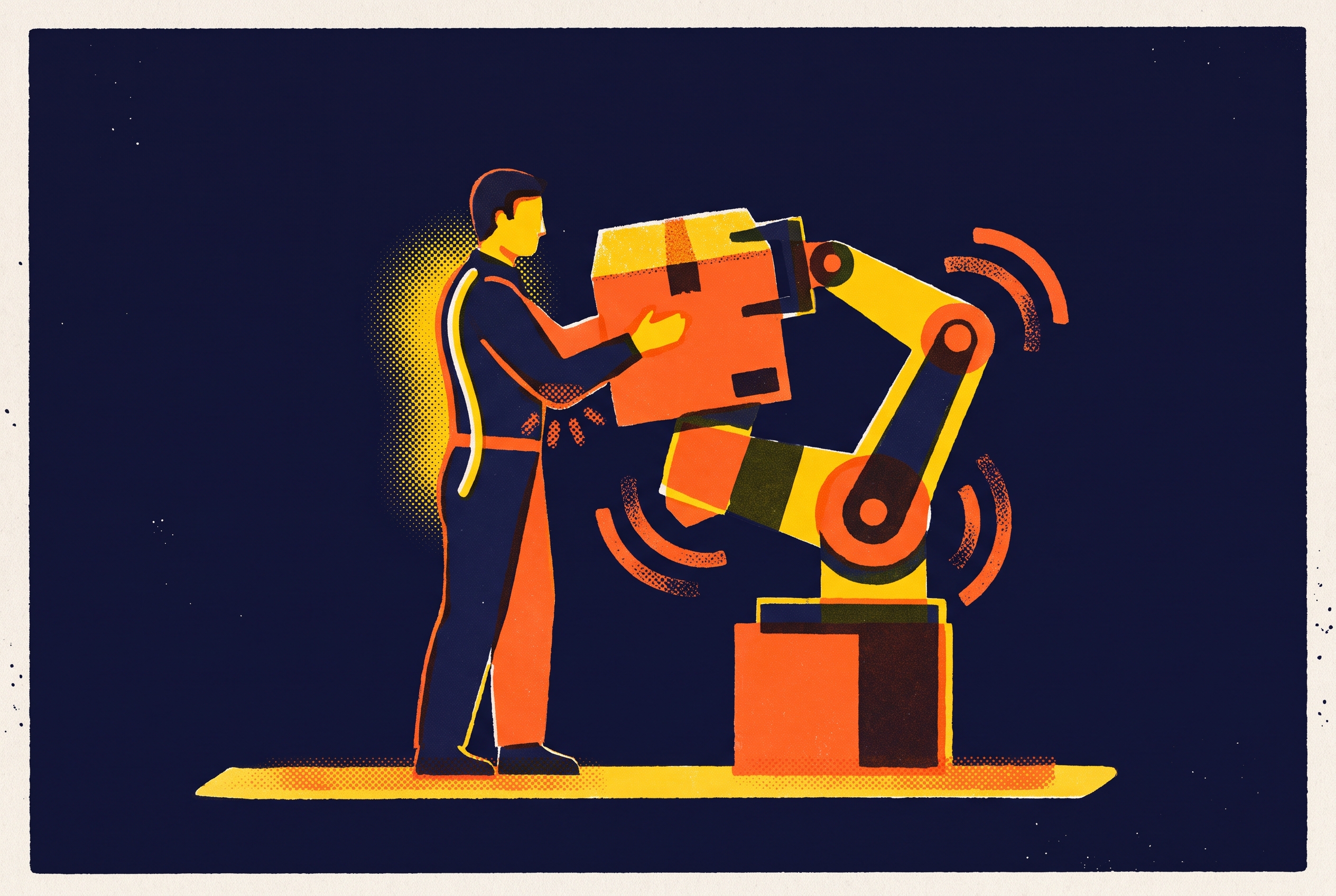
Cobot-assisted manual tasks can reduce biomechanical load, improve posture, and lower work-related musculoskeletal disorder risk. Those gains do not establish that the whole job has become ergonomically better. Collaboration also creates monitoring and coordination demands and can introduce new physical strain.
What cobots actually do in manual work and why ergonomics is the right lens
Cobots change manual work by reallocating its demands. The robot takes on high-force, repetitive, or awkward elements, while the worker retains responsibility for judgment and adaptability. That division changes both the actions a person performs and the conditions under which those actions occur. A worker relieved of a repetitive movement may instead monitor the robot, assess the result, and handle variation.
Ergonomics captures both sides of that change. Physical assessment examines the forces, movements, and postures that remain after task reallocation, while cognitive assessment examines the attention and decisions the new arrangement requires. This fits the Industry 5.0 vision of human-centred manufacturing, in which reducing physical and cognitive strain is an explicit design goal.
How cobots reduce biomechanical load and musculoskeletal disorder risk
When a cobot takes over a demanding part of a manual task, the worker’s muscles no longer need to generate all the force required by that operation. Assistance can also change how muscles work together. Fiorino and colleagues’ 2025 IEEE EMBC study measured surface EMG across sixteen upper-limb and trunk muscles and found more efficient muscle coactivation patterns with cobot assistance. The body recruited muscles more selectively rather than bracing broadly, indicating reduced biomechanical risk.
Postural findings support the same underlying mechanism. Research on standing tasks found that increased cobot assistance significantly enhanced postural stability and reduced biomechanical load. The benefit is therefore not limited to making an object easier to handle. Assistance can improve the physical conditions in which the worker handles it. Lower force demands and better stability can together help lower the risk of work-related musculoskeletal disorder, or WMSD.
A wire harness assembly case makes the change concrete. Before cobot integration, RULA and JSI assessments returned the highest possible risk scores. After integration, RULA fell from 7 to 4, while JSI fell from 12 to 4.5. These validated ergonomic instruments showed a large improvement, but the scores still showed risk that kept conditions from being fully acceptable. The distinction is important when interpreting a successful deployment.
BMW Spartanburg illustrates how task reallocation removes a specific exposure. Four cobots roll adhesive insulation into car door panels hundreds of times per shift, while workers check the quality and deal with variation. That arrangement eliminates the cumulative repetitive strain of the rolling motion. A large-parts picking model also found ergonomic gains when the main goal was to improve productivity. Physical improvements can therefore arise from the structure of task reallocation, even when worker health is not its main objective.
Why physical gains do not automatically translate into full ergonomic improvement
Relieving one muscle group does not protect every other one. A cobot can reduce targeted effort while creating awkward postures or static strain elsewhere, depending on workstation design and task pacing. If the robot’s motion sequence does not match natural human body mechanics, the worker adapts to the machine. Reaching, monitoring, or keeping pace can then require constrained positions. The relevant physical outcome is the worker’s remaining exposure across the task.
This creates a distinction between removing force and improving posture. A cobot may handle the demanding operation while its operator holds an awkward position to observe the result. Poorly designed human–robot collaboration workstations can also retain repetitive upper-limb movements or introduce sustained static postures. An assessment confined to the assisted movement can therefore miss a new source of strain in the surrounding work.
Robot pacing can make that mismatch harder to escape. Research on robot-paced collaboration found that temporal demand increased with repeated exposure, while learning effects were insufficient to offset the imposed time pressure. Workers cannot be assumed to resolve a physical adaptation problem simply by becoming more accustomed to the cobot. Because adapting to the robot also requires attention, the physical assessment leads directly to a second question about the mental work required to maintain collaboration.
The cognitive load cobots add and why it is not simply offset by physical relief
Workers must monitor the robot’s state, anticipate its behavior, and coordinate their own actions with it. Their attention is divided between doing the task and supervising the collaboration. When robot behavior is unpredictable or feedback is difficult to interpret, that division can become mental overload.
The ISARC 2025 modular construction study gives direct field-adjacent evidence of this trade-off. Mean scores for fatigue, mental effort, and distress were all higher with the cobot than with manual work. The role itself can become more exacting. Moving from co-operator to supervisor of the work situation requires sustained situational awareness rather than attention focused only on performing a manual task.
However, increased cognitive load is not a universal result. Some studies show that cognitive load is slightly lower when workers collaborate with cobots than when they do all the work manually. Task complexity helps explain the difference, because more complex situations require more monitoring and coordination. Studies using physiological and self-report measures found that higher task complexity significantly raised both cognitive workload and stress. The evidence therefore points to conditions that shape the result, rather than a single cognitive effect of cobot presence.
Worker autonomy is another variable in that relationship. Research on human-cobot production units found that productivity rose sharply when workers had more say in decisions about their jobs. That result suggests that control over the interaction can help workers manage its demands, although productivity improvement is not itself proof of reduced cognitive strain. Robot-set pacing and meaningful worker control are different working conditions. Physical assistance and the mental burden the collaboration introduces must be assessed within those conditions.
This fits the Industry 5.0 vision of human-centred manufacturing, in which reducing physical and cognitive strain is an explicit design goal.
What happens when physical and cognitive demands interact — the combined-technology finding
Physical and cognitive demands can also affect each other. An automotive assembly study examined a proximity-aware cobot and an exoskeleton in confined-space work constrained by takt time. Each technology lowered biomechanical load when used on its own. Their combined use, however, produced no additive physical benefit and introduced cognitive and coordination costs that offset the physical gains. Separate benefits did not predict the combined outcome.
The cobot required attention to its spatial behavior, while the exoskeleton imposed movement constraints. Managing those demands simultaneously diverted cognitive resources that could otherwise support safe posture management. The body could therefore lose part of the benefit of assistance because coordinating that assistance required additional mental work. This is why physical and cognitive ergonomics cannot be evaluated as independent workstreams.
The finding shows that deployment design must account for the worker’s total cognitive budget alongside the biomechanical tasks assigned to each device. The same concern applies more generally to a single unpredictable or poorly interfaced cobot. Attention spent supervising the robot is attention unavailable for posture correction, body mechanics, and fatigue management. Whether this mechanism produces the automotive study’s result in a single-cobot installation requires assessment in that deployment.
How implementation quality — not cobot presence alone — determines whether ergonomic gains materialize
The critical fit is between the robot’s behavior and the worker’s physical and cognitive capabilities. Workstation design is the first part of that fit. A layout can remove the heavy lift yet still force the operator to crane or reach to monitor the result. In that case, the deployment reduces one exposure while its geometry creates another.
Interface design governs a different part of the burden. Opaque feedback or inconsistent behavior makes the worker devote more attention to understanding the robot’s state. A well-designed interface makes that state legible at a glance, reducing the effort of supervision. Predictability is therefore an ergonomic property. It influences how much attention remains available for the worker’s own actions and physical condition.
When the robot sets the pace, workers have less control over their rhythm, and the temporal-demand findings show why practice alone may leave them under time pressure. When workers set or negotiate the pace, they keep control over their work and face less strain. Layout, feedback, and pacing each shape a different part of the same job. A strength in one does not automatically correct a weakness in another.
The physiotherapy rehabilitation study makes the value of a specific fit visible. A UR16e deployment explicitly redistributed shoulder and trunk effort and reduced shoulder muscle activation by 31.6%. The task allocation addressed the therapist’s particular strain profile. This is a targeted result specific to this deployment. Its significance lies in the connection between the physical demand identified and the assistance designed to relieve it.
What organizations must actively manage to capture the gains without incurring the risks
Organizations need ongoing, structured assessment rather than a one-time judgment that installation has improved ergonomics. That assessment must cover the worker’s remaining postures and movements as well as monitoring, coordination, and pacing demands. Residual risk needs explicit attention even when before-and-after scores improve. Regular reviews can then use the strain found in the work to guide changes in who does which tasks, the interfaces, or how the robot behaves.
Posture-responsive assistance offers one way to make that process dynamic. Iodice et al.’s 2025 computer-vision framework enables continuous posture assessment based on an observational method, detects risky postures, and triggers robotic interventions. It moves beyond a fixed division of tasks toward assistance that responds to the worker’s posture. An expert ergonomist still needs to interpret the risk data to decide how to act on it.
Cognitive management also requires attention to individual differences. The proposed “Socially Adaptive Safety Engine” adjusts robot speed and proximity thresholds dynamically according to worker trust levels and preferences. Its intended role is to reduce the unpredictability that contributes to monitoring burden and stress. Its outcomes across workplaces remain to be established. More broadly, organizations can preserve meaningful worker control over pacing and task sequencing rather than treating autonomy as a fixed feature of the technology.
These adjustments require continuing organizational support. OSHA’s increased focus on ergonomics and musculoskeletal disorders in 2026 adds external pressure to validate deployments beyond their initial implementation. Ongoing reprogramming and cultural change management are therefore part of the management agenda. Most findings come from controlled laboratory or field-adjacent studies with small samples, while large-scale longitudinal workplace evidence remains sparse.
Organizations should use their current deployments to learn. The uncertainty calls for thoughtful adoption that takes measurable physical benefits into account.
Sources
- Collaborative robots for quality control: an overview of recent studies and emerging trends
- Jurnal Teknologi - COBOT
Provided the physiotherapy deployment with reduced shoulder muscle activation.
- Muscular Coactivation to Evaluate the Ergonomic Impact of Human-Robot Collaboration in Manual Handling Tasks
Supplied the surface EMG findings on muscle coactivation with cobot assistance.
- The Impact of Human-Robot Collaboration Levels on Postural Stability During Working Tasks Performed While Standing: Experimental Study - ScienceDirect
Reported that greater cobot assistance improved postural stability and reduced biomechanical load in standing tasks.
- Can collaborative robotics help in large parts picking for assembly? An ergonomics/economics model
Provided the large-parts picking model showing ergonomic gains alongside productivity goals.
- JMIR Human Factors - The Impact of Human-Robot Collaboration Levels on Postural Stability During Working Tasks Performed While Standing: Experimental Study
Source of the standing-task finding that increased cobot assistance enhanced postural stability.
- A comparison of motivational work characteristics and cognitive workload in manual vs. cobot-assisted manufacturing tasks
Informed the comparison of cognitive workload between manual and cobot-assisted work.
- Journal of Medical Internet Research - Understanding Workers’ Well-Being and Cognitive Load in Human-Cobot Collaboration: Systematic Review
Systematic review informing the discussion of cobot cognitive load, monitoring demands and task complexity.