Automation Investment Payback in Seasonal Fulfillment Operations
Seasonal warehouses need capacity models, not just labor cost savings, to justify automation ROI.
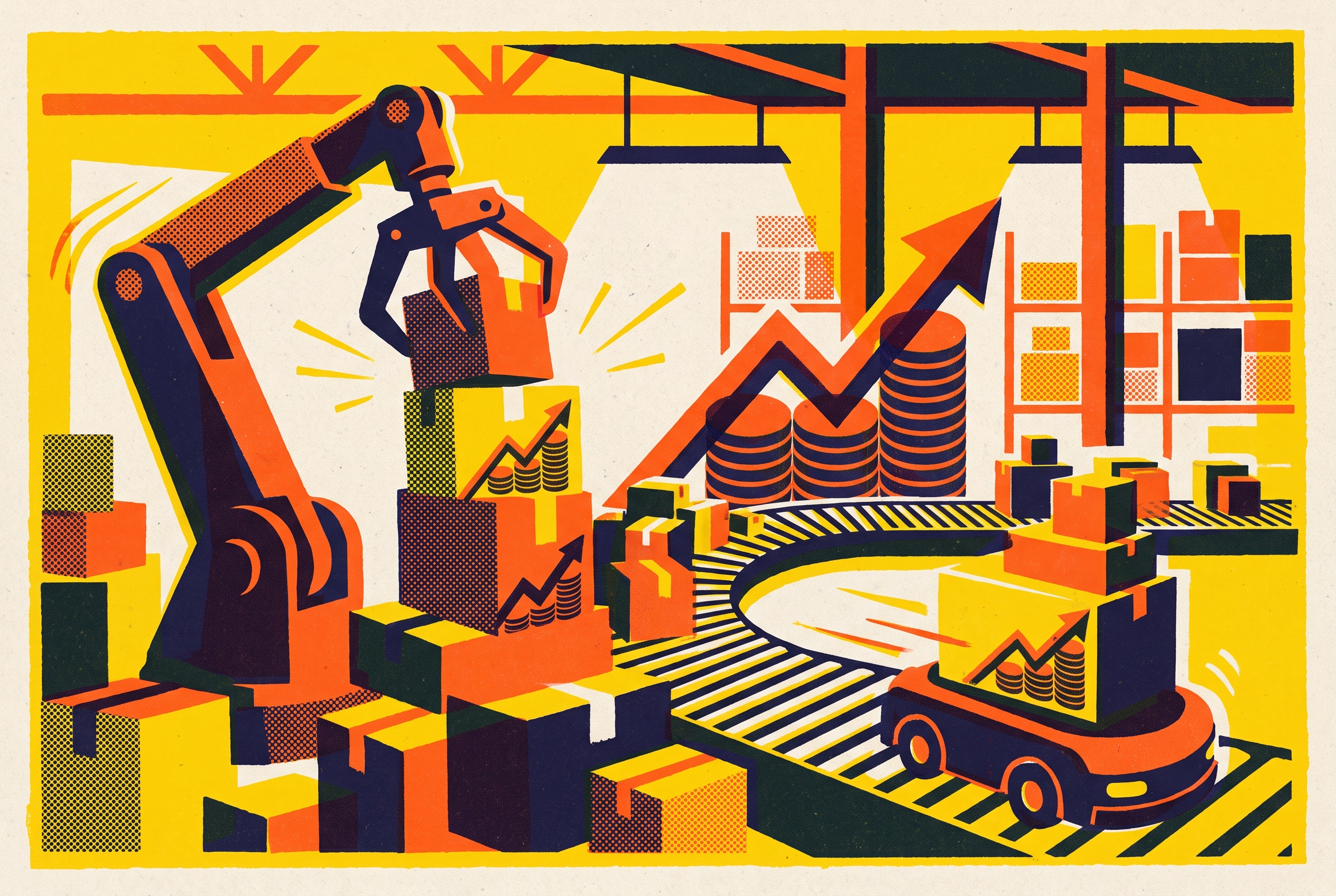
A 34,700-job decline in warehousing employment through mid-2026 coincided with containerized import volumes that ran ahead of the previous year in June, creating a condition conventional payback models were never built to parse. Seasonal fulfillment operations now confront a labor market that contracts precisely when demand demands expansion. The result is a structural mismatch between how automation ROI has historically been calculated and how seasonal operations actually fail.
The core assumption behind conventional automation ROI is that labor supply is elastic enough to absorb demand spikes without structural throughput loss. Traditional capital budgeting for warehouse robotics measured payback against displaced wages, a framework that treated labor as a variable cost that could be scaled up or down on demand. That assumption held in a labor market where temporary workers were available when needed and released when not. The Bureau of Labor Statistics data breaks that assumption: the largest single-month losses occurred in September and October 2025, the window when seasonal ramp-up should be accelerating, not contracting. By mid-2026, the year-over-year gap in warehousing jobs measured through July stood at 34,700 positions eliminated.
Import volumes compound the problem. Containerized imports rose 13.2% year over year in June, then fell 3.9% in July. The June gain largely reflected 2025's depressed post-'Liberation Day' tariff baseline, per the National Retail Federation, but the directional signal remains: volume is rising as the labor pool shrinks. The operational question this creates is not whether robots cost less per pick than a temporary hire. It is whether automated systems can absorb the volume that 200 unfilled seasonal roles would otherwise handle. When a facility cannot fill receiving or sortation roles in September, a missed hire forecast becomes a service failure by Monday morning. The exposure is revenue and customer retention, not just labor cost.
This is the limit of the baseline model. A seasonal operation needs to know what automation protects at peak. Those are different questions, and they produce different numbers. The distinction between a cost model and a capacity model is the dividing line that the rest of this argument develops.
What a capacity-based payback model accounts for that a labor-displacement model misses
A payback model built around peak capacity preserves throughput and protects revenue, but a wage-displacement model cannot see that value and so cannot justify it. Capacity models count what automation protects at peak. In seasonal operations, the peak figure is the larger one by a wide margin.
Consider what a capacity model includes that wage-displacement frameworks treat as invisible. There is the hard ROI of revenue protected during peak, the order volume that would have been delayed, cancelled, or lost without automated throughput. There is the avoided emergency labor cost, the overtime premiums, temporary staffing agency fees, and last-minute surge hiring that materialize precisely when labor markets are tightest. There is error-reduction value, because guided automated workflows reduce mispicks and rework, and accuracy gains compound during peak when manual error rates rise with fatigue and inexperienced temporary workers. And there is training time reduction, since automated guided workflows compress onboarding, letting temporary staff contribute faster and reducing the supervisory drag of pulling top performers off the floor to train new hires.
The concept of avoided disruption is the biggest line item in a seasonal operation's capacity model. It is the revenue that does not vanish when a facility cannot process its peak, the customer relationships that do not fracture under missed delivery windows, the corrective labor that never has to be hired. Seasonal operators know better.
Soft ROI inputs strengthen the case further. Workforce stability comes from automation that reduces repetitive tasks, lowers turnover, and keeps experienced workers available for value-added roles rather than burning them out on seasonal surge. Customer satisfaction and retention follow from throughput consistency at peak, which is exactly when relationships are made or broken in fulfillment. Safety improves as manual handling drops under high-pressure, high-volume conditions, so injury rates and their associated costs fall. The business case stalls not because automation is weak but because the model is too narrow.
How technology choice shapes how quickly and how fully the peak-season ROI materializes
Technology selection is itself a payback variable. Different automation types deliver their peak-season value on different timelines and at different points in the fulfillment workflow, which means the payback calculation cannot treat technology as a fixed input. The spread in payback periods across automation types is wide, and it maps onto different operational bottlenecks.
AMRs deploy in weeks rather than quarters because they require no fixed guide-path infrastructure. They matter when the constraint is downstream processing speed rather than pick rate. Robotic picking solutions address the hardest automation problem, irregular items, and carry correspondingly longer payback timelines.
Sequencing determines whether the chosen technology actually delivers its peak value. Facilities that deploy robotics across receiving, sortation, and fulfillment zones find that bottlenecks migrate from individual tasks to handoff points between automated and manual processes. Buying the most advanced system available does not.
The hidden costs that extend payback timelines and how to account for them before committing capital
Automation payback timelines slip most often not because the technology underperforms but because the pre-deployment cost model omits the integration, infrastructure, and workforce transition costs that surface during implementation. Integration complexity is the most commonly underestimated cost. WMS and ERP integration requires engineering time that is rarely costed into initial proposals, and the scope expands when the facility runs multiple systems or manages a mixed automated-manual workflow. Facility modification costs, floor leveling, fire suppression upgrades, electrical capacity, are frequently treated as negligible in early-stage business cases and material by the time construction begins. Financial models for seasonal operations carry a structural weakness: they typically assume consistent order volumes and predictable SKU demand, even though seasonal peaks, supplier disruptions, and changing product mix continually affect actual warehouse performance.
The workforce transition cost is real and two-directional. Operators who automate picking reduce headcount dependency, but the remaining workforce needs different skills, and the supervisory cost of managing a hybrid human-robot floor at peak is rarely modeled. Cross-functional stakeholder alignment is a prerequisite for accurate cost modeling. IT owns WMS integration, HR owns resource planning, operations owns inventory, safety owns incident rate impact. When those stakeholders are not involved from the outset, business cases win approval and then underdeliver.
The answer to these risks is not to avoid automation but to build a cost model that names each category explicitly, establishes a baseline before deployment, and tracks results against projection at regular intervals. A business case that names facility modification costs up front does not invite scrutiny. It preempts the scrutiny that would otherwise arrive when actuals diverge from forecast. The discipline of baseline measurement, expected gains, and regular review transforms the payback argument from a projection into a managed process.
Containerized imports rose 13.2% year over year in June, then fell 3.9% in July.
What the CapEx-versus-RaaS decision means specifically for operations with concentrated seasonal peaks
For operations where peak demand is heavily concentrated in a short window, the financing model is not a secondary consideration. The CapEx case rests on high utilization. Owned robots that run near-continuously across a long operating period generate the best total cost of ownership. If robots sit partially idle for months, the utilization penalty erodes that advantage. An operation that runs at peak for three months and at low volume for nine carries a fundamentally different profile than one with two major peak windows per year.
RaaS converts automation from capital expense to operational expense. Operators pay per pick or per robot per month rather than buying capacity outright, allowing operations to scale with demand, ramping up for peak season and scaling back when volume dips. But the utilization risk does not disappear under RaaS. True RaaS, where the operator pays for throughput outcomes and the machinery is owned by the vendor, removes utilization risk from the operator and changes the payback calculation more fundamentally. This model is maturing but not yet universal. The right structure depends on the shape of the seasonal curve. An operation that does not model its utilization curve before choosing a financing structure is making an avoidable error, one that will surface in the payback calculation long after the contract is signed.
How DSV, Lululemon, and THG Fulfil sized and timed automation investments around peak performance
The operations that demonstrate the strongest automation payback in seasonal contexts share a common logic. They sized and timed their investments around peak throughput requirements rather than baseline labor replacement.
DSV Logistics: dual seasonal peaks and speed-to-value
DSV, operating in health and beauty with two seasonal peaks per year, partnered with Locus Robotics in a deployment that scaled across multiple DSV facilities and successfully managed peak season throughput without the months-long installation windows that conventional automation required. The deployment's speed allowed DSV to align automation capacity with each peak window as it arrived, rather than committing to fixed infrastructure built for one annual surge.
THG Fulfil: extreme spikes and commercial flexibility
THG Fulfil's distribution site now operates as the world's highest direct-to-consumer output facility, processing 11,790 outbound bin presentations per hour, with bin wait times cut from 8.71 seconds to 4.52 seconds through intelligent batching and software-driven optimization. As of October 2026, THG Fulfil operates 796 AutoStore robots internally, delivering over 11,000 bins per hour, with a reported 78% reduction in average pick wait times. Across its automation ecosystem, THG Fulfil reports a 650% increase in output capacity and an 18% reduction in headcount dependency, with throughput per head up materially year-on-year. At that scale, the cost of under-automating is not inefficiency but lost revenue and customer churn.
Lululemon, Brampton: planning for peak variability from the start
Lululemon opened a 1-million-square-foot distribution center in Brampton, Ontario, one of the largest AutoStore-enabled automated distribution operations in North America, where 525 robots pull from 292,000 storage bins. The facility broke ground in 2023 and became fully operational in June 2026, with Element Logic as integration partner and AutoStore R5 pro robots as the backbone. The project is being watched as a model for sizing automated capacity across North American retail networks, specifically for its allocation logic spanning SKU velocity, duty exposure, parcel zones, and return paths, a planning framework that embeds peak-demand variability into the system design from the start.
Why intelligence and software are now the primary lever for compressing payback after hardware is deployed
Hardware creates the capacity ceiling. Software determines how close to that ceiling the operation actually runs during peak, which is where the payback case is won or lost. An automated warehouse sized for peak throughput only delivers that throughput if the orchestration layer can manage real-time demand variability. Static task assignment and fixed routing leave capacity on the table precisely when it is most needed.
The advantage in 2026 comes from software capable of predicting and managing peak demand before it hits, and AI that can navigate supply chain complexity and make real-time changes. Predictive maintenance platforms use IoT sensors and machine learning to prevent equipment failures before they occur, a capability whose payback value is highest during peak, when an unplanned downtime event is maximally costly. Baseline analytics models don't know what normal looks like when additional robots join the floor for Q4, causing anomaly detection to degrade precisely when throughput pressure is highest. That problem is solved at the software layer.
THG Fulfil's throughput gains demonstrate the point. Operators who treat software as a secondary line item in the automation budget are leaving peak-season throughput, and therefore payback, on the table. The software investment determines whether that capacity shows up when the peak arrives.
How to structure the business case so that peak-season performance drives the investment timeline
A business case built around peak-season performance arrives at a more accurate payback timeline and a more persuasive investment argument than one built around steady-state labor savings. The peak is where the investment is actually tested. The structure should reflect that from the first assumption.
Start with the peak throughput requirement, not the baseline labor cost. Define the maximum order volume the operation must process reliably, the window in which it must do so, and what happens in revenue and customer-retention terms if it cannot. That establishes the capacity gap automation fills. Build the cost model in layers: hard ROI at peak, covering revenue protected, emergency labor avoided, and error costs eliminated under high-volume conditions. Hard ROI at baseline, the labor efficiency gains during steady-state operations that are real but secondary in a seasonal context. Soft ROI, including workforce stability, reduced turnover, safety improvement, and customer satisfaction, because omitting these systematically undervalues the investment. And a full cost inventory naming capital equipment, WMS and ERP integration engineering, facility modifications, workforce transition, and ongoing software and maintenance explicitly so the payback timeline is defensible when actuals are compared to forecast.
Match the financing structure to the utilization curve. If your operation has a short, steep seasonal peak, model a RaaS or hybrid structure against full CapEx ownership before committing, because idle capital outside peak erodes the payback thesis. Sequence deployment around the seasonal calendar. Systems that can go live in weeks, modular AMRs, scalable AS/RS add-ons, offer a different risk profile than those requiring months of facility modification. The THG Fulfil Libiao deployment's 35-day go-live is a benchmark for what speed-to-peak looks like when the calendar constrains the window. Involve cross-functional stakeholders at the modeling stage: IT, HR, operations, finance, and safety each hold cost or risk inputs that belong in the business case before approval, not as surprises during implementation. Plan the software investment alongside the hardware investment. Orchestration capability determines how close to peak capacity the system actually runs, and a business case that omits AI and analytics costs also omits the throughput gains those capabilities unlock.
A strong automation strategy frames robotics as a long-term investment, not a one-time project. Payback models that account for how the system performs across multiple peak seasons, and how it scales as volume grows, are more accurate than those that model a single deployment event. Operators who complete this business case before peak season, rather than after a failed surge, arrive at their investment decision with evidence rather than regret. The seasonal stress event is the proving ground. The business case should treat it as such from the start.