Robotics-as-a-Service Pricing Models in Warehouse Automation
Warehouses now choose among four distinct pricing models based on who bears utilization risk.
Robotics-as-a-Service has stopped functioning as a financing workaround for operators who can't afford a capital purchase. It now separates the question of what a robot can do from the question of who carries the balance sheet risk for owning it, and that separation is what's turning warehouse automation from a capital expense into an operating line item. Three forces make this durable, not just a passing response to tight credit markets. Labor scarcity is pushing warehouses toward replacing headcount rather than simply backfilling open positions, since quit rates in transportation, warehousing, and utilities have stayed elevated. Robot capability moves fast enough that hardware bought today can fall meaningfully behind the state of the art within two to three years, so RaaS contracts with upgrade clauses push that obsolescence risk onto the vendor. E-commerce demand swings unpredictably, so owned equipment sits idle during slow stretches, and subscription structures exist to blunt that exposure. What used to require a substantial capital commitment as recently as 2023 is now available as a monthly subscription. Warehouses processing a modest number of orders per day can access systems that were once reserved for large distribution operations. That accessibility is also what raises the stakes: the easier RaaS is to sign up for, the more consequential it becomes to understand exactly which model you're buying into.
What "RaaS" covers
"RaaS" names a spectrum of commercial arrangements with different risk profiles, not a single contract type, and treating them as interchangeable is how buyers end up with agreements that don't match how their operations actually run. Four pricing structures are commercially active in the warehouse market today: per-robot-per-month subscription, the most common form; per-outcome or per-pick pricing, often described as the closest thing to "True RaaS"; per-hour billing, used by a smaller number of vendors; and hybrid structures that combine a lower fixed base fee with variable usage charges. The distinction between these models isn't cosmetic. In a per-robot-per-month subscription, the customer keeps paying the invoice whether the robots are working at capacity or sitting idle, so the customer carries the utilization risk. In a per-pick or per-outcome model, that risk sits with the vendor instead, because revenue only flows when the system produces output. Procurement teams are growing sophisticated enough to press vendors on this distinction directly, and a sales pitch built only around converting capex into opex no longer answers the questions that matter. The sections that follow walk through each of these structures in turn, starting with the one most buyers encounter first.
Per-robot-per-month subscriptions and utilization risk
Per-robot-per-month subscription pricing is the dominant structure in warehouse AMR deployments. It looks simple, a flat recurring fee per unit, but that hides a utilization risk that many buyers underestimate before they sign. Typical pricing runs $2,000 to $8,000 per robot per month, and what's bundled into that fee varies by vendor but commonly includes hardware, software, maintenance, support, deployment, and training. Locus Robotics, one of the best-known names in this category, offers volume discounts for larger fleets, but it requires a minimum three-year commitment paid in advance, so buyers are locked into a multi-year relationship before a single pick has been completed. Vecna Robotics takes a related but distinct approach, pricing on an all-inclusive annual fee that bundles implementation and maintenance into one number, with the large majority of its projects delivered under a RaaS structure rather than outright sale, and its per-hour framing is a distinct variant within the subscription family. Rapid Robotics serves machine-tending applications in manufacturing rather than warehouse picking, and it offers an all-inclusive monthly model with a minimum contract term of just three months. Contract minimums differ sharply depending on vendor and application, and they don't converge on any single industry norm. A fixed monthly fee generates the same invoice whether the warehouse is moving peak-season volume or sitting through a seasonal lull, an integration delay, or a demand shortfall, and the customer absorbs the cost of that idle capacity either way. Costs that only appear once a contract is underway also tend to be left out of low headline subscription rates. Software integration work with the warehouse's existing systems can account for a significant share of first-deployment spending, and it sits entirely outside the advertised monthly fee. Network upgrades, facility mapping, and safety reviews are frequently billed separately. Adding robots during peak season carries its own fee structure, early termination clauses can carry meaningful charges, and site licensing, chargers, and facility relocation costs often land outside the subscription line item. If you're evaluating a per-robot-per-month quote, you need to itemize each of these before comparing it against alternatives, because the headline number rarely represents the full cost of the contract.
Per-pick and per-outcome contracts and vendor risk
Per-pick and per-outcome contracts invert the risk allocation built into subscription pricing: the vendor's revenue is tied directly to the throughput the system actually delivers, which aligns incentives in a way flat monthly billing does not, even as it introduces its own layer of pricing complexity. inVia Robotics illustrates the model directly. Customers pay only for the productivity its autonomous mobile robots deliver, while inVia's service team actively oversees the system in real time, and the company describes itself as the first economical RaaS goods-to-person picking system on the market. Per-pick rates in warehouse AMR deployments typically run $0.03 to $0.10 per pick, and for an operation running meaningful volume, the effective annual cost can compare favorably against the fully loaded cost of human pickers handling the same volume. Cargo Cove, a third-party logistics provider operating through finite customer contracts, shows exactly when this model becomes the rational choice: Cargo Cove deployed inVia's RaaS suite, including its PickMate worker-directing application, part of the broader inVia Logic warehouse execution system, alongside inVia's Picker AMRs, specifically because a large capital outlay made no sense against the short lifespan of its customer contracts. The per-pick structure matched how Cargo Cove's own revenue works: it pays for automation only when that automation helps it earn from its customer, rather than carrying a fixed cost independent of whether the contract renews. The incentive alignment runs deeper than cost matching, too. Because the vendor only earns when the robots are actually working, it has a direct financial stake in maintaining uptime, resolving integration problems quickly, and optimizing throughput, a dynamic that simply doesn't exist in a subscription model where the invoice arrives regardless of how the system performed that month. The tradeoff comes in pricing complexity: per-pick rates shift based on pick type, SKU mix, tote weight, and order complexity, so buyers have to model their expected pick volumes and product mix carefully before signing, since a low headline rate can turn expensive fast if volume shifts toward harder-to-handle items. There's also a real limit to where this model makes sense. At very high and stable throughput, the cumulative cost of per-pick billing can exceed what a subscription or an outright purchase would have cost over the same period, because the operator is paying a variable rate for volume that was predictable enough to have negotiated a fixed one. Per-pick and per-outcome pricing favors operations that have variable demand, finite or uncertain contract terms, and a priority on vendor accountability for uptime. But it works against operators who run high, stable volume, since they could have locked in a lower effective rate through ownership or subscription instead.
Per-robot-per-month subscription pricing is the dominant structure in warehouse AMR deployments.
Outcome-based and hybrid contracts, and the humanoid pricing ceiling
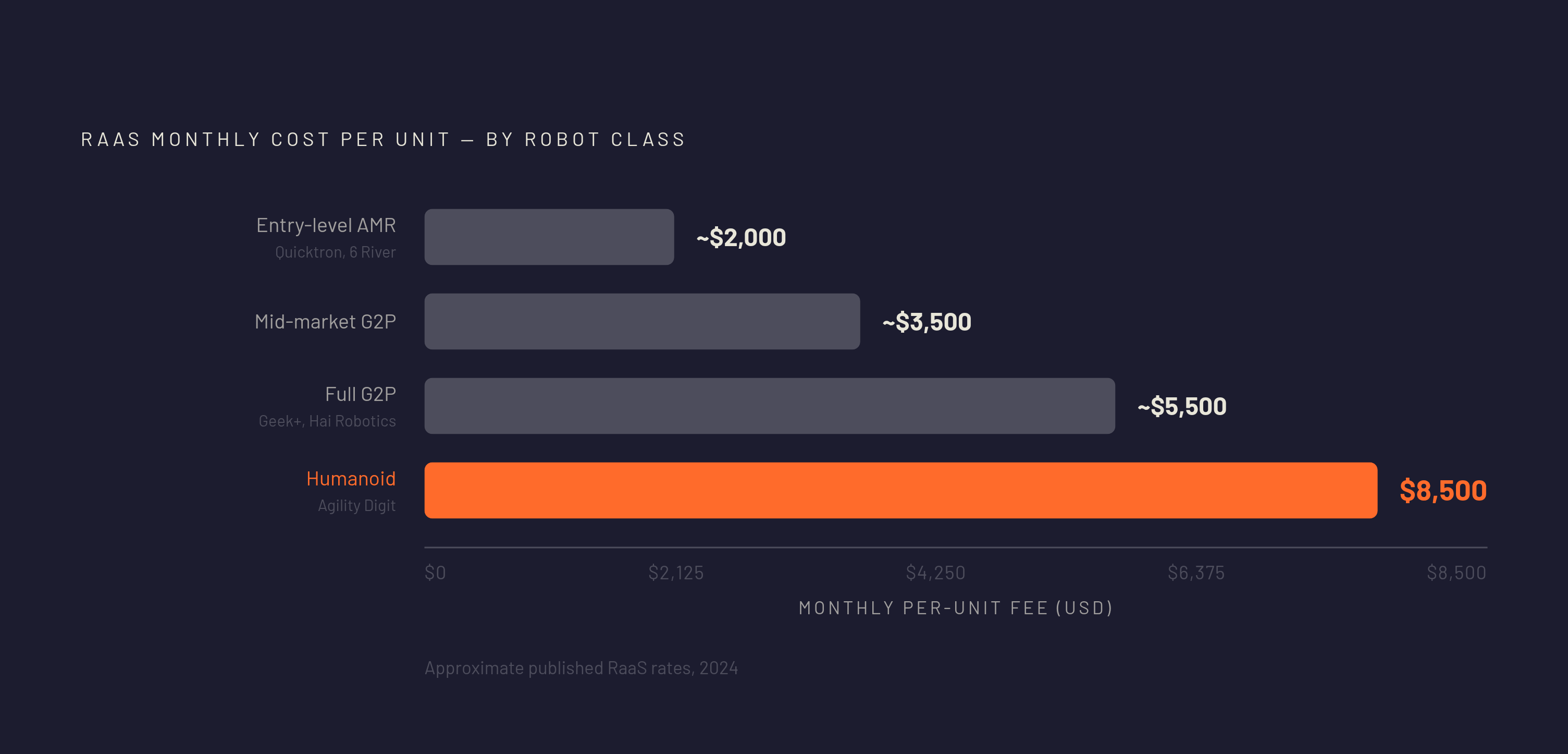
RaaS contracts are growing more layered as vendors combine base subscriptions with usage-based charges and performance incentives, and the emergence of humanoid robots as a commercial category is setting a new high end for what operators will pay when the labor math supports it. Hybrid models typically pair a lower fixed base fee with variable usage charges, smoothing out some of the idle-capacity cost that plagues pure subscription pricing while keeping much of the billing simplicity operators are used to. Tiered pricing built around the number of facility locations is a common variant for multi-site operators who manage fleets across several buildings. Performance-based incentives are also appearing as add-ons layered onto standard subscription contracts: vendors offering rebates or rate reductions tied to uptime guarantees or throughput milestones, a partial fix for the misaligned incentives baked into flat-fee subscription billing. The humanoid tier has moved from concept to live pricing reference. Agility Robotics models illustrative RaaS pricing for its Digit humanoid robot at approximately $8,500 per month per unit, a figure positioned explicitly as a discount against the fully burdened cost of the human labor it's meant to replace, making the labor-replacement calculation the central argument in its commercial pitch. The clearest benchmark for what humanoid RaaS looks like in practice comes from GXO Logistics, which signed a multi-year humanoid RaaS agreement with Agility Robotics in 2024, described as the industry's first formal commercial humanoid deployment. By late 2025, Digit units had moved a large volume of totes at GXO's Flowery Branch, Georgia facility while maintaining strong on-task accuracy, so the industry now has an actual operating record, not just a pilot announcement. That deployment sits at the top of a pricing structure that has become visibly stratified by robot class. Entry-level warehouse AMRs, standalone units from vendors like Quicktron and 6 River, cost the lower end of the monthly pricing range. Mid-market goods-to-person systems sit in a middle tier. Full goods-to-person systems from providers like Geek+ and Hai Robotics cost substantially more per month, and they run to multiples of what entry-level AMRs cost. Humanoid-class units now sit above all of them in illustrative per-unit monthly pricing. The caution attached to that humanoid pricing ceiling is a real one: in its September 2026 SEC S-4 merger filing, Agility Robotics disclosed very substantial net losses against minimal recognized revenue, a gap that persisted even against a large disclosed multi-year order pipeline. That ratio reflects how far contracted pipeline can run ahead of actual revenue recognition in a first-generation humanoid deployment, and it's a distinction buyers should hold onto: a signed multi-year order is not the same thing as a scaled, proven commercial system, and the GXO deployment is further along that path than the broader humanoid RaaS market as a whole.
Break-even dynamics between RaaS and ownership
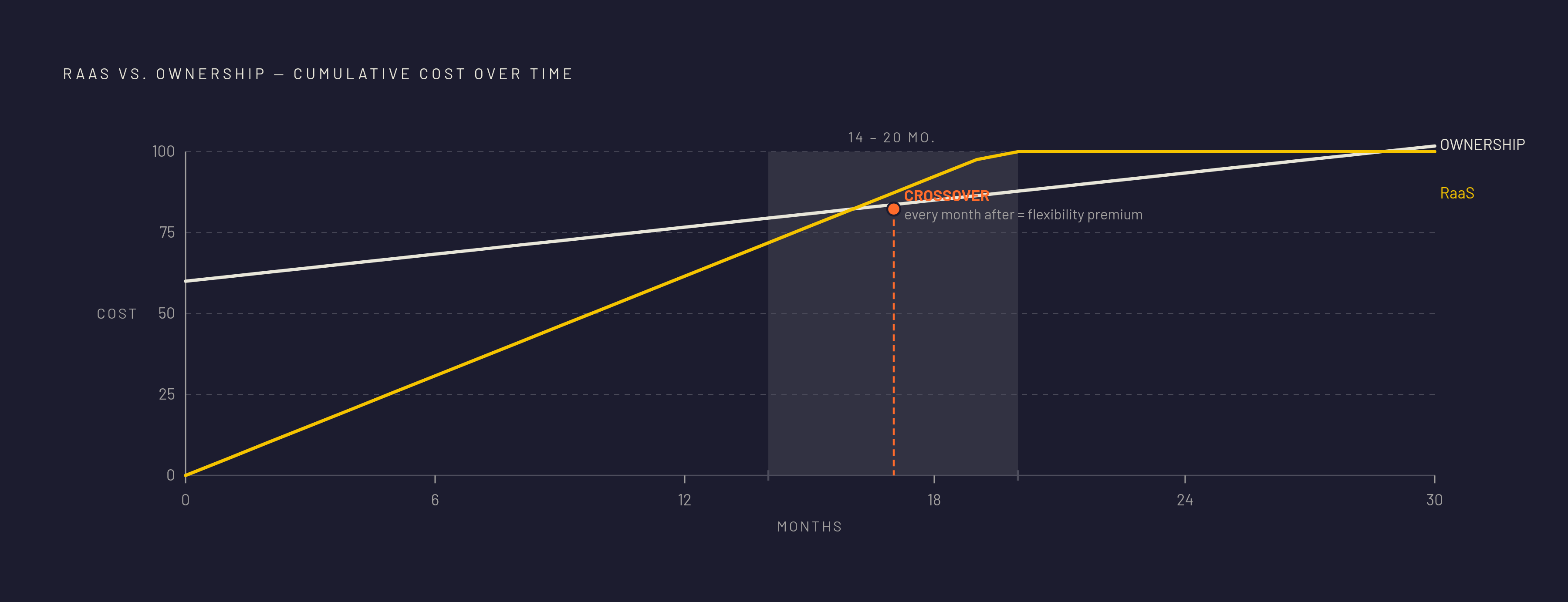
RaaS doesn't carry a fixed verdict as cheaper or more expensive than outright ownership. Where the crossover sits depends on utilization, contract length, and how quickly the buyer's operational needs are likely to change over the life of the agreement. Across the pricing structures described above, the crossover point where outright purchase becomes the cheaper option than continuing to pay for RaaS typically falls between 14 and 20 months. Past that point, every additional month paid under subscription costs more than ownership would have, and over the full term of a five-year contract that gap compounds into a meaningful premium paid for flexibility. That math changes shape depending on which model a buyer has signed. A per-robot-per-month subscription running near the $2,000 to $8,000 range reaches its break-even point on a fairly predictable schedule, since the monthly fee is fixed and comparable directly against amortized purchase price plus maintenance. A per-pick contract priced at $0.03 to $0.10 per pick breaks even on a volume curve. An operation running stable, high volume will cross the point where ownership would have been cheaper much faster than an operation with variable demand; Cargo Cove's finite-contract, variable-volume profile made per-pick pricing the rational choice, while a high-volume, long-horizon distribution center might find the same structure expensive by comparison. Hybrid contracts sit somewhere between the two curves, since their fixed base component behaves like a subscription while their variable usage charges behave like a per-pick fee, and the humanoid tier's $8,500-per-month benchmark makes the same arithmetic apply at a far higher cost basis, anchored against the fully burdened human labor rate it's built to undercut. None of these figures tell a buyer which model to choose in isolation. They tell a buyer what to calculate before signing: expected utilization, contract length, demand volatility, and how quickly the underlying technology is likely to be superseded. A warehouse with stable, predictable, high-volume throughput and a long planning horizon is the clearest candidate for ownership or a long-term subscription negotiated at scale. A warehouse with finite contracts, seasonal swings, or genuine uncertainty about future volume is the clearest candidate for per-pick or outcome-based pricing, where the vendor, not the warehouse, absorbs the cost of an uncertain future.