Goods-to-Person Picking System Architectures
Four goods-to-person architectures make different trade-offs on throughput, density, and cost.
Advertisement
Warehouse operators are facing a cost problem that will not resolve itself. U.S. warehouse production and nonsupervisory workers earned an average $26.30 an hour in May 2026, up from $25.49 in February, and labor cost in this sector is not static Synkrato. Layer on top of that a staffing problem that has become chronic: 52% of companies rate hiring and keeping warehouse workers as extremely difficult, and nearly half, 45%, say they plan to buy automated systems specifically in response. Meanwhile the volume moving through these buildings keeps climbing. Global parcel volumes reached 121 billion B2C shipments in 2025, and that kind of growth strains capacity even in logistics hubs that are supposed to be built for scale Mordor Intelligence.
The waste inside conventional picking operations makes the case even sharper. Walking accounts for 60%–70% of a picker's shift time in conventional person-to-goods operations, and it is exactly the inefficiency that goods-to-person, or GTP, architecture is built to remove. Adoption numbers back up that the market has already made this call: over 450,000 logistics robots sold worldwide in 2025, against just 75,000 in 2019, a 500% increase Sellers Commerce. Estimates put total commercial warehouse robot installations at approximately 4,691,685 units by the end of 2026, spread across more than 50,000 warehouses globally Sellers Commerce. Within that broader robotics buildout, the goods-to-person segment specifically is valued at roughly $2.9 billion in 2026 and is projected to grow at a 14.1% compound annual rate through 2036.
None of this is cyclical. Labor scarcity is structural, tied to more than one hiring season, and parcel volume has settled at a permanently higher baseline than it sat at a decade ago. When those two forces combine, the real question facing an operator becomes which architecture actually fits the operation, since goods-to-person automation is already the default choice. It's which architecture actually fits the operation.
Architecture choice as the consequential decision in goods-to-person systems
That single change is what eliminates the pick walk entirely, and the pick walk is where most of the wasted time in a conventional warehouse lives.
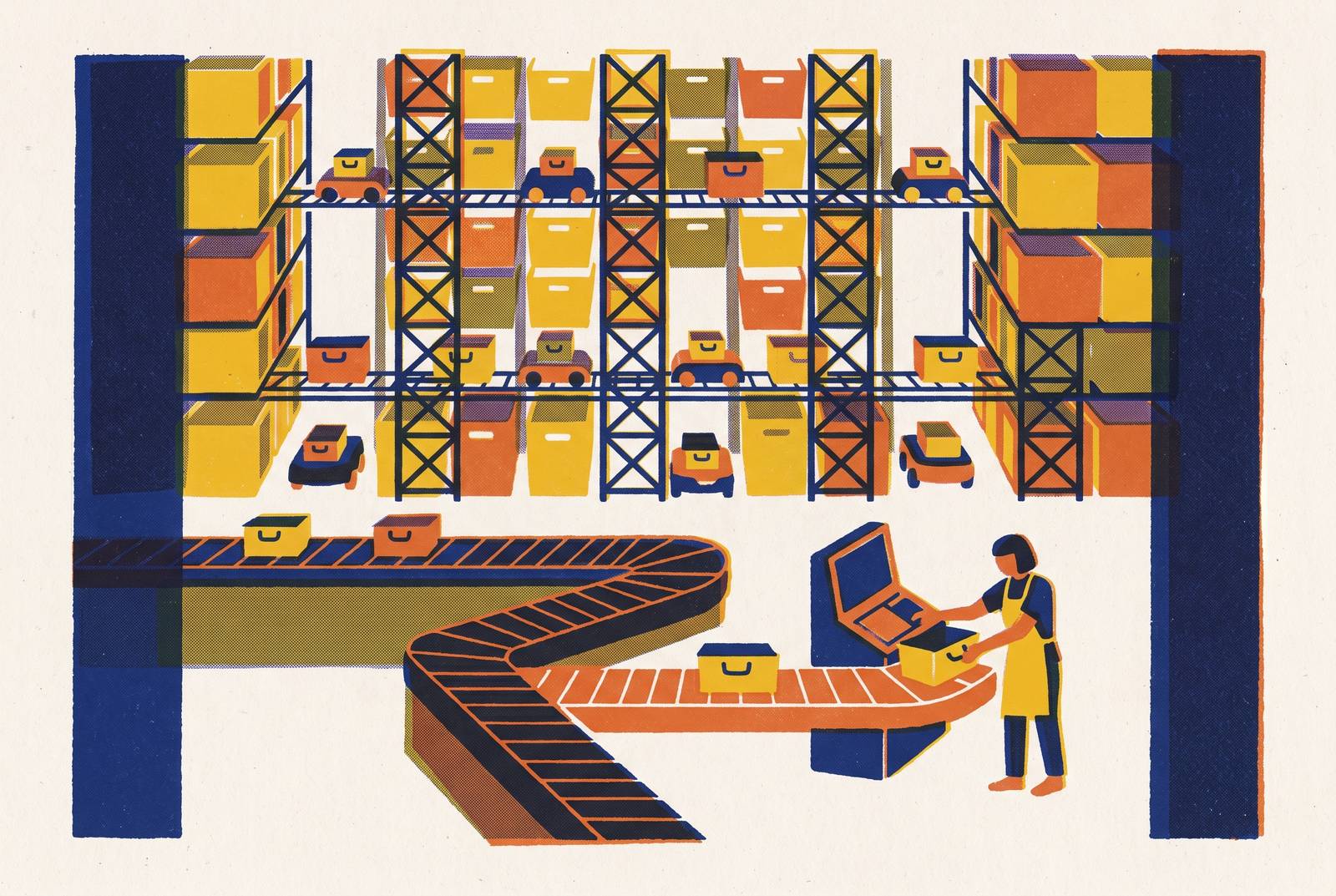
But moving inventory around a warehouse without a human directing every step takes more than robots and racking. A GTP system is really an integration of hardware and software working together to coordinate that movement with as little manual intervention as possible, and the integration layer is what ends up determining how well the whole thing performs. Two software layers do the real work here. A warehouse management system handles inventory and orders at the macro level, tracking what's where and what's been sold. Underneath it is the warehouse execution system, the real-time operational brain that orchestrates robot movement, sequences picks, batches orders, and keeps everything synchronized with whatever other automation sits on the floor.
Here is why the architecture decision carries so much weight: every one of these systems makes a different trade-off across four dimensions, throughput, SKU density, scalability, and capital cost, and once the infrastructure is poured into the floor, those trade-offs are locked in. You don't get to change your mind cheaply after the concrete's set.
This piece covers four primary architecture families: cube storage, or grid-based ASRS; rack-climbing, or 3D mobile robot systems; and shuttle ASRS. Conveyor-based GTP, vertical lift modules, and carousels get covered too, but as supplementary or complementary technology rather than standalone primary architectures. Each architecture makes different structural trade-offs across four dimensions (throughput, SKU density, scalability, and capital cost), and those trade-offs are largely locked in once infrastructure is built. The goal here isn't to hand down a verdict, it's to give you the vocabulary to evaluate which trade-offs matter most for your own operation.
Cube storage ASRS: how grid-based systems maximize density at the cost of retrieval sequencing
Picture an aluminum grid, robots crawling across the top layer, bins stacked in columns underneath. No aisles cut through it, no walkways, no human ever steps inside the storage structure itself. The energy footprint is oddly modest for what it does, too. Ten of these robots draw about as much power as a single vacuum cleaner running in your living room.
The catch sits in retrieval sequencing. Bins near the bottom of a column are buried under everything stacked above them, so pulling one out means digging through the layers first, and that digging constrains throughput whenever an order calls for something deep in the stack. It's the direct cost of the density advantage: pack bins that tightly and you inevitably create some retrieval friction for whatever sits at the bottom.
Scaling one of these systems, though, is straightforward. Add robots, add ports, add grid sections, and capacity grows with little to no downtime on the operation already running. On the software side, AutoStore, the vendor most associated with this architecture, runs on an open API, which matters a great deal for any operation trying to bolt this onto an existing WMS or a mix of third-party tools rather than ripping out what's already there.
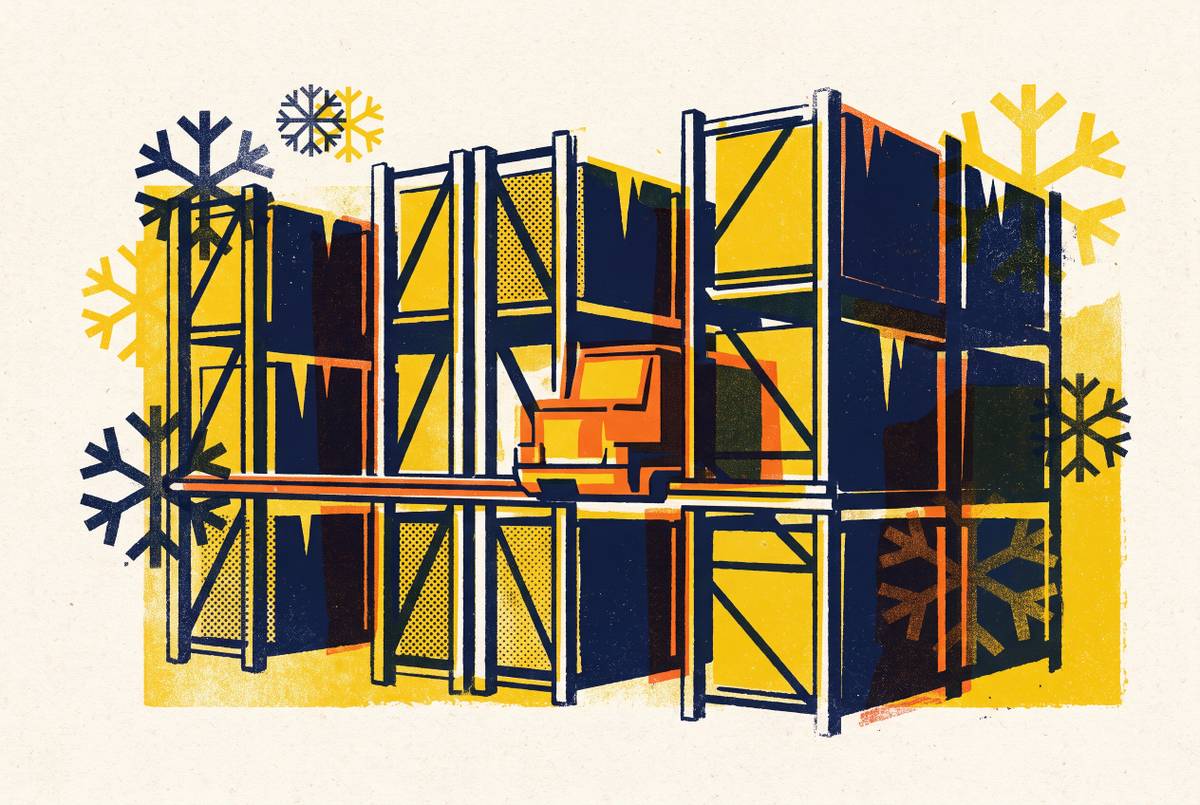
The scale of adoption here is hard to overstate. Recent product moves show the architecture stretching into new categories: a Multi-Temperature Solution for cold and frozen storage, unveiled in September 2024 and orderable from the first quarter of 2025, plus CarouselAI, launched in 2025 alongside Berkshire Grey. Spring 2026 brought VersaAI, a robotic picking capability powered by vision and AI. On the deployment side, Lululemon stood up an AutoStore installation running 525 robots in Brampton, Ontario, in June 2026 Mordor Intelligence. Toyota Automated Logistics, meanwhile, treats AutoStore as one of its two primary GTP technologies, pairing it alongside Vanderlande FASTPICK, which shows this architecture reaching the market through systems integrators as well as direct sales.
Put simply, cube storage earns its place where SKU count is high, item size runs small, floor space is tight, and the priority is packing as much inventory as possible into a footprint rather than guaranteeing instant access to whatever's buried at the bottom of a column. The 2025 Multi-Temperature Solution also opens the door to cold chain applications that this architecture couldn't touch before WWD. AutoStore reported revenue of US$538.6 million in 2025 and employs more than 1,000 people.
Rack-climbing 3D robot systems: how direct-access retrieval trades density for throughput flexibility
Rack-climbing systems solve the cube storage sequencing problem by changing how robots move. Instead of crawling across a top layer, robots here travel horizontally along the racks and vertically up the rack faces. Any robot can reach any tote directly, no digging through whatever happens to be stacked on top of it. That direct access is the whole selling point: it makes this architecture a strong fit for operations with volatile SKU mixes, or ones that need sophisticated sequencing on the outbound side.
Exotec's Skypod is the clearest example of this category in the market today. The company commercially launched its Next Generation Skypod in February 2025, and the redesign brought a more compact robot, denser storage, updated workstations, and a new component called the Exchanger. A survey found up to 50% higher throughput at a single workstation, and up to 30% higher storage density, both compared to the previous generation. Skypod has also started absorbing tasks that used to sit outside the AS/RS boundary entirely, internal buffering, semi-finished order storage, outbound sequencing, even case and each-level handling, which suggests the architecture is broadening its footprint rather than staying confined to pure storage and retrieval.
Deployments back this up across several industries. GXO runs 127 Skypod robots at a Guess distribution center in Venlo, in the Netherlands WWD. Oxford Industries, the parent company behind Tommy Bahama, Lilly Pulitzer, and Johnny Was, picked Exotec in 2025 for a new 560,000-square-foot omnichannel distribution center in Georgia, designed to process more than 20 million units a year using upward of 450 robots across 450,000 storage locations WWD. TRUSCO NAKAYAMA began full-scale operations at its "PLANET AICHI" distribution center in August 2026, and Mitsubishi Shokuhin's Soka FSDC facility went fully operational the month before, in July 2026.
The trade-off against cube storage comes down to floor space. Rack structures need more room per storage location than a cube grid does, so cube storage keeps the density edge, while rack-climbing keeps the edge in throughput flexibility and direct SKU access. Where that trade favors rack-climbing is anywhere throughput demands run high, SKU mix shifts constantly, or outbound sequencing needs to flex with order composition, which is exactly the profile of a lot of omnichannel fulfillment today.
Shuttle ASRS: aisle-based high-speed retrieval for structured, high-volume operations
Shuttle ASRS takes a different structural path altogether. Autonomous shuttle vehicles move horizontally and vertically inside a racking structure to pull totes or trays, and those shuttles work in tandem with lift mechanisms and conveyors that carry inventory the rest of the way to a picking station. Unlike the grid layout of cube storage, this is an aisle-based design that needs defined lanes, standardized bin and tray formats, and a substantial amount of fixed infrastructure poured in up front.
What that infrastructure buys you is speed. Shuttle systems deliver high dynamic performance and excel in operations with clearly structured bins and predictable goods-to-person workflows, which makes them a strong match wherever the SKU range is well-defined and order patterns don't swing around much. A handful of vendors dominate this space, each running its own proprietary software stack: Swisslog and KUKA use the SynQ platform, Knapp runs KiSoft, and that proprietary nature carries real integration consequences for any operation trying to layer one of these systems onto a WMS it already has in place. In mature, high-volume distribution, the real architectural contest tends to come down to cube-based ASRS from AutoStore against high-speed aisle-based shuttle systems from vendors like Dematic and Knapp, and there's no universal winner here, just a structural choice that depends on the operational profile in front of you.
A.P. Moller-Maersk opened its World Gateway II facility in Singapore in March 2026, a fully automated global and regional distribution center built around Multi-Shuttle systems, AS/RS, and autonomous case-handling robots working together. The cost of that performance is commitment. Shuttle systems demand more capital and more fixed infrastructure than cube or rack-climbing alternatives, they're less modular once installed, and they're harder to reconfigure if the SKU mix or order profile shifts substantially down the road. Vanderlande's FASTPICK system, built around its ADAPTO shuttle technology, is another implementation here. It achieves high double cycles per hour and is positioned for next-day and same-day fulfillment, and Toyota Automated Logistics integrates it as a primary GTP technology alongside AutoStore.
AMR-based shelf-to-person systems: lower infrastructure entry point with flexibility trade-offs
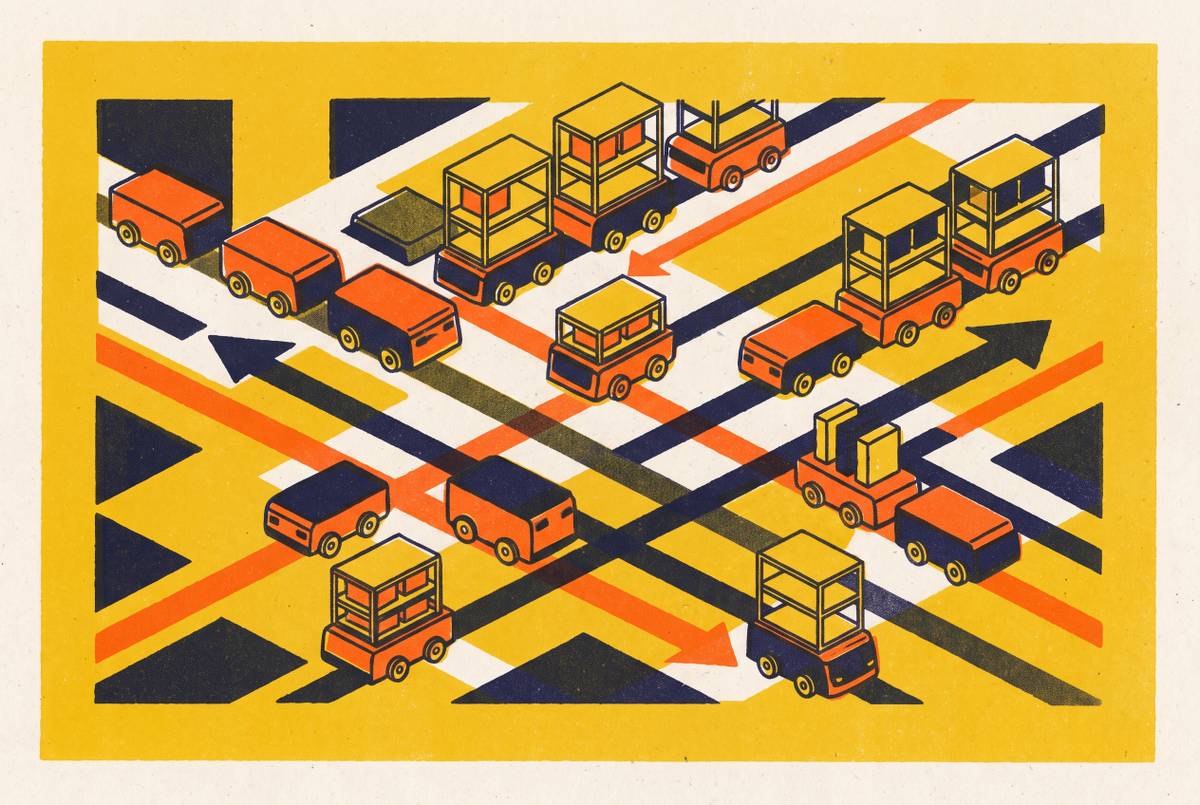
AMR-based systems strip out almost all of the fixed infrastructure. Mobile robots carry shelving units or storage pods over to a stationary human picker, no racking bolted to the floor, no conveyor network, no grid to build out first. These robots navigate using sensors, cameras, and onboard software that lets them move dynamically around obstacles and around the people working alongside them, a real departure from older AGVs that were stuck following fixed magnetic strips laid into the floor.
That lack of fixed infrastructure is the whole value proposition. Capital cost runs lower than grid, rack-climbing, or shuttle ASRS, deployment moves faster since there's no major construction or racking install standing between decision and go-live, and scaling is about as simple as it gets: add robots, add capacity. Vendors in this space include Locus Robotics and Fetch Robotics, both running AMR-based person-to-goods/collaborative picking, and 6 River Systems' Chuck robot is also person-to-goods, not shelf-to-person. Addverb takes a different approach to the same category, offering a full portfolio across AMRs, ASRS, conveyors, and sorting robots, all designed, engineered, and built in-house, which the company positions as giving operators complete control over quality and integration rather than stitching together a stack from multiple vendors.
The trade-off is density. This architecture is a strong fit for operations scaling up from manual picking, mid-sized fulfillment with variable SKU mix, operations that need fast deployment or seasonal capacity flexibility, and facilities where avoiding major infrastructure investment is a priority. It's a weaker fit anywhere storage density is the binding constraint, or where order volume demands the kind of throughput consistency only a fixed-infrastructure ASRS can deliver.
Vertical lift modules, carousels, and conveyor-based GTP as supplementary or niche architectures
Vertical lift modules take a much smaller-scale approach to the same basic idea. Inventory sits in vertical trays inside an enclosed unit, and the machine automatically delivers the tray an operator needs straight to the opening. The footprint is compact, which makes VLMs a natural fit for smaller operations or specific zones inside a larger facility, a parts room, a pharmacy dispensing area, a corner of the floor dedicated to industrial small parts, anywhere floor space is the binding constraint rather than raw throughput.
These aren't high-throughput systems, and they were never meant to be. A vision-based model works best as a workstation-level solution, or as a supplement bolted onto a larger, higher-volume architecture rather than as the backbone of a full-scale fulfillment operation.
Horizontal carousels operate on a similar logic but with continuous circulation instead of tray-by-tray delivery. Stock units rotate past a fixed operator station without stopping, and the picker stays put while the carousel brings each unit into position. Like VLMs, carousels tend to play a supporting role, filling a specific niche inside a broader facility rather than competing head-to-head with cube storage, rack-climbing, or shuttle ASRS for the primary fulfillment workload. The decision for most operators centers on which of these systems to include.