Robotic Palletizing vs Manual Palletizing in Food Distribution
Manual palletizing costs far more than wages once you count injuries, damage, and lost capacity.
Advertisement
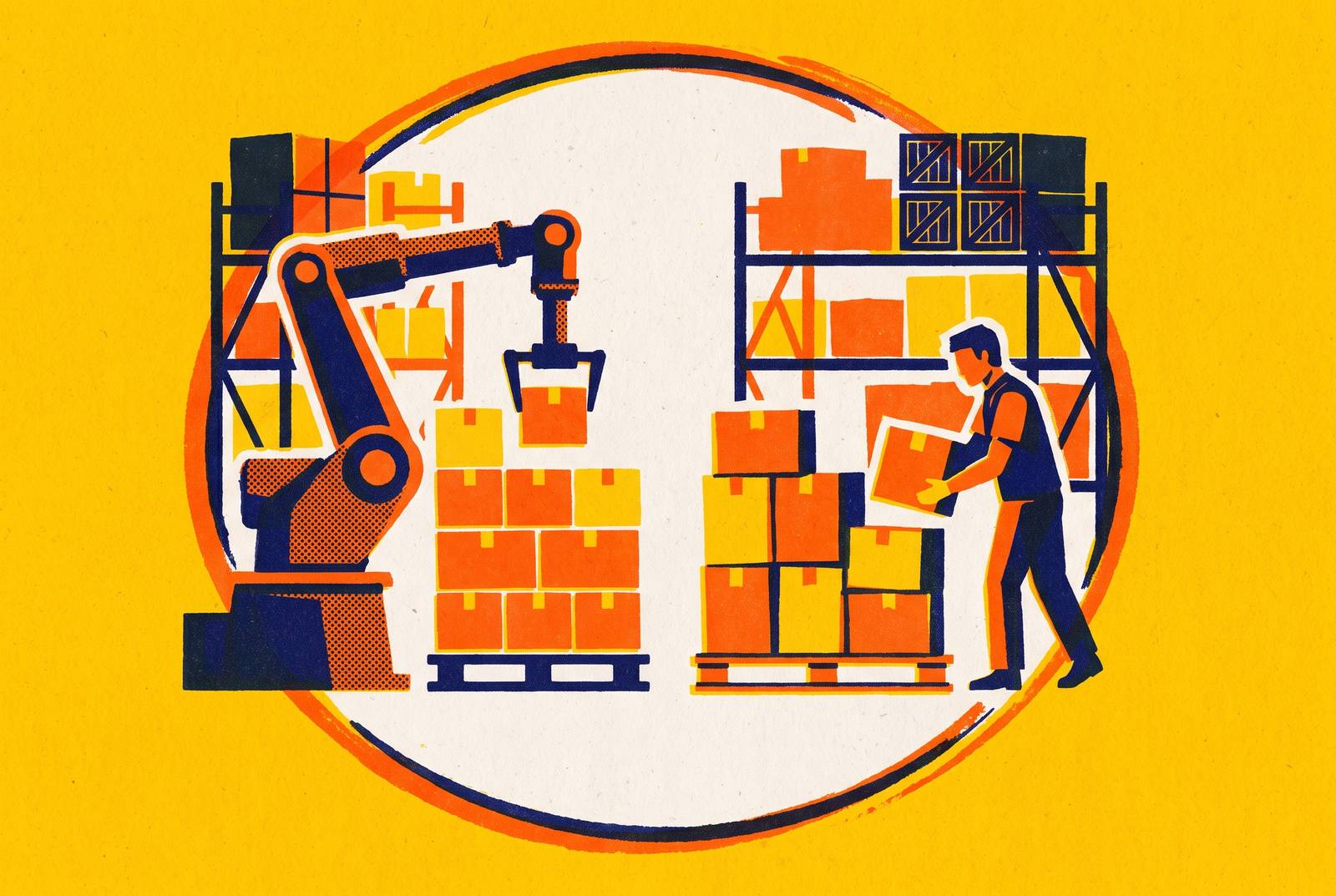
Palletizing, once treated as a routine end-of-line task handled by whoever was available on a given shift, now is central to how food distributors plan capacity, staffing, and compliance. Production lines upstream have gotten faster and product variety has expanded, but the stacking of cases onto pallets at the end of the line has stayed largely a manual job, and that gap between how fast a facility can produce and how fast it can actually get product onto a truck is where the pressure builds. CNN Robotics, writing in August 2026, captured the shift in how manufacturers now frame the question: it's no longer "can we automate palletizing," but how much production capacity gets lost every day by keeping it manual. The cost of that lost capacity compounds across shifts in ways that don't show up on a single line item. Fatigue late in a shift leads to incorrect stacking patterns, damaged packaging, and a higher rate of injury, and each of those problems carries its own financial consequence well past the hourly wage paid to do the work. None of this means robotic palletizing is automatically the right call for every facility. It means the decision now carries enough weight that getting it wrong, in either direction, has real operational cost, and the right answer depends on the specifics of the facility making it.
What manual palletizing costs a food distribution facility
Most food distribution facilities budget for palletizing as a labor cost, and that framing understates what the task actually costs once everything downstream of a bad stack or an injured worker gets counted. Wages are the visible part of the ledger. The invisible part includes workers' compensation claims tied to musculoskeletal disorders from repeated lifting, twisting, and reaching under load, overtime paid out when staffing gaps force surge coverage, product damage from inconsistent stacking that leads to load failures and shipping complaints, and the recruiting and retraining costs that come with filling roles that are chronically hard to keep staffed. A case involving an Ohio snack-foods manufacturer, sourced from UltraMech, shows how far off a labor-only estimate can be: the facility's initial business case counted only direct labor savings, and it understated the real annual savings by a wide margin once product damage reduction, lower workers' comp exposure, eliminated overtime, and maintenance savings were added in. The labor line on a palletizing budget is often the smallest piece of the real cost.
Regulatory exposure belongs in that same accounting, and it is not hypothetical. In January 2024, OSHA investigated The Martin-Brower Co. LLC at a food-services warehouse in Fairfield, Ohio, and found that workers there suffered severe injuries at nearly four times the average rate for their industry, with a high share of those injuries classified as ergonomic musculoskeletal disorders tied to manual material handling. That finding matters beyond the one facility it describes. It shows that sustained manual palletizing, at scale, is not just a productivity question but an active compliance risk that federal inspectors are willing to investigate and document. A facility weighing whether to keep palletizing manual is weighing more than throughput. It is weighing exposure to the kind of injury pattern that drew a federal investigation at a comparable operation.
How robotic palletizing systems work
A robotic palletizing system, in its basic form, follows a straightforward sequence: product arrives by conveyor, vision sensors read its position and size, an end-of-arm tool picks it up and places it according to a programmed stacking pattern, and in more advanced setups, AI-assisted controls adjust in real time for variation in case dimensions or concerns about load stability. Standard Bots, in a January 2026 description of the process, lays out that sequence in detail. What a distributor actually buys within that sequence varies a great deal, and the choice of system type is where most of the practical decision-making happens.
Four system types cover most of the market, and each fits a different operational shape. Conventional, layer-forming palletizers run fast on single-SKU lines where the product and the pattern don't change, but they lose that advantage quickly when a format change requires mechanical retooling. Robotic arm palletizers, built on 4-axis or 6-axis designs, handle mixed SKUs, irregular shapes, and varied stacking patterns without needing hardware changes, which makes them the most common fit for food distribution's mixed-product reality. Collaborative robots, or cobots, are force-limited by design: they detect contact and stop automatically, which lets them run alongside workers without safety caging, and that lowers both footprint and integration cost in a way that suits smaller or space-constrained facilities. High-speed palletizers are built for maximum throughput on continuous lines, often pairing a robotic arm with layer-forming equipment, and they appear most often in beverage and snack production where volume and consistency matter more than flexibility.
The tooling on the end of the robotic arm deserves as much attention as the robot itself, because it's a common point of failure in food applications specifically. Vacuum grippers suit sealed cartons and cases. Mechanical clamps work for bags or irregularly shaped products. Fragile goods call for custom soft-touch tooling. Choosing the wrong one for the product on hand is one of the more common ways a robotic palletizing project runs into trouble during integration. A complete system also typically includes automatic pallet dispensers, slip sheet applicators, and stretch-wrapping equipment built into the cell, so the robotic arm itself represents only part of the total investment, not the whole of it.
Price reflects that complexity. Paxiom gives a typical installed system range, varying with payload capacity, speed, and integration complexity, of $200,000–$450,000. That range gives distributors a basis for comparison, since anchoring to a single average figure may have nothing to do with the configuration their own facility actually needs.
Matching palletizing approach to operational conditions
No single palletizing method wins across every food distribution operation. The right choice depends on a cluster of variables: throughput volume, how much the SKU mix varies, how available and stable the labor pool is, and what the physical facility can accommodate. Each of those variables pulls toward a different answer, and the work of choosing a system is the work of weighing them against each other for a specific operation.
On throughput, human stacking rates tend to decline over the course of a shift as fatigue sets in, while robotic systems hold a consistent pace from the first pallet to the last. Conventional high-speed systems can exceed 30 picks per minute on single-SKU lines, and robotic arms handling mixed SKUs still run faster than manual stacking without the fatigue-driven slowdown. For a facility running medium-to-high volume across multiple shifts, that consistency translates into more predictable output planning. For a facility running genuinely low or intermittent volume, the throughput gap narrows enough that it may not justify the investment on its own.
SKU variability cuts a different way. A single-SKU beverage line is the natural home for a conventional high-speed palletizer, since format changes on that kind of system mean mechanical retooling. Robotic arm systems handle mixed SKUs and pattern changes through software rather than hardware changes, and Food Industry Executive, in April 2026, pointed to accelerating SKU proliferation as the reason software-driven pattern generation now does work that used to require mechanical retooling or a worker's own judgment call. Manual palletizing still holds an advantage at the far end of that spectrum, where products are highly irregular, volumes are low, and the product mix changes often enough that programming a new pattern for every run isn't worth the time.
Labor availability shapes the decision as much as throughput or SKU mix. In markets where end-of-line palletizing roles sit unfilled for months regardless of pay increases, a robotic system resolves a staffing problem that money alone hasn't fixed. CNN Robotics frames the shift in terms of redeployment rather than elimination: automation lets existing teams move into higher-value work while the repetitive, physically demanding stacking gets handled by machines. A facility with a stable, available workforce and a low injury history has a weaker near-term case for automation built on labor grounds alone, which is a legitimate reason to wait.
Food safety and product integrity carry their own weight in this calculation, and they matter more in food distribution than in most other industries using the same equipment. Inconsistent stacking leads to load instability, which damages product in transit and threatens the kind of cold-chain consistency that prevents cross-contamination in regulated environments. Folio3 FoodTech, writing in 2025, points out that consistent handling aligns with FDA food safety protocols, and that automated systems support lot traceability through vision-system barcode scanning, a compliance capability manual operations can't match at the same reliability. Worker fatigue degrades stacking consistency in ways that are genuinely hard to monitor in real time on a manual line, and a robotic system simply doesn't experience that decline.
Facility footprint closes out the comparison. Traditional industrial robotic cells need safety fencing, which eats floor space that older food distribution facilities often don't have to spare. Cobots remove that constraint by design: their force-limited operation allows them to work in open floor space alongside employees, which makes them viable in tight layouts where a full robotic cell wouldn't fit. Cold-chain facilities add another layer of constraint on top of footprint, since hygiene requirements affect what tooling and sanitation protocols a robotic system needs to meet.
Put together, the logic maps fairly cleanly. Very low volume, highly irregular SKUs, and limited capital point toward manual palletizing remaining the right call. Medium-to-high volume with mixed SKUs and real labor pressure points toward a robotic arm palletizer or a cobot. High volume on a stable single SKU, where maximum throughput is the goal, points toward a conventional or high-speed palletizer. Constrained floor space combined with a smaller operation points toward a cobot. None of these combinations is universal, and a facility that doesn't fit neatly into one category should read these as directional rather than exhaustive.
The "automation is too complex for our operation" objection
The claim that food distribution is too complex for robotic palletizing has real history behind it, and it deserves to be taken seriously rather than dismissed. A market research firm, citing data from a robotics industry federation, points out that food and beverage has long accounted for a smaller share of industrial robot installations than electronics or automotive, despite how heavily the sector depends on end-of-line operations. That underrepresentation reflects real constraints: tight capital budgets, packaging that doesn't come in uniform shapes, and cold-chain compliance requirements that added cost and complexity to any automation project. The objection wasn't invented to resist change for its own sake. It grew out of conditions that were, for a long time, genuinely true.
Several of those conditions have shifted. On mixed-SKU loads, 3D vision-guided pattern generation now lets robotic systems handle mixed-case loads that used to require a person's judgment to sort out, and AI-driven adjustments for dimensional variance close much of the remaining gap. UltraMech describes this capability as enabling full capital payback within 12 to 15 months for food and beverage plants, a timeline that would have been hard to justify under older, less flexible systems. On cost and scale, cobots have lowered the entry point for smaller distributors by removing the need for safety fencing, cutting the floor space required, and shortening how long integration takes. Standard Bots, in January 2026, describes cobots operating in open floor environments directly alongside workers without physical barriers between them. On integration complexity, software-driven pattern generation now handles the kind of quick changeovers that used to mean mechanical retooling or a worker improvising on the line, and Food Industry Executive frames the rising pace of SKU proliferation as a reason to automate rather than a reason to avoid it.
What hasn't changed is the case for very small operations running highly irregular, low-volume, specialty product mixes, where manual labor can still be cheaper and more adaptable than any robotic cell built to handle that kind of variability. The objection applies to a narrower slice of food distribution than it did even a few years ago, and that slice keeps shrinking as vision systems and software-driven pattern generation close the gaps that used to make automation impractical outside of high-volume, single-SKU lines.
The market's direction backs that up. Research and Markets put the palletizing robot market at $3.8 billion for the year, with food and beverage identified as the dominant end-use driving that growth. A market moving at that pace, with food and beverage leading the demand, is infrastructure that a growing share of food distributors are treating as standard, and the facilities still relying entirely on manual palletizing are the ones now facing the harder question: not whether automation works, but whether their own operation still has a good reason to wait.
Sources
- Palletizing robots: Updated 2026 guide - Standard Bots
- Smarter Food Stacking With Automated Palletizing In 2025
- Robotic vs Traditional Palletizing: 2026 ROI Guide
- Food Palletizing Automation in 2026
- Case Packing and Palletizing Automation in 2026: Adapting to SKU Growth and Tighter Labor Markets - Food Industry Executive
- Palletizing Robots Market - Global Opportunity Analysis and Industry Forecast (2026-2036)