Warehouse Robot Fleet Management Software
Warehouses doubling robot fleet sizes need software to coordinate them.
Advertisement
Putting one autonomous mobile robot on a warehouse floor makes the job simple enough: follow the map, pick up the tote, drop it off, repeat. Putting twenty of them on that same floor, sharing aisles with forklifts and people, makes the simple job disappear. Something has to decide which robot takes which job, keep robots from meeting at a junction, decide when they charge, and alert a supervisor when one is stuck. That coordination layer, sitting above the individual machines, is what fleet management software actually is: centralized monitoring, task assignment, coordination between units, data collection, and automated decisions made across the fleet rather than inside any one robot.
The industry hasn't settled on clean vocabulary for this, and three terms get used almost interchangeably despite meaning different things. Narrowly defined, fleet management means monitoring and controlling robots, individually and as a group. Fleet orchestration goes further, coordinating robots, tasks, and resources so an entire workflow runs end to end. Fleet automation is different again, referring to the automated decision-making that cuts down on a human having to intervene every time something changes.
That distinction between management and orchestration sounds academic until a facility's fleet gets big and mixed. A small warehouse running fifteen identical robots from one vendor might get by with monitoring and basic dispatch. A larger, messier operation cannot. SCAND's 2026 guide describes the more typical case now: a distribution center running AMRs that shuttle pallets between storage and picking zones, AGVs on fixed routes between production areas, and robotic arms doing the packing, each piece from a different manufacturer, each with its own software, its own protocol, its own dashboard. Nobody designed that setup on purpose. It's what accumulates after three separate purchasing decisions made two years apart. Orchestration has to make that accumulation behave like one system instead of three.
Drivers of rapid market growth and adoption
However the analysts slice this market, the direction is the same. Depending on whether the researcher counts software alone or the full orchestration stack, the numbers differ, but they all point up and to the right. ResearchandMarkets, looking at the broader warehouse robotics fleet orchestration category, has it growing substantially from 2025 into 2026 and reaching $6.47 billion by 2030, a 22.3% compound annual growth rate. Custom Market Insights, focused more narrowly on fleet management software itself, projects the segment to more than quadruple in size by 2035. Roots Analysis, looking at warehouse robotics overall rather than just the software layer, expects the broader market to grow several-fold over the same stretch. Three different scopes, three different numbers, one consistent trajectory.
What's driving that trajectory isn't mysterious. Three forces appear across nearly every source on this: a labor shortage in logistics that hasn't let up, e-commerce fulfillment volume that keeps raising the bar on throughput and unpredictability, and the arrival of robotics-as-a-service models that let an operator rent a fleet instead of buying one outright. That last point affects how well the system handles scaling and unpredictability, since renting a fleet through robotics-as-a-service changes how quickly an operator can adjust capacity.
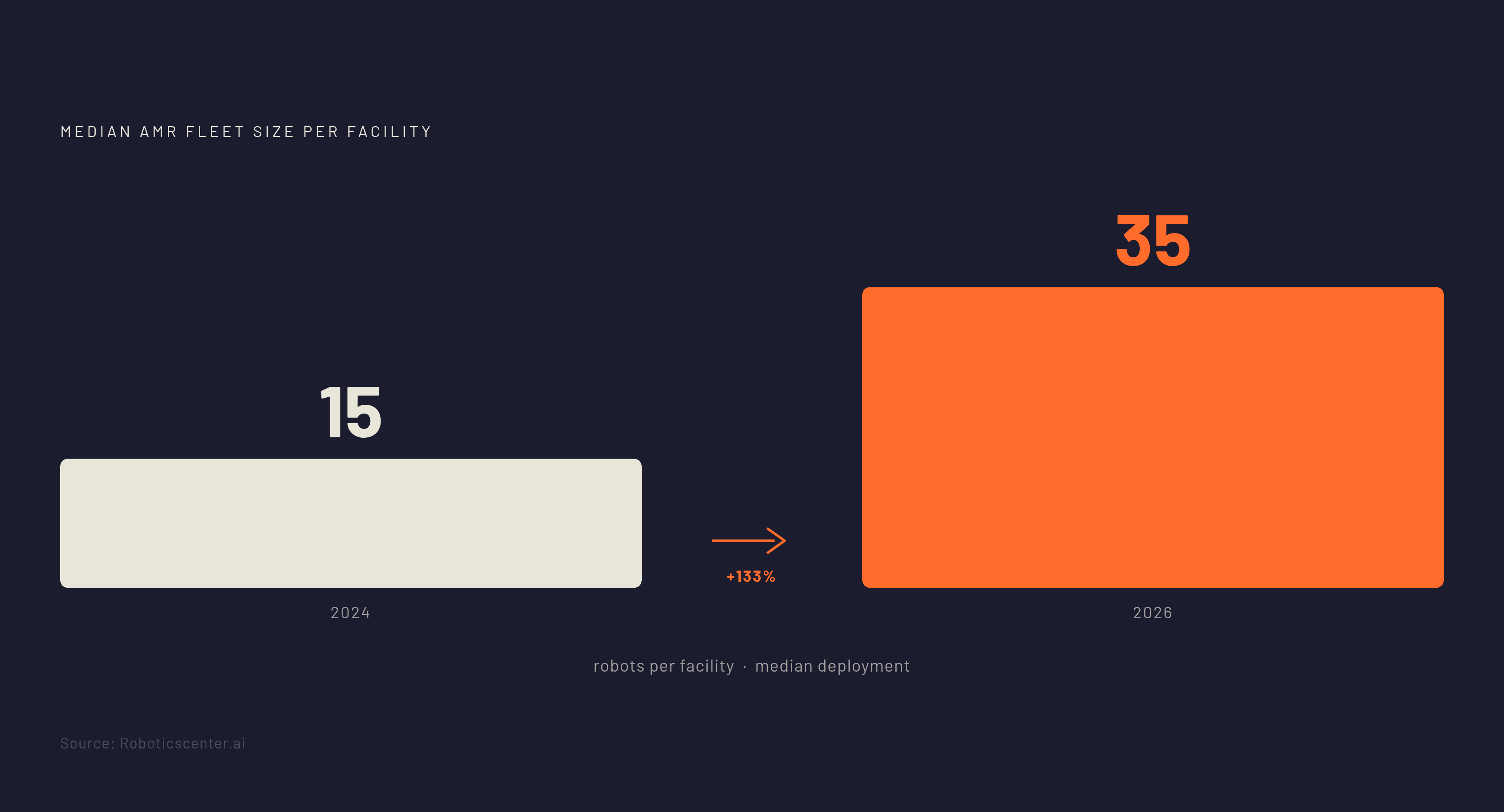
Scale itself is the tell. Roboticscenter.ai tracked the median size of a new AMR deployment at 15 robots in 2024; by 2026 that median had grown to 35 robots per facility, as operators move past pilot programs into full production runs. That's more than double in two years, and it's happening at the median, not just among the largest operators. Intel Market Research puts it even more bluntly: the majority of midsize and large warehouses plan to have AMR fleets running by the end of 2026. Those two data points together make the demand curve for fleet software clear. Coordinating 15 robots and coordinating 100 are not the same problem scaled up; they're different problems, and a lot of warehouses are about to find that out at once.
The six core capabilities that make fleet software more than a dashboard
Start with visibility, because nothing else works without it. Fleet software has to give one centralized view of every robot's location, status, battery level, current task, connectivity, and any errors, regardless of which vendor built the machine.
Visibility alone doesn't move a single tote, though. Task dispatch is the next layer: the system has to weigh which robots are available, where they are, how much battery they've got, what they're capable of carrying, and how urgent the job is, then assign work accordingly. The better platforms don't stop at that first assignment. When a robot drops offline mid-task or conditions on the floor change, the system reassigns work on the fly rather than waiting for a human to notice the gap.
Routing and traffic coordination sit on top of dispatch. A fleet of fifty robots sharing one floor doesn't need fifty robots each solving their own routing problem; it needs one system managing intersections, priority zones, restricted areas, and charging bays as shared infrastructure. KNAPP's 2026 look at logistics trends states that the software is what distributes orders, optimizes travel paths, and adjusts priorities as conditions shift in real time. The robots themselves aren't solving the bottleneck; they're executing a plan built somewhere above them.
Charging tends to get treated as an afterthought, which is a mistake. The naive rule, send a robot to charge once its battery crosses some threshold, creates queues at charging stations during the busiest hours and leaves robots sitting idle during the slow ones. A well-built system predicts how much energy upcoming tasks will need, slots in opportunity charging during natural lulls, and spreads the load across stations so there's always a charged robot ready to work. Robotomated.com puts the payoff at 15 to 20 percent more effective fleet availability from charging optimization alone, which for a mid-size fleet is roughly the same as adding several extra robots without buying any new hardware.
None of this matters if the fleet operates in isolation from the rest of the business. Integration with warehouse management, manufacturing execution, and ERP systems addresses that. Fleet software connects to that broader stack through cloud APIs or on-premise connectors, and without that connection, robots are just executing tasks blind to inventory logic and order priority, an island rather than a working part of the operation.
Last comes predictive maintenance, which shifts the whole relationship with downtime from reactive to scheduled. By pulling telemetry, battery health, motor performance, how often errors crop up, the software can flag a developing problem before it turns into a robot stalled in the middle of an aisle during peak volume.
How edge computing is changing where fleet intelligence runs
Fleet management has traditionally worked on a simple split: the central controller decides, the robot executes. That's starting to change. Through 2026, more of the actual orchestration logic is moving out of the central controller and onto the robot itself, or onto local infrastructure sitting closer to the floor.
Promwad's analysis breaks down why this shift matters operationally. Perception at the edge means a robot reads its own surroundings locally instead of waiting on a remote system, so it reacts to a forklift pulling out or a worker stepping into an aisle in real time rather than on a delay. Routing at the edge means the robot makes navigation calls based on the traffic and conditions right in front of it, reacting faster than a signal from a central scheduler that's already a few seconds stale. And fleet management at the edge turns orchestration into something closer to distributed policy, local autonomy operating inside shared rules, rather than one brain issuing an instruction every second to every machine.
Neither the fully centralized model nor the fully distributed one wins outright, and nezzhub.com's 2026 guide is direct about the tradeoff. Centralized systems give consistent coordination across the whole floor, but that consistency comes with a dependency: if the central system slows down or goes offline, the whole fleet feels it. Distributed systems respond faster locally, but without a shared policy framework sitting above them, two robots can make locally sensible decisions that conflict with each other. The deployments holding up best in 2026 split the difference on purpose: shared policy set centrally, local autonomy at the edge to act on it.
That architectural choice matters more the bigger a fleet gets. A platform that runs cleanly with fifteen robots and a mostly centralized design may not hold up at a hundred, and buyers evaluating fleet software need to ask about that scaling path before they need the answer. Planning tools fit into this in a specific place. Verticalstorageusa.com reports that early adopters pairing AI orchestration with digital twin simulations, testing a layout virtually before a single robot touches the floor, see 15 to 30 percent better space utilization. That kind of upfront modeling cuts down on the guesswork an edge-heavy system would otherwise have to absorb once it's live and running.
The interoperability problem and the standards attempting to solve it
Running AMRs from one vendor and AGVs from another in the same building creates a real chance they cannot coordinate at all. Each speaks its own protocol, runs its own control software, and reports into its own dashboard, so what should be one fleet becomes a set of isolated automation islands sitting on the same warehouse floor. That's the problem the industry now calls interoperability, and it's arguably the single hardest unsolved piece of multi-vendor fleet management.
VDA 5050 is the most established attempt at a fix. It's a standardized protocol interface for communication between different mobile robots, AGVs and AMRs alike, and a central management system, essentially a common language so robots from different manufacturers can work together under one fleet controller. It came out of a collaboration between the German Association of the Automotive Industry and the VDMA Materials Handling and Intralogistics Association. Version 3.0 was published on GitHub in March 2026 and announced by the VDA on 21 April 2026, following intensive development work under technical supervision of the Institute of Materials Handling and Logistics (IFL) at the Karlsruhe Institute of Technology, and a subsequent public consultation on GitHub. That version extended the interface to cover higher-autonomy robots and added zone concepts along with path sharing between units. Under the hood, it typically runs on a publish-subscribe MQTT architecture, with a master control system, a broker, and the robot clients all communicating through that broker rather than talking to each other directly.
What VDA 5050 doesn't do matters just as much as what it does. It says nothing about safety requirements, routing algorithms, prioritization logic, congestion handling, or deadlock resolution (navigation and intelligence remain proprietary to robot manufacturers). All of that intelligence stays proprietary to whoever built the robot. The standard hands robots a shared channel to talk through; it doesn't tell them what to say.
Other standards fill in from different angles. The MassRobotics Interoperability Standard takes a different approach entirely, not routing commands through a central fleet manager but letting robots and fleet managers broadcast location and status to each other directly, so mixed fleets can coexist safely even without one system in charge of all of them. Open-RMF, an open-source framework, tackles coordination across multiple robot platforms and the building systems around them. None of this overlap is wasted effort. Goat-robotics.com frames it correctly: VDA 5050 handles control interoperability, MRIS handles information sharing, Open-RMF handles multi-platform coordination, and because interoperability breaks down across multiple layers, it needs a standard at each layer rather than one standard trying to cover all of it.
Even so, a platform adopting VDA 5050 Version 3.0 in full still has to build its own logic for routing, prioritization, congestion handling, and deadlock resolution from scratch. The standard defines how robots talk. It says nothing about what they should decide.
The platform landscape: what leading solutions look like in practice
No single company owns this problem end to end, and the vendor map reflects that. Hardware manufacturers like Geek+, 6 River Systems, and Fetch (now under Zebra) bundle fleet software with their own robots. WMS and WES vendors including Manhattan Associates and Blue Yonder are building robotics coordination into platforms that started out managing inventory and orders, not robots. Cloud providers, AWS, Azure, and Google Cloud among them, supply the compute backbone that a lot of this orchestration runs on. Vision and sensor companies like Cognex and Photoneo handle the perception layer robots depend on to see what's in front of them. And systems integrators, Dematic, Swisslog, Bastian Solutions, stitch all of the above into something that actually runs on a warehouse floor.
Within the fleet orchestration software category specifically, the named platforms split roughly by how vendor-agnostic they're built to be. Synaos positions itself as fleet management software for orchestrating autonomous mobile robots across vendors, and ZipDo's March 2026 review calls it a best fit for operations teams needing centralized robot dispatch, telemetry, and incident follow-up without heavy custom scripting. Formant, described by ZipDo as runner-up, covers cloud-based monitoring and operation of mixed robot fleets, suited to teams that need centralized dispatch alongside live monitoring of missions in progress. Cogniteam Nimbus rounds out that same review as a cloud platform for deploying and supervising fleets, aimed at operators managing multi-robot, multi-site warehouse missions who need orchestration and telemetry in one place.
Vecna Robotics takes a different angle with Pivotal, an orchestration engine built to integrate with existing warehouse management systems and coordinate Vecna's own AMR fleet alongside human workers, aiming at centralized control of material handling workflows rather than a vendor-agnostic multi-brand approach. Open-RMF shows up again here too, this time as a deployable option rather than just a standard, an open-source framework promoting coordination across environments well beyond logistics, including healthcare facilities running their own mobile robots.
Roboteon fits into this landscape as well, having announced live demos at Automate 2026 (June 22–25, 2026) showcasing advanced capabilities across multiple OEMs for AMRs and robotics pick arms (Cobots). That range, working with hardware from more than one manufacturer inside a single demo, is precisely the capability the interoperability standards above are trying to make less painful to build. The market at this point offers a wide range of options. It's short on operators who've mapped their own fleet's complexity closely enough to know which layer of this stack they actually need first.
Sources
- Robot Fleet Management Software: A Complete Guide | SCAND
- Warehouse AMRs in 2026: Why Edge Perception and Fleet Management Are Reshaping Automation
- Robot Fleet Management: How Systems Operate in 2026
- Warehouse Robotics Fleet Orchestration Market Report 2026
- Autonomous Mobile Robot AMR Fleet Management Software Market 2026 to 2034
- AMR Fleet Management Software: What to Look for in 2026 | Robotomated
- Global Robot Fleet Management Software Market Size 2026-2035
- Version 3 of VDA 5050 is a toolkit for automation projects - Automated Warehouse