Scalability Economics of Modular Robotics Systems
Modular robots cut the cost of each added deployment, if parts interoperate.

Modular robotics changes the economics of scaling automation by turning a bespoke capital purchase into a sequence of reusable investments. Its strongest financial advantage is the declining cost of subsequent deployments as modules, configurations, and integration knowledge spread across operations. That advantage depends on interoperability, so returns must be evaluated across a portfolio of deployments.
Why the traditional robotics investment model breaks at scale
Conventional industrial robotics commits capital up front to a fixed, purpose-built system. The system is engineered for a defined task, but it is hard to redeploy when the product mix or throughput requirements change. Changing production requirements create a structural mismatch between a capital cycle measured in years and a production cycle measured in months. A system can therefore still work well after the application it was bought for is gone.
Each new line or site requires another engineering and integration cycle, so adding capacity repeats much of the original investment. Costs grow linearly or worse when each installation introduces fresh customization. For decision-makers, the question is consequently not whether to automate, but how to avoid locking capital into assets whose economic usefulness depends on an unchanging task.
What modular architecture actually means for cost structure
Modular architecture changes the unit of investment from a bespoke system to a replicable building block. Identical motor and link modules can serve different configurations, allowing the components of a palletizer to be reconfigured into a material-handling arm. Inventory becomes useful across applications. That reduces spare-parts variance and storage costs while preserving a route to redeployment when production changes. Standardized manufacturing also lets vendors make identical parts in repeated runs, cutting some of the custom work that goes into each conventional system’s price.
Much of conventional programming effort goes into coordinating robot controllers, PLCs, and safety and vision systems. Beckhoff’s ATRO system integrates kinematics directly into TwinCAT/EtherCAT, making the robot a standard machine component and avoiding separate integration work. The economic distinction is the engineering work avoided. Hardware modularity alone would not remove that overhead if each new arrangement still required a separately engineered control layer.
TU Munich’s paper “Holistic Optimization of Modular Robots,” published in IEEE Transactions on Automation Science and Engineering in November 2025, with its current version dated February 2026, jointly optimizes module composition, base placement, and trajectory. Those choices had previously been solved separately. The paper finds that joint optimization can reduce cycle time by up to 25%, connecting architectural choice to both operating performance and acquisition expense.
How the incremental logic works in practice: acquisition and first deployment
The first investment can address a single production bottleneck. A business can deploy a small module set, validate its return, and extend the system after learning how it performs. Early deployments act as funded pilots, with capital at risk on the modules needed for the task rather than on a plant-wide transformation whose assumptions remain untested.
Under a large fixed-system commitment, much of the expenditure precedes operational learning, leaving limited room to revise the investment as evidence emerges. Incremental acquisition allows that evidence to inform the next purchase. A 14-month payback, for example, would be fast enough to inform a further investment decision before the original modules were fully depreciated.
Deployment economics also depend on the integration mechanism described above. ATRO received the Innovation Award 2026, but the relevant financial feature is its consistent integration into the machine’s control environment. The award does not establish a project’s return. Rather, the architecture illustrates how an application-led module purchase can avoid becoming a new standalone controls project, keeping the first investment closer to the production requirement it is intended to serve.
How standardization turns each deployment into a template for the next
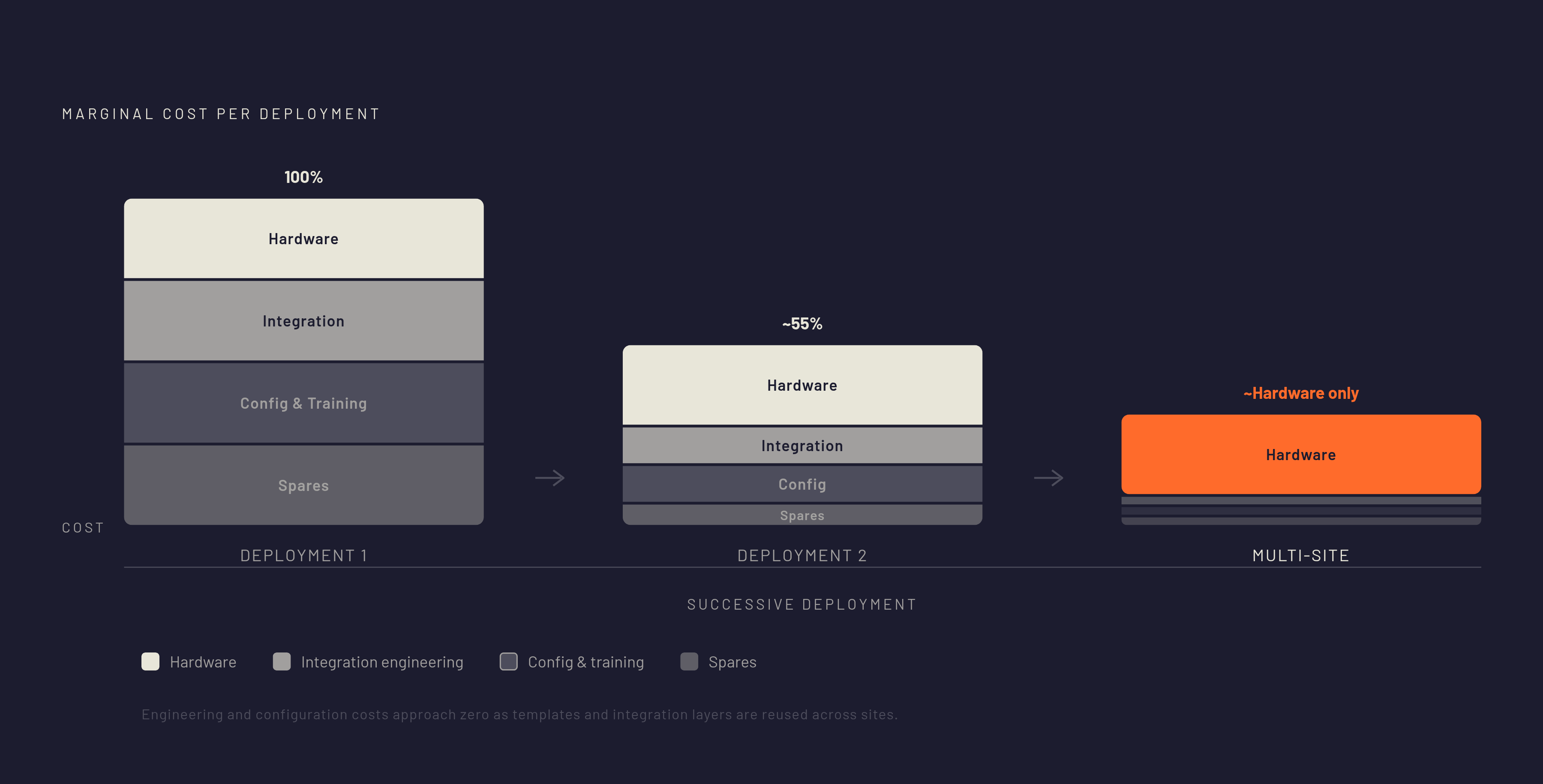
The second deployment begins with assets the first deployment had to create. Standard module inventory, operational templates, and integration knowledge are already available, so some costs no longer need to be incurred afresh. Existing spares can cover additional configurations using the same module types. More capacity is economically different when each increment requires less preparatory work than the one before it.
Configuration work can also become less burdensome. The TU Munich paper reports that optimized robots were successfully deployed in the vast majority of real-world validation cases in under an hour. That result addresses an engineering exercise that could previously take weeks. It shows how a method for searching the design space can reduce the effort needed to turn standardized parts into a working application.
Control reuse strengthens the same effect in practice. ATRO’s consistent TwinCAT/EtherCAT integration allows software configurations developed for one installation to transfer to the next without re-architecting the control layer. Across closely matched applications, such as repeated palletizing tasks or welding cells, configuration, training, and integration costs can approach zero at later installations. Once replication works within a site, the larger economic question is whether that template survives transfer to other sites.
Each new line or site requires another engineering and integration cycle, so adding capacity repeats much of the original investment.
Multi-site and multi-line expansion: where modular economics produces the largest gains
Multi-site operations offer a larger base over which to spread reusable engineering and inventory. A fixed-system approach requires a full integration and programming effort at each location, while a modular system with consistent control integration can reduce the remaining work to application configuration. The difference grows each time a similar system is deployed. When the task and architecture stay much the same, engineering costs at each site can fall toward zero, freeing expansion budgets from much of that repeated cost.
Shared inventory changes the working-capital requirement as well. A central stock of standardized modules can service an entire fleet, creating a relationship between installations that reduces the need for each site to hold spares for its own bespoke systems.
Palletizing across sites and welding across production lines illustrate where repeated tasks support that relationship. Parcel sorting offers another example of incremental capacity. Unbox Robotics states that operators can add or remove robots according to throughput needs and increase destinations without redesigning layouts. These applications demonstrate why replication and expansion are distinct economic capabilities, even when they occur together. Their wider financial logic holds only if modules and control arrangements remain interoperable across deployments.
The interoperability constraint and what it actually costs
Interoperability is the strongest qualification to the modular investment case. Standard parts can form a shared investment base only if components from different vendors or generations can work together. ARIA’s report “The Future of Robotics Modularity and Interoperability” identifies the lack of common standards as the most frequently cited obstacle among robotics stakeholders. Common standards are missing for connector dimensions, communication protocols, and data formats. Without agreement at those interfaces, nominally modular purchases can become separate islands of equipment.
That fragmentation directly threatens the expected marginal-cost decline. If a new deployment requires incompatible parts or fresh control engineering, earlier inventory and templates no longer substitute for new expenditure. Even compatible robots may require substantial engineering to connect with legacy manufacturing execution systems or proprietary enterprise software, eroding the savings attributed to per-site replication.
Robotics-as-a-Service, or RaaS, does not remove this constraint. Hardware bought through a subscription may still need a lot of customization to fit an existing workflow and enterprise software stack, cutting the benefit of treating that spending as operating expense. Integration work also depends on access to qualified technicians. The lesson for procurement is to treat standards compliance as a criterion. Interoperability is not a reason to reject modular architecture, but unresolved compatibility costs cannot be excluded from its investment case.
Three developments that are shifting the interoperability calculus
Research is reducing one part of the difficulty, namely the cost of selecting a workable modular configuration. The TU Munich method addresses a design space that can contain more than a million conceivable options, where composition, placement, and movement decisions previously required separate judgments. It reduces the engineering burden of using modules with compatible interfaces, making a standardized architecture more practical to deploy repeatedly.
Robot-agnostic platform design addresses a different part of the problem. It treats standards as a procurement discipline, making compatibility a basis for assembling a fleet rather than an aspiration after equipment has been bought. MassRobotics’ AMR interoperability standard and VDA 5050 provide open-interface approaches in the AMR space. Their scope remains important to the economic claim. Interfaces for mobile robot fleets are evidence of progress within that scope, while combining modular robotics hardware and software more broadly may still require additional work.
A 2026 paper on RaaS and embodied AI calls for behavioral API standards and fleet orchestration API standards while the market is still forming, linking interoperability to EU industrial and competition policy. Such pressure ties standards to market access, so coordination is no longer left entirely to those who choose to take part. The trajectory is favorable, but the standards are still forming and the optimization research is recent. For investment analysis, the implication is to recognize improving reuse prospects without treating future compatibility as a guaranteed return.
What the modular cost structure means for calculating returns
A single-installation internal rate of return model captures the savings from one application over its useful life, but misses value transferred into later deployments. The unit of analysis must therefore expand. In a multi-deployment model, expenditure on initial modules, configuration templates, and integration knowledge can reduce the cost of subsequent installations rather than being attributed solely to the first task.
This requires separating recurring gains from reused investment. Machines published an April 2025 study of collaborative modular robotic manipulators documenting substantial time savings and meaningful energy reduction, as well as lower acquisition cost through component sharing and shorter time-to-market than non-modular equivalents. Energy and operating-time gains recur when the same configuration is deployed, while shared components and faster deployment change the cost and timing of expansion. They should be listed across the deployment sequence so the model accounts for when they arise beyond the initial purchase.
RaaS changes how returns are assessed because a business pays for robotic capacity as an operating expense. Cost per unit of output then becomes more relevant than equipment payback, with scalability judged by how that cost improves as volume grows. Compatibility still has a price in either model. The expected gains from reuse must be weighed against estimated engineering costs for non-standard components and enterprise integration to show how much of the theoretical compounding can become an achievable return. Enterprise governance should therefore evaluate modular robotics over a portfolio of deployments, because judging only the first and economically weakest installation systematically understates the value of the investment.
Sources
- Holistic Optimization of Modular Robots
Supplied the findings on jointly optimizing module composition, base placement and trajectory, including the cycle-time reduction and fast deployment of optimized robots.