Hidden Costs of Warehouse Robot Integration Projects
Software, site prep, and labor can dwarf the robot price tag.
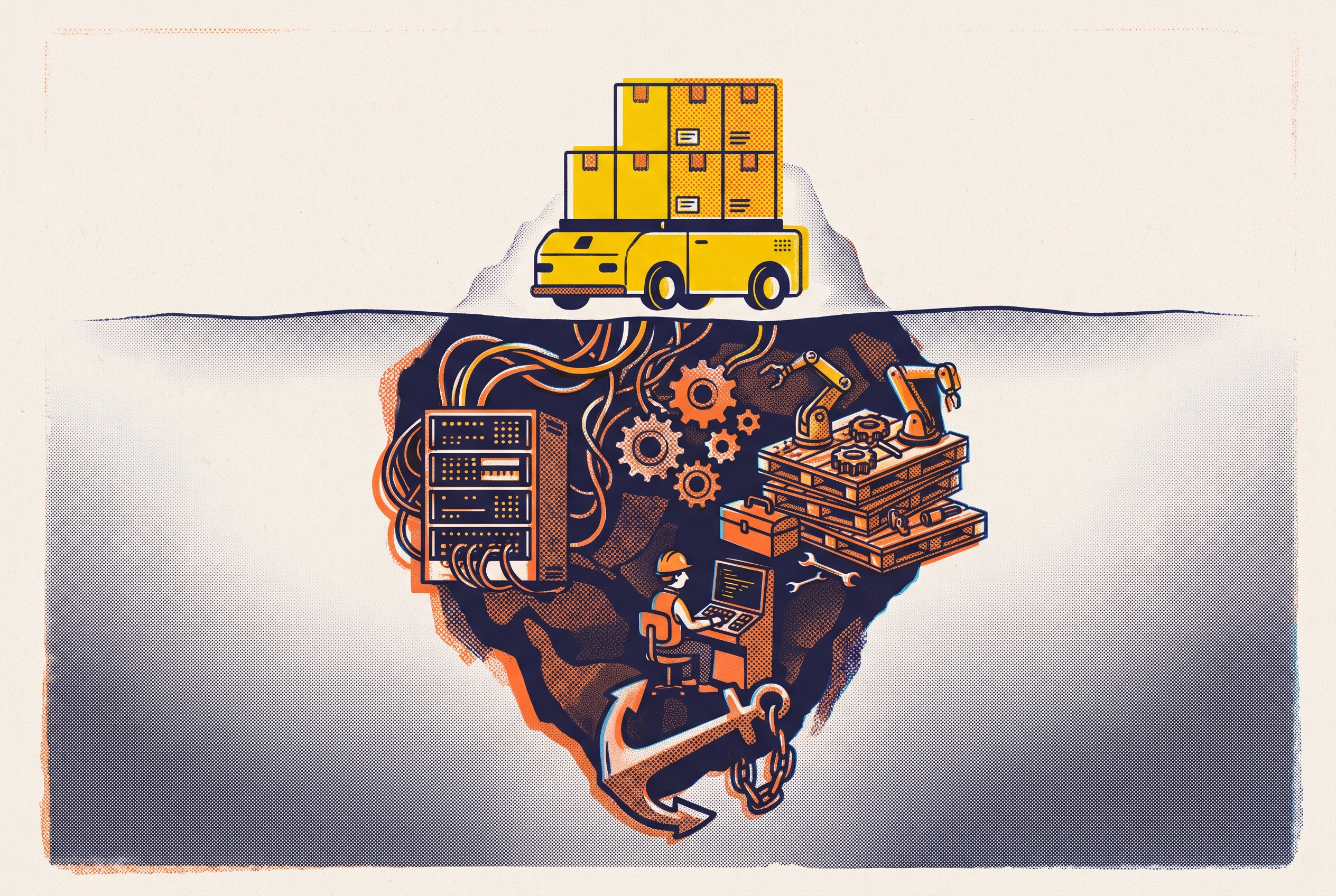
Warehouse robot integration projects cost more than the machines because they change the software, facility, processes, and workforce around them. The hardware quote is therefore not a project budget. A sound investment case prices the transition to stable operation and the years that follow, rather than treating integration as a small implementation allowance.
Why warehouse robot projects routinely cost far more than the hardware quote
Finance teams encounter the gap when an approved investment starts generating costs that were absent from its business case. Hardware is relatively easy to estimate and usually appears first in the vendor’s proposal. Integration becomes visible later, during implementation. Yet those charges come from what the deployment needs to work, as well as from poor execution or unexpected defects.
OrderPilots’ 2026 TCO audit states that software integration, WES licensing, and physical infrastructure together account for up to 40–60% of total project cost. A legacy WMS built for batch processing may lack APIs capable of handling concurrent requests from a live robotic fleet. Bridging that gap requires middleware or WMS replacement. Neither is necessarily included in the hardware quote.
A regional 3PL approved six AMRs with an implementation allowance roughly equal to its hardware budget. Actual first-year costs beyond hardware exceeded that allowance by more than five times, covering integration, site changes, IT infrastructure, specialist support, and parallel labor. The financial consequences arrived at the 12-month review. The project nearly failed that review because the IRR presented to the CFO had assumed the original, much lower estimate.
How the software layer becomes the largest single cost item most buyers never see coming
WMS upgrade or replacement is the largest single hidden cost in brownfield deployments. A manual warehouse’s WMS can issue a pick list to a person, while an automated operation requires continuous communication between ERP, WMS, and fleet manager. That changes the software requirement fundamentally. A WES or fleet-management layer must coordinate execution across dozens or hundreds of machines.
The orchestration layer has its own licensing cost. As the robot count grows, more WMS, fleet-management, and control-system licenses may be needed, and building API connectors adds to the engineering bill. Yearly software and cloud fees also mean the bills continue after implementation. Legacy WMS integration consumes a large share of the project timeline, so its cost includes a longer period of hybrid, reduced-efficiency operation.
Getting data ready adds to the bill before go-live. Incorrect SKU dimensions, weights, and bin locations produce mispicks at robotic speed when automation arrives. Cleaning and migrating those records requires time and internal effort.
Physical infrastructure costs that show up after the contract is signed
Owning the facility does not establish that it is ready for robots. Concrete flatness, wireless coverage, electrical capacity, and aisle geometry are separate prerequisites. The audit finds that slab preparation, enterprise Wi-Fi roaming, charging stations, and aisle changes routinely add 10–15% to baseline project costs. Facility preparation can, in some projects, approach the cost of the robots themselves.
Existing wireless coverage may be inadequate for low-latency roaming across the full warehouse. Access-point density, handoff configuration, and segmentation require engineering work, while fixed-path AGVs may need magnetic tape, embedded wires, or QR fiducials. Floor resurfacing scales with the area requiring treatment. Charging capacity, compute infrastructure, positioning systems, and safety equipment can also add to the bill.
At XPO Logistics’ fresh-goods automated crane warehouse in Nieuwegein, Netherlands, pallet inspection criteria did not match equipment requirements. Pallets were diverted, placed on support pallets, or reloaded, consuming labor that automation was intended to remove. CHEP helped revise inspection procedures and train employees, after which rejected pallets and “slave” pallet use fell by roughly half. The case extends readiness beyond floors and wiring to pallet condition and dimensional compliance.
Commissioning downtime and the parallel-labor period buyers forget to price
Installation does not immediately produce the labor savings used to justify it. During commissioning, throughput falls while the facility pays to run the old and new operating models at the same time. Employees scheduled for redeployment may need to remain in place. Temporary labor may also be required to maintain order fulfillment SLAs.
This transition has a direct cash cost. Facility downtime can put tens of thousands of dollars per day in productivity at risk, and the 3PL’s first-year overrun included several months of parallel labor coverage. Integration defects can prolong that exposure. WMS–WES latency or incomplete SKU cleanup may require engineering work after errors emerge under operating conditions.
For finance teams, the implication is to model commissioning as a revenue-and-cost event. A go-live date says little about the pace of recovery. Throughput forecasts for weeks two through eight, together with the labor needed to support them, provide a more useful basis for the transition budget.
Recurring operational costs that compound long after go-live
Spending continues after stable operation ends the transition period. Maintenance labor, spare parts, software subscriptions, energy, and specialized staffing all affect whether projected savings survive over time. Annual software and cloud charges can be a substantial percentage of hardware cost.
Energy requires a facility-specific model. Automated grocery facilities have reported substantially higher peak-period electricity use costs than their pre-automation equivalents, but those operating conditions do not represent every warehouse. The relevant input is the deployment’s expected energy delta. Assuming electricity costs will stay the same leaves an ongoing cost out of the investment case.
AI-based picking introduces another recurring workload as catalogs change. New SKUs must be scanned and trained into the ML model, so meaningful catalog churn generates continuing onboarding expense. Together, these costs can lengthen payback well beyond the estimate built from labor savings alone.
Cybersecurity exposure that robotic fleet connectivity creates
Connecting the fleet creates an attack surface that a manual warehouse does not have. WMS connections, cloud infrastructure, and coordination signals expose the integration layer to ransomware and signal-spoofing risks. The Rotterdam case illustrates that distinction directly. The compromised element was fleet coordination signals.
Network segmentation, encrypted fleet communications, and intrusion detection at WMS integration points add implementation costs that rarely appear in vendor quotes. Retrofitting segmentation into a live fleet is disruptive and expensive. The budget must account for protection before go-live.
OrderPilots’ 2026 TCO audit states that software integration, WES licensing, and physical infrastructure together account for up to 40–60% of total project cost.
Workforce retraining costs and the talent gap that automation creates
Automation can reduce volume headcount while increasing specialist labor costs. Mechanical and electrical engineers are scarcer and more expensive than the picker and forklift operator roles being reduced. That narrows the net labor saving. In some facilities, specialist headcount costs have risen even as the broader workforce has contracted.
Retraining the workers who stay adds a separate cost. Hybrid role certification has a per-employee cost that becomes significant at facility scale, and employees hired after go-live need the same preparation. Training is therefore not solely an implementation charge. It recurs as the workforce changes.
Role redesign also requires more than software instruction. Pickers who become exception handlers and supervisors who become system monitors need help with new processes, while a poorly managed change can lead to resistance that makes commissioning take longer. The XPO/CHEP case shows where an unexpected training requirement can emerge. Employees needed revised pallet inspection guidance to resolve a process mismatch that predated automation.
What the Walmart and Amazon cases reveal about integration cost at scale
Walmart’s warehouse automation expansion ran into technical failures and rising costs as robots were taught to do human tasks. Some early tests failed, while others cost too much to scale. Resources did not remove the transition difficulty. Walmart needed to take what the technology could do and make it work at a cost that made sense across the supply chain.
Symbotic, based in Wilmington, is Walmart’s primary automation partner for nonperishable goods, and Walmart holds a stake in the company. Walmart also acquired Alert Innovation in 2022 before selling it to Symbotic at a loss. That outcome illustrates how scaling costs can weaken the financial logic of an automation investment. Hardware acquisition alone does not establish the economics of deployment.
Amazon introduced Vulcan, a two-armed robot with force sensing, in 2025. Its multi-armed package-sorting robot Blue Jay was unveiled in October 2025 and tested in South Carolina before being halted in early 2026. For mid-market buyers, these cases underscore the additional burden of a first project without an existing robotics engineering team, WMS APIs, or established vendor relationships.
How AutoStore's CubeVerse and the RaaS model represent the industry's response to the integration tax
AutoStore described a strategic shift toward “intelligent fulfillment” in 2026, centered on its cloud-based CubeVerse platform introduced that year. The platform connects data from design, simulation, deployment, and live operations in a unified environment. It is designed to work with existing WMS and WES systems, keeping them in place. That addresses the replacement risk underlying many brownfield software budgets.
Robot-as-a-Service, or RaaS, addresses a different constraint. Monthly fleet subscriptions cut the capital needed up front and let warehouses add units for peak periods and scale down afterward. The model shifts integration risk toward the vendor. It does not remove the work required to connect robots to the operation.
Both responses have limits that remain relevant to budgeting. CubeVerse still requires integration engineering, while RaaS still depends on WMS connectors, network readiness, and training. Kardex’s 2025 integrated warehouse survey found that three out of four respondents saw system integration as a must for getting the full benefits of automation. The market’s response increasingly centers on those connections.
When automation does not pencil out and when it does
The alternative to automation also has a cost. Wage inflation, turnover-related retraining, and regulatory exposure can worsen the economics of manual operation over a multi-year horizon. Delaying investment is not financially neutral. A fair comparison weighs those pressures against the cost of integration and the ongoing costs of running an automated warehouse.
Automation makes a stronger case when there is enough volume, SKUs stay stable, labor costs favor it, and the facility can fit the system. When pick volumes are low, it is hard to cover fixed costs, while frequent catalog changes add more ML onboarding work. Seasonal-only demand can leave equipment underused for much of the year. Space-constrained legacy buildings can also require civil engineering work that changes the return.
The decision should therefore follow workflow-fit analysis. When flows are unstable and tasks keep changing, the savings may be too small to cover integration. But when workflows are a good fit, the investment can make sense even if getting ready costs a lot. A five-year TCO model should test that case using commissioning expense, annual maintenance, energy delta, software renewals, and specialist labor against the expected savings.
What to demand from vendors and integrators before signing a contract
To turn that model into a contract-ready budget, buyers should demand separate software line items for WMS upgrade or replacement, WES licensing, fleet-management licensing, API connector development, and data cleanup. A bundled “integration” allowance conceals the scope. Buyers should also establish whether the proposed architecture works with existing systems or requires replacement, including whether an additive platform such as CubeVerse reduces that risk.
Facility readiness should be documented before signing. The assessment should include a report on concrete flatness, a Wi-Fi site survey, a review of power capacity, and an analysis of aisle geometry. The commissioning schedule should then pair its dates with transition-period throughput projections. Parallel labor belongs in the project budget.
Recurring costs should be itemized separately from capital expenditure. The five-year comparison should include software licenses, maintenance contracts, the expected energy impact, and the specialist staff needed. Buyers should also insist on open standards, including VDA 5050 and API-first fleet managers, because proprietary integration architectures make future upgrades cost more. These demands make the full deployment scope visible while the buyer can still negotiate it.