Shuttle System Selection for Cold Storage Warehouses
Picking the right shuttle architecture determines whether equipment lasts three years or one.
Advertisement
The global cold storage market is worth $185.8 billion in 2025, on track for $474.2 billion by 2033 (an 11.8% compound annual growth rate). Inside that number, the shuttle segment for cold storage is projected to hit $1,011 million in 2025, growing at 5.2% a year through 2033. Buyers moving into this space now are making a decision that goes past generic automation. They're picking equipment that has to survive physical conditions most warehouse robots were never built for, and the wrong architecture choice means equipment that lasts one year instead of three.
Why cold storage automation is accelerating now
The frozen segment generated over 77.95% of cold storage revenue in 2025. The temperature band hardest on equipment is also the one carrying almost all the commercial weight. Demand sits exactly where mechanical and electrical failure risk runs highest, so treating frozen-rated design as a niche concern, something you bolt on for a subset of customers, is a mistake vendors keep making anyway.
Automated cold stores are growing at 16.72% a year through 2031. Conventional, non-automated facilities still held 85.27% of the market as of 2025. Read that gap for what it is: most of the industry hasn't automated yet, and the operators moving first are choosing equipment in a market where vendor track records are still short. That raises the cost of getting the architecture wrong. Getting it wrong now means a fleet that needs replacing before the loan on it is paid off. It means a fleet that needs replacing before the loan on it is paid off.
What cold storage does to automation equipment
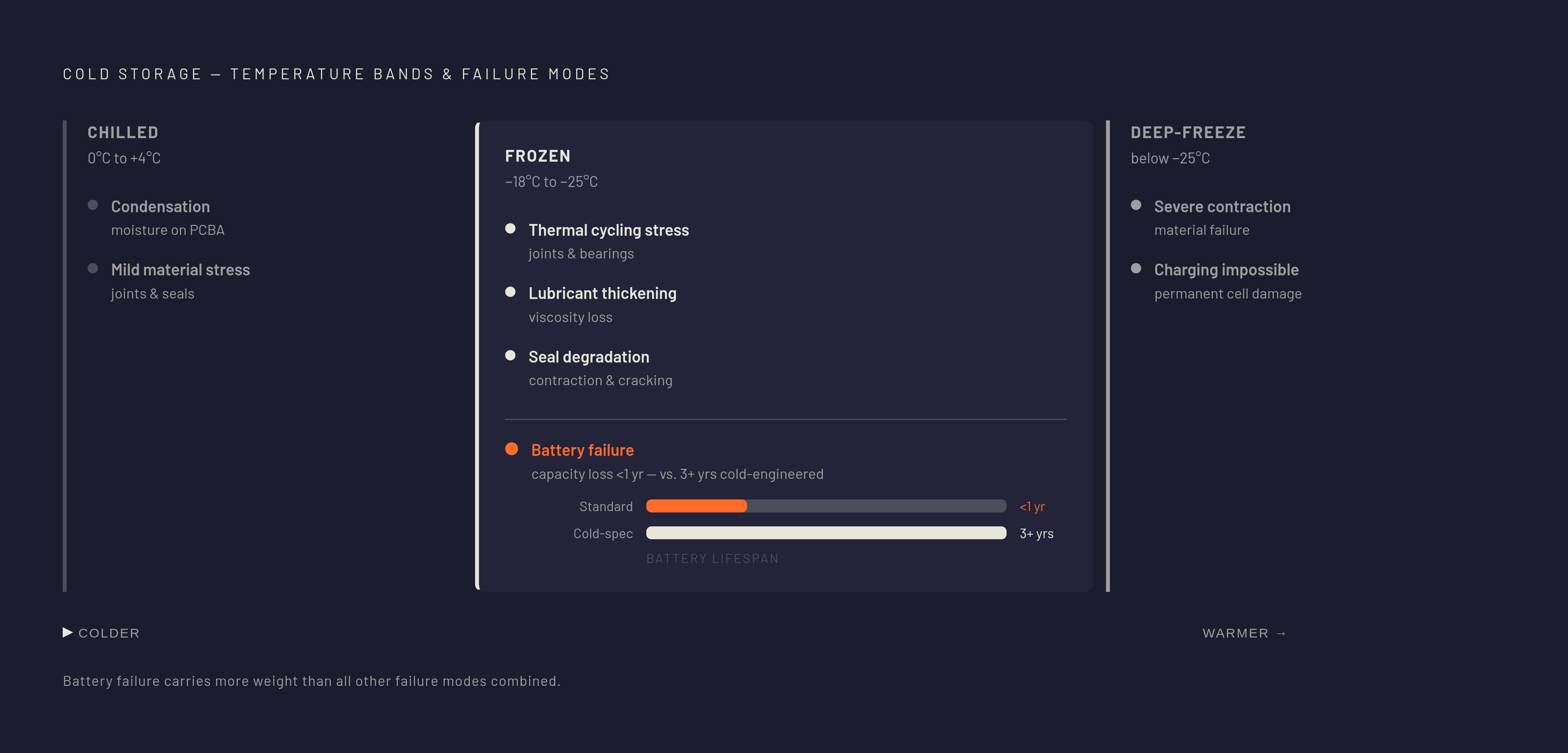
Cold storage is three environments. It's three, and each punishes equipment differently. Chilled storage, running 0°C to +4°C, brings condensation risk and mild material stress, the kind of thing a warehouse robot can mostly shrug off with minor spec changes. Frozen storage, at -18°C to -25°C, is the dominant commercial segment, and it's where battery chemistry, lubricant behavior, and seal integrity stop being footnotes and become the actual design brief. Below -25°C sits deep-freeze, the domain of pharmaceutical cold chain and specialist food storage, where material contraction turns severe and charging a battery at all becomes a genuine engineering problem.
Four failure modes recur in equipment that wasn't built for these bands. Thermal cycling makes metals contract at different rates, so joints and bearings have to tolerate repeated expansion and contraction without binding or working loose. Standard grease thickens and loses viscosity below freezing. Freezer-rated lubricant is therefore a distinct line item, not something ordered later as an afterthought. Electronics face moisture exposure whenever warm air meets cold air, which happens every time a door cycles or a technician walks in for maintenance, so PCBA conformal coating isn't optional. And batteries lose usable capacity as temperature drops, with a sharper risk behind it: charging a lithium cell below freezing can damage it permanently.
The battery point carries more weight than the other three combined. Facilities running standard batteries in sub-zero conditions typically see meaningful capacity loss within about a year. A battery actually engineered for the temperature band holds its rated capacity for three years or more. That's the gap between a fleet that needs replacing during its first winter and one that doesn't, and it appears directly in total cost of ownership. The reference point here is IEC 62619, the industrial lithium cell standard covering short-circuit, thermal-abuse, and mechanical-stress testing. Ask for the compliance documentation. A vendor's word that a battery is "cold-rated" is not a spec.
How the main shuttle architectures differ in cold-storage terms
Four shuttle architectures dominate the market, and picking among them by price alone is how buyers end up with the wrong one.
Two-way, or one-way lane, shuttles move only forward and back along a single lane, with no lateral movement. That's a real limitation, but it happens to fit cold storage with low SKU counts, high pallet volumes, and strict FIFO or LIFO workflows, which describes a lot of bulk frozen product. These systems are mechanically simple and cheap to enter with. Scaling is the catch, since adding throughput means adding shuttles and dedicating whole aisles to them, so the model stops making sense once an operation gets more complex than that.
Four-way shuttles travel in all four horizontal directions across a rack grid and switch aisles on their own, no separate transfer vehicle needed. In a freezer, that matters more than it sounds like it should. Every aisle in a cold warehouse is conditioned volume, and every forklift aisle is a channel for warm-air infiltration. Cut the aisle, cut the infiltration. Zikoo Robotics' R-bot is one example: 125 mm body height, rated load up to 1,500 kg in its Japanese Type variant, travel speed of 1.6 m/s empty and 1.2 m/s loaded, cold-chain configuration rated to -25°C on a low-temperature lithium battery good for 6 to 8 hours. Interlake Mecalux's 3D Automated Pallet Shuttle is a separate commercial take on the same four-way concept, designed for high-density pallet storage applications. This class suits multi-SKU operations where storage positions get reassigned as inventory mix shifts.
Six-way, or 3D, shuttle systems add a dedicated vertical bidirectional shuttle, sometimes called an H-bot, on top of the four-way horizontal movement. Zikoo Robotics' H-bot spec lists ±1 mm positioning accuracy, rated load up to 1,800 kg, and an operating range from -25°C to 45°C. Any pallet becomes reachable inside a fully three-dimensional network while other shuttles keep working elsewhere, with no aisle lockout. This is the most complex, most capital-intensive option in the family, and it earns its cost only when density and throughput needs outrun what a four-way-plus-lift setup can deliver. Zikoo Robotics has launched a six-way shuttle solution; buyers should confirm project-specific configuration and availability directly with the vendor.
Mother-child, or satellite, systems solve a different problem. A larger "mother" vehicle carries a smaller satellite into the storage channel, and the child runs deep into the racking under its own power. This fits operations with predictable volumes and low SKU counts, where the goal is precision and tight use of deep-lane space rather than dynamic reallocation. It's a mechanically distinct approach from four-way grid systems, and the right comparison point for anyone looking at deep-lane, single-temperature-zone storage specifically.
Where shuttle systems outperform stacker cranes in cold environments
Deep-freeze warehousing has defaulted to stacker cranes for decades, and that default made sense: cranes have a proven operating history in deep-freeze environments, and nobody got fired for choosing the established option. Modern shuttle systems can now be engineered for the same conditions, and where that's true, the crane is usually the wrong default, not the safe one.
Density is where shuttles win. A stacker crane needs a dedicated aisle to work in, full stop. A four-way shuttle system paired with elevators serves multiple levels and lanes off shared hardware, typically delivering 20 to 30% more storage positions in the same footprint. That's not a marginal gain in a building where every cubic meter of conditioned space costs money to refrigerate.
Energy tells a similar story, and the mechanical reason behind it is specific. Shuttle systems split horizontal and vertical movement: a lightweight shuttle handles the horizontal travel while a separate, optimized lift does the vertical work, so no single component hauls the other's full mass on every cycle. A stacker crane moves its entire structure on every lift, every time. Zikoo Robotics claims each shuttle operation uses roughly a tenth of the energy a stacker crane cycle requires. That's a vendor figure, not an independent one, and it belongs in a business case only after someone checks it against the specific site.
Redundancy is probably the difference that matters most day to day. If a stacker crane fails, the whole aisle it serves goes down with it. If one shuttle in a fleet fails, the rest keep working. In a freezer, where maintenance windows are short and getting a technician in means suiting up for sub-zero conditions, that gap separates a localized problem from a shutdown that costs a shift's worth of throughput.
None of that makes stacker cranes obsolete, and pretending otherwise would be dishonest. A single-temperature, high-volume, low-complexity operation may still benefit from a crane's mechanical simplicity and its long industry history. The decision is about matching the architecture to the operational profile. It is not about crowning a universal winner, because there isn't one.
The selection criteria that cold storage demands
Start with temperature range, and be exact about it, not approximate. Confirm the shuttle's rated operating temperature against the facility's actual design temperature, not an average reading, because pharmaceutical deep-freeze and food frozen storage call for genuinely different specs. Ask for IEC 62619 compliance documentation on the battery system. Don't accept a "cold-rated" label as a substitute for the paperwork.
Battery chemistry and charging design deserve their own round of questions. Confirm the battery is rated for continuous operation at the facility's minimum temperature. Check that charging ports are built for low-temperature conditions, so robots recharge in place instead of relocating to a warm zone every cycle. A system that forces warm-zone charging builds in a thermal transition point on every single cycle, and condensation risk and lost throughput occur at that transition point. Ask for documented capacity retention curves at actual operating temperature, over time.
Push back hard on condensation and materials specs, where buyers get sold on vague language. Ask for the actual PCBA conformal coating spec, in full. Freezer-rated lubricant is standard, included in the quote from the start. Verify seal and gasket materials are rated for repeated thermal cycling across the facility's full temperature delta.
Then there's the trade-off between storage density and retrieval speed, and it plays out differently depending on the operation. Deeper lanes store more pallets but need more shuttle travel to reach product at the back. In a FIFO-heavy frozen food operation, deep lanes suit bulk SKUs fine. In a high-mix pharmaceutical cold store, shallower lanes with faster access are often worth trading some density away for. Current and projected SKU counts should drive lane depth, even across two facilities running the exact same temperature range.
Realistic performance outcomes once a system is running
Cold storage automation earns its return on three fronts at once: density, throughput, and predictability. An ROI calculation that counts only labor savings will understate the real return, because it misses what happens to the refrigeration bill and the building footprint, which is often where the bigger number is hiding.
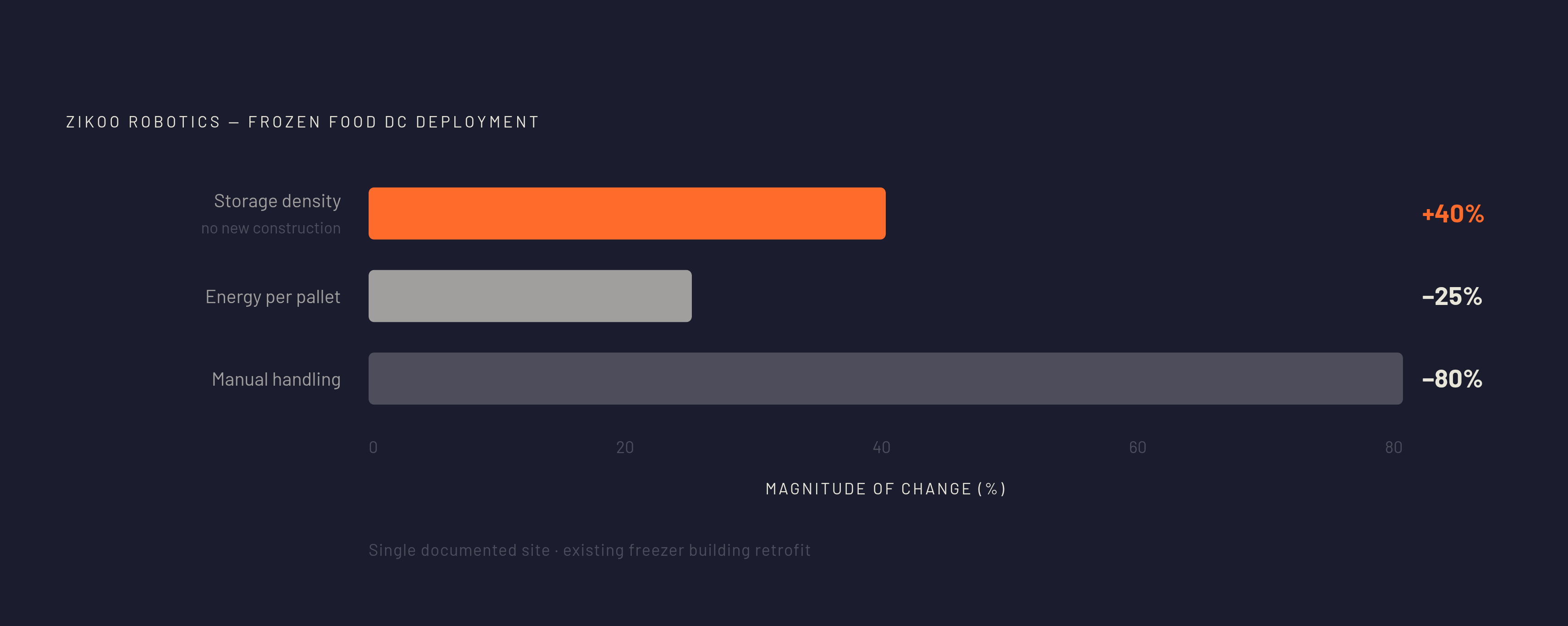
One documented case makes this concrete. A Zikoo Robotics deployment inside an existing freezer building, for a frozen food distributor, recorded 40% more storage density without expanding the building's footprint. Energy consumption per pallet stored dropped 25%, because the same refrigeration system now served more product inside the same conditioned volume, spreading the fixed cost of keeping that space cold across a larger inventory base. Manual handling in that deployment fell by 80%.
Numbers like that aren't a universal guarantee, and treating them as one would be a mistake. They describe one deployment, in one building, with one architecture. What they do establish is the shape of the return: density gains come without new construction, energy savings come from squeezing more out of refrigeration capacity that already exists, and labor reduction occurs alongside both rather than instead of either. That combination is the real case for shuttle automation in cold storage. It has to be made building by building, spec sheet by spec sheet, not lifted wholesale from a market growth chart.