Drone Inventory Scanning in Large Distribution Centers
Autonomous drones now scan warehouse shelves overnight, replacing error-prone manual counts.
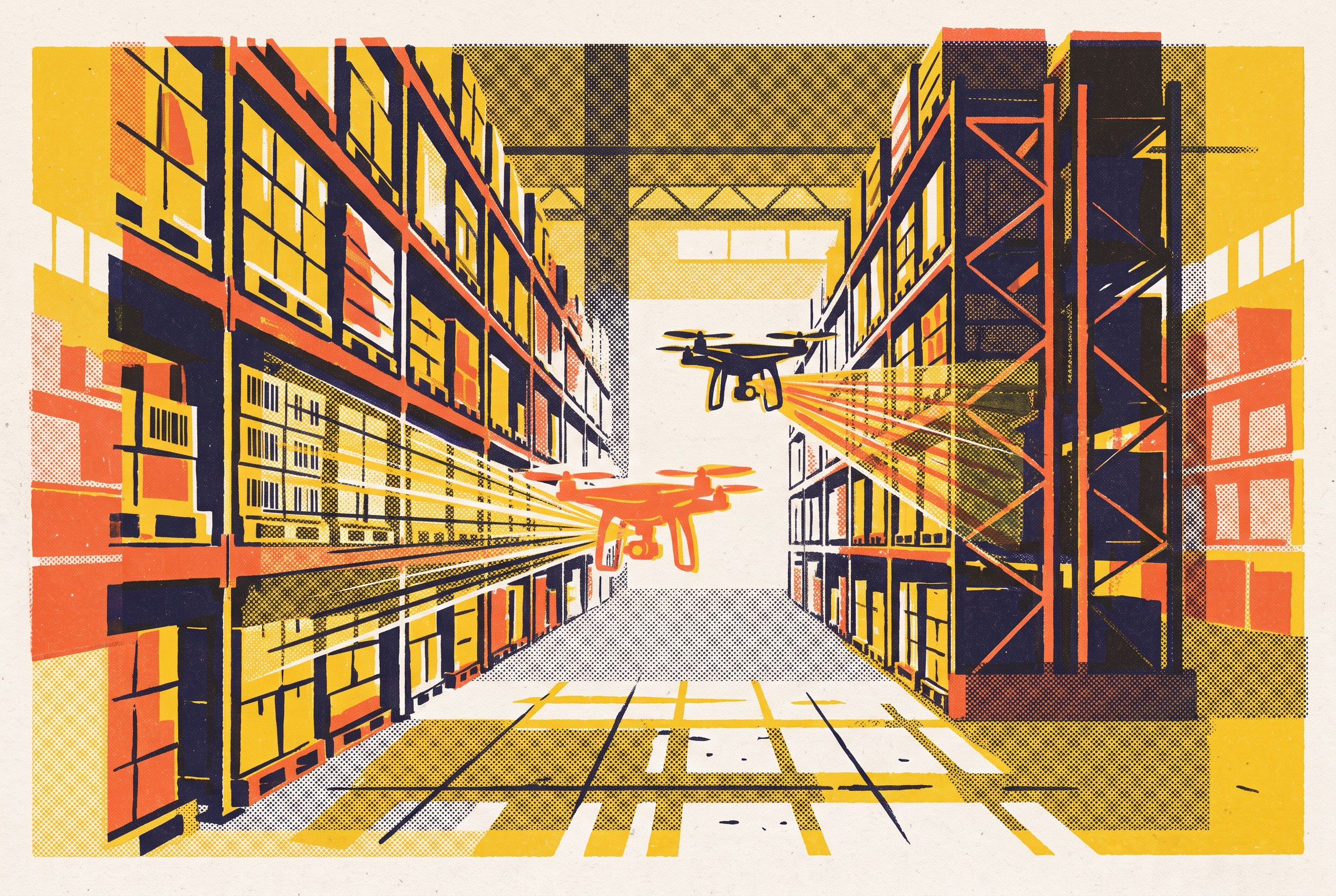
Manual cycle counting fails at distribution center scale because its errors compound as facilities grow, not merely because it runs slow. The method was built for smaller, discrete counting zones, and it buckles under the throughput demands of a modern distribution center, where tens of thousands of pallet locations, multi-level racking, and round-the-clock order fulfillment leave little room for a team walking aisles with handheld scanners.
Autonomous drones that scan barcodes, lot codes, and pallet occupancy, then reconcile the results against the warehouse management system (WMS), are now in production at companies including Dermalogica, GEODIS, GNC, Mondi, and Kroger. This post covers why manual counting breaks down, how drone scanning systems work, how overnight scanning changes the operating model, what early adopters have reported, how the technology performs in freezers, where its limits remain, and who is gaining access to it.
Why Manual Cycle Counting Breaks Down at Scale
A worker walking a facility aisle by aisle, scanning bins as they go, will miss locations at a consistent rate no matter how careful the process. Each miss doesn't just leave a gap. It forces a full recount of that zone, so the labor needed to close the gap multiplies rather than simply adding up. At Dermalogica's Carson, California distribution center, one dedicated cycle counter needed as long as two months to get through a single pass of the facility. By the time that counter finished, the earliest counts in the pass were already out of date, and the inventory picture stayed perpetually stale.
The physical demands compound the problem. At Mondi, workers used forklifts to lift two people at a time so they could scan inventory stored at height, a process that in some locations happened only once a year. That work needed overtime outside normal hours, and each time it happened, regular warehouse activity had to pause for safety clearances. At Scholl, annual financial-compliance checks forced a full warehouse shutdown. Every shipment stopped, order fulfillment slipped by several days, and staff had to count every pallet location by hand before operations could restart.
The real cost shows up downstream, at the pick face, where discrepancies finally surface. A missing product or a misplaced pallet goes unnoticed until someone needs that exact item to fill an order, and by then the options are an emergency search, a shipment delay, or a failed order. Dermalogica's Jason Brown described the pattern directly: "In the past, we would notice something was missing when we went to pick it, and it wasn't in the location. That would trigger a full search to find the product." The gap between one count and the next is long enough for the warehouse's actual contents to drift away from what the records say, and that drift is discovered when an order is already waiting.
What Drone Inventory Scanning Systems Do
Drone inventory scanning doesn't speed up the human walking pattern. It replaces that pattern with a different kind of data collection, one that runs continuously and needs none of the infrastructure a human counter depends on.
Navigation comes first, and it has to work without the aids most indoor robotics rely on. Corvus One uses embodied AI, computer vision, and a proprietary large-world model to move through GPS-denied warehouse environments without Wi-Fi, localization markers, or a human operator guiding it. Corvus Robotics enterprise sales director Tony Esquith said earlier generations of the technology couldn't do this.
Once the drone is moving through the facility, its machine vision reads barcodes, lot codes, expiration dates, case counts, damage, and how much of a pallet slot is occupied. The system then checks that read against the warehouse management system to find where the two disagree. Honeywell's SwiftDecoder barcode-decoding software, built into Corvus One as of March 2025, lets the system batch-scan, capturing many barcodes in a single pass rather than reading them one at a time. That capability makes counting at the case and pallet level fast enough for distribution center scale.
Gather AI takes a related but different approach: it builds on machine-vision work that came out of Carnegie Mellon University. Rather than photographing whatever happens to sit in the camera's path, the system uses Bayesian AI to actively seek the data it needs, such as barcodes, expiration dates, and anomalies. Anyline has shown that the scanning intelligence itself doesn't require purpose-built hardware: the company embedded its mobile data capture software into DJI Mini 3 Pro drones at Mondi's warehouses, running on commodity equipment rather than a custom platform.
The output is not a folder of photos for someone to review later. The system produces a daily inventory report that flags specific pallet locations, missing products, and misplaced stock, giving warehouse staff a short, prioritized list of items to check.
Why Overnight Scanning Changes Operations
Ryan Whitney, director of enterprise data at WinSupply, described the goal in concrete terms: drones counting product on shelves between 2 a.m. and 6 a.m., with the lights off, because "the drones can just do their thing and maneuver around" once no one else is in the building. Companies are building toward this target now.
The logic is structural. In a large, active distribution center, the only time a drone can move freely without crossing paths with forklift traffic, pick operations, or a worker's safety zone is when no one else is working. Off-hours counting is the only window where autonomous flight and normal warehouse operations don't compete for the same floor space. Dermalogica's Corvus One system runs its scans outside of active hours, imaging the warehouse 52 times a year without interrupting daytime fulfillment work.
That shift changes what cycle counting is. It stops being a discrete event, such as a shutdown, an overtime shift, or a dedicated counter working through aisles on a two-month cycle, and becomes a background process that runs every night. The inventory picture stays current because the scan never really stops.
That continuity depends on the drone's overnight data reaching the warehouse management system before the morning shift starts picking. Accurate overnight scan data accomplishes nothing if reconciliation into the WMS happens hours after the first picks of the day begin. The model only works end to end if the handoff from drone to system finishes before the day shift arrives.
Three Companies Replace Manual Counts With Drones
Three companies have put this model into production, and each found something different about speed, frequency, and what gets done with the time that is freed up.
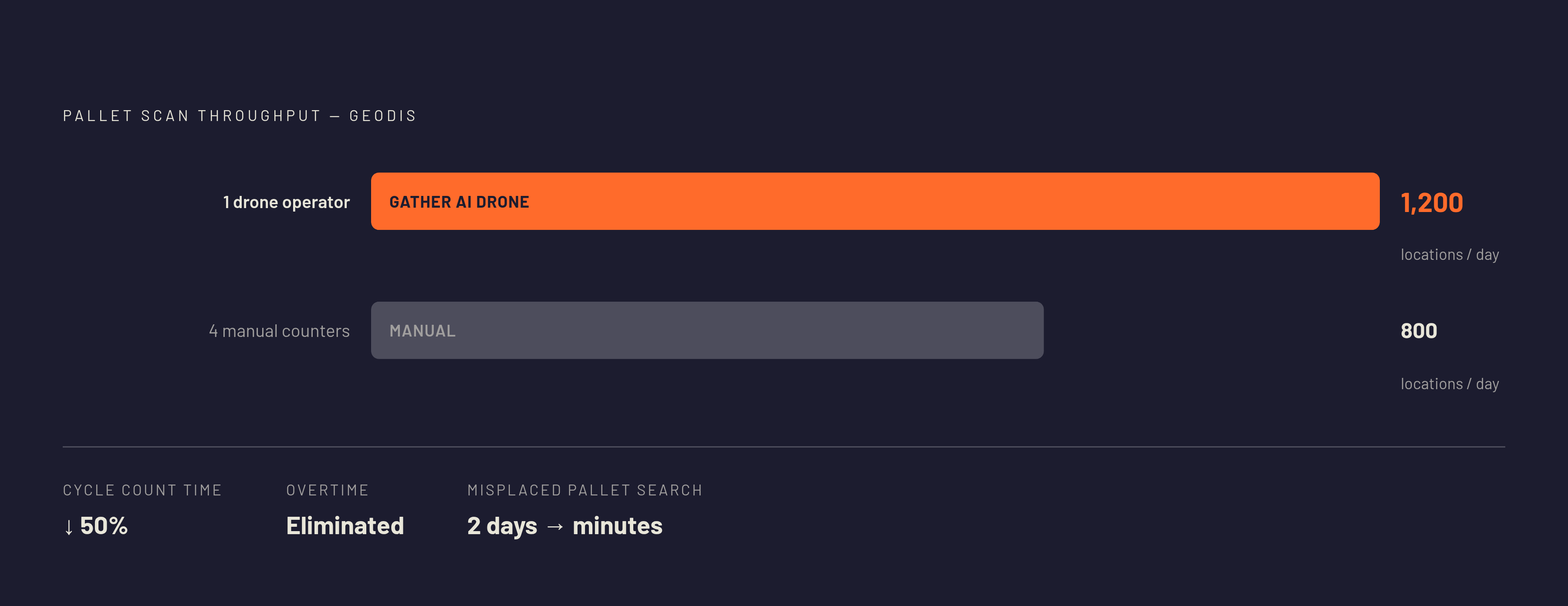
At GEODIS, a single drone operator working with Gather AI's system now completes 1,200 pallet location scans a day, more than the 800 that four manual counters managed combined. Cycle count time dropped by half, overtime disappeared from the schedule entirely, and misplaced pallet searches that used to take up to two days now take minutes. GNC had previously been limited to a handful of manual stocktaking cycles each year across its large distribution centers. After deploying Corvus Robotics' autonomous drones, with coverage beginning in April 2025, GNC now runs facility-wide cycle counts many more times a year than it did before.
What ties these cases together is what each company did with the labor hours the drones freed up. Dermalogica didn't cut its cycle counter's role. It redirected that person to spend roughly three quarters of their time on other work, since the drone had absorbed the counting itself. The case for drone scanning at this scale rests as much on what it lets workers do instead as on the hours it saves.
Brown described the change in the counter's daily task directly: "We now have a concise list of items to verify rather than randomly going out and starting to count." The job stopped being about discovery and became about verification, confirming what the drone had already flagged. Corvus Robotics CEO Jackie Wu described the stakes: "Retailers and brands operating global distribution networks cannot afford blind spots." The companies selling this technology pitch inventory visibility as infrastructure that runs continuously, like a security or fire suppression system.
A worker walking a facility aisle by aisle, scanning bins as they go, will miss locations at a consistent rate no matter how careful the process.
Drones Now Work in Freezer Environments
Sub-freezing storage has long been treated as a condition that rules out autonomous drones, and Kroger's deployment is the first confirmed production case that says otherwise. Kroger put Corvus One for Cold Chain drones into its ambient and sub-freezing distribution operations, where the system autonomously scans pallet locations across freezer zones and gives the company weekly inventory visibility across the facility.
The Corvus One for Cold Chain variant runs in freezer environments down to minus-20 degrees Fahrenheit, and it does so without Wi-Fi, localization markers, lighting changes, special barcodes, or a human operator standing by. That matters most for safety: manual counting in sub-freezing zones carries real physiological risk for the people doing it, and removing the need for associates to perform those counts eliminates that risk rather than just reducing it.
The accuracy case in cold chain carries a cost dimension that ambient warehouses don't have in the same way. The Kroger deployment supports FIFO compliance and shrink control for goods with short shelf lives, and in these categories an inventory error means product that spoils before anyone catches the mistake. Corvus Robotics confirmed that Kroger's rollout has moved from initial validation into operational deployment across multiple phases, which points to a production system rather than a pilot, but the company hasn't said how many facilities run it or how large the drone fleet is at each site.
The implication reaches well past Kroger's own operations. If a drone can scan reliably at minus-20 Fahrenheit, fewer environments are too harsh for this technology. Food distribution centers, pharmaceutical cold chains, and refrigerated third-party logistics operators no longer have to rule the technology out over the environment before evaluating it.
Where Drone Scanning Still Falls Short
The real limits on drone scanning today are geometry and data integration, and an operator who overlooks them will deploy into conditions where the system underperforms.
Current systems read the pick face, the visible front of a pallet or bin, and that works well if storage is single-deep. It works less well where items sit stacked at different heights or hidden behind other stock, since the drone's camera can't see into multi-deep racking the way it can see a single exposed row. That is a geometric limit, not a processing one, and better AI doesn't change what the camera can physically see.
Label integrity is the other hard constraint. A damaged barcode or an RFID signal bouncing off a metal rack produces a scan the system can't resolve, because the read is only as good as the label underneath it. A facility with disorganized or outdated labeling will see lower accuracy, and current technology can't compensate for a label it cannot read.
Battery life sets a practical ceiling too. Most drones can only fly for a limited window before they need to recharge, so in a large facility with heavy inventory volume, one flight won't cover the whole floor. Covering it requires several automatic charging stations or multiple drones flying at once, and either way you add equipment cost and operational complexity on top of the base system.
The data pipeline matters as well. If the drone's output doesn't feed directly into the WMS or ERP in real time, drone scanning gives you little value. A deployment that collects accurate scans but reconciles them by hand, or with a lag, recreates the staleness problem manual counting created. Turning raw scans into layout recommendations, congestion analysis, or a digital twin of the facility takes an analytics pipeline that sits on top of the drone hardware, and an operator evaluating only the scanning capability can easily underestimate what that pipeline costs to build.
Taken together, these limits describe a clear boundary. Current drone scanning technology is built for well-organized, well-labeled, single-deep facilities. Brownfield distribution centers run legacy rack configurations and inconsistent labeling, so they face a steeper integration climb than a greenfield facility built with this technology in mind from the start.
Access Is Expanding Beyond Enterprise Pilots
Access to drone scanning is widening past the large enterprise deployments that have defined the category so far, through distribution partnerships, new venture funding, and regional build-out decisions that bypass older deployment models.
Gather AI's first dealer partnership, with Burwell Material Handling, will put its drone-based and camera-based inventory systems in front of customers across 20 brick-and-mortar centers in the United States. That is a shift from direct enterprise sales toward channel distribution, a path that reaches mid-market operators who were never going to be the first call for a direct enterprise sales team. Gather AI backed that move with a substantial Series B, led by Smith Point Capital and involving former Salesforce co-CEO Keith Block, which brought the company's total funding up to tens of millions of dollars. Confirmed enterprise customers at the close of that round include Kwik Trip, Axon, GEODIS, and NFI Industries.
Future Market Insights points to Asia-Pacific as the fastest-growing region for this technology, and the reason has less to do with demand than with how facilities get built there. Buyers in the region are skipping ground-based intermediate scanning systems and building new logistics hubs designed from the start for robotic integration. Western markets contrast with this: brownfield retrofit, adding this technology to facilities built decades before it existed, still dominates there.
HTF Market Intelligence values the drone inventory scan market at approximately $1.25 billion in 2024, with North America the largest market today and Asia-Pacific the fastest-growing. The competitive field spans purpose-built autonomous platforms such as Corvus Robotics, Gather AI, and Verity; software specialists like Anyline, which runs on commodity hardware such as the DJI Mini 3 Pro drones deployed at Mondi; and established industrial automation players such as Honeywell, whose SwiftDecoder software now runs inside Corvus One. That range of entry points, whether a purpose-built platform, a software layer on commodity hardware, or an established automation vendor, gives operators several ways into the technology rather than a single enterprise price point.
Sources
- Autonomous warehouse drones streamline inventory control
Supplied the WinSupply account of drones counting shelves overnight with the lights off.
- Why warehouses are hiring drones instead of inventory counters
Provided the Dermalogica details, including the two-month manual count, 52 scans a year and the Jason Brown and Jackie Wu quotes.
- Honeywell Software to Power Corvus Robotics Drones to Automate Inventory Tracking in Warehouses
Described the Honeywell SwiftDecoder integration into Corvus One and its batch barcode scanning.
- Drone Inventory Scan Market Booming on Development Activities
Supplied the market size estimate and regional growth picture.
- Autonomous Industrial Inventory-Tracking Drone Market Size, Share & Forecast to 2036
Supported the Asia-Pacific growth and greenfield versus brownfield discussion.
- Gather AI
Provided the GEODIS throughput comparison of 1,200 scans versus 800 for four counters.
- Autonomous Warehouse Inventory Drones
Described the cold chain drone's operation down to minus 20 °F without Wi-Fi or markers.
- Kroger taps inventory drones for cold chain distribution operations
Covered Kroger's deployment of cold chain drones across ambient and freezer operations.