Robotic Sortation Systems for E-Commerce Fulfillment
Smaller packages and volatile demand are making robots a better fit than fixed conveyor lines.

Advertisement
Fixed conveyor sortation was built for a world of pallets moving in bulk to a handful of destinations. E-commerce runs on the opposite pattern: fragmented, high-mix, small-order flows that never repeat the same way twice. That mismatch, not any single equipment failure, is why warehouses are replacing belts and trays with mobile robots.
The clearest evidence sits in the load unit itself. Totes are steadily taking over from pallets as the main handling and storage container in intralogistics, according to research out of Tsinghua University's Shenzhen International Graduate School. Warehouses need finer-grained units to process demand that arrives one order at a time rather than one truckload at a time.
Parcels themselves have gotten smaller and lighter, too. UPS's own figures show domestic package weight fell 30% between 2012 and 2022, and Cainiao estimated that most of its 2023 Singles-Day parcels weighed under 2 kg. Warehouses are sorting far more individual units instead of heavier freight, each one lighter than the last generation of equipment was designed around.
Fixed sorters, cross-belt, tilt-tray, sliding shoe, were engineered around a defined throughput ceiling and a permanent physical footprint. Reconfiguring one for a new flow pattern or a seasonal spike means tearing out steel and rebuilding, not pushing a software update. That rigidity is expensive on its own, but it becomes untenable once demand volatility is the norm rather than the exception.
Labor was supposed to be the backstop that let older infrastructure limp along, but it isn't holding. The MHI 2025 Annual Industry Report ranks talent shortages and hiring difficulty as the top internal supply chain challenges, cited by large shares of companies, and warehouse turnover means backfilling open roles has become a permanent line item rather than a seasonal headache. A sortation model that assumes an elastic, available workforce doesn't hold up when that workforce is the scarcest input in the building.
What a robotic sortation system does, step by step
Strip away the branding: every sortation system, robotic or mechanical, performs the same four functions in sequence, identify, convey, divert, and organize. What separates a robotic system from a belt is that reprogrammable mobile agents carry out those functions instead of fixed mechanical diverters bolted to one spot on the line.
Identification happens first, at induction. Barcode scanners, RFID readers, and sensors read each item as it enters the system, and AI-powered vision, deployed by vendors including Siemens, Honeywell Intelligrated, Dematic, and Körber, now recognizes parcels automatically even when size, shape, label placement, or packaging condition varies widely. That automatic recognition matters because e-commerce parcels rarely arrive in uniform boxes the way retail cartons once did.
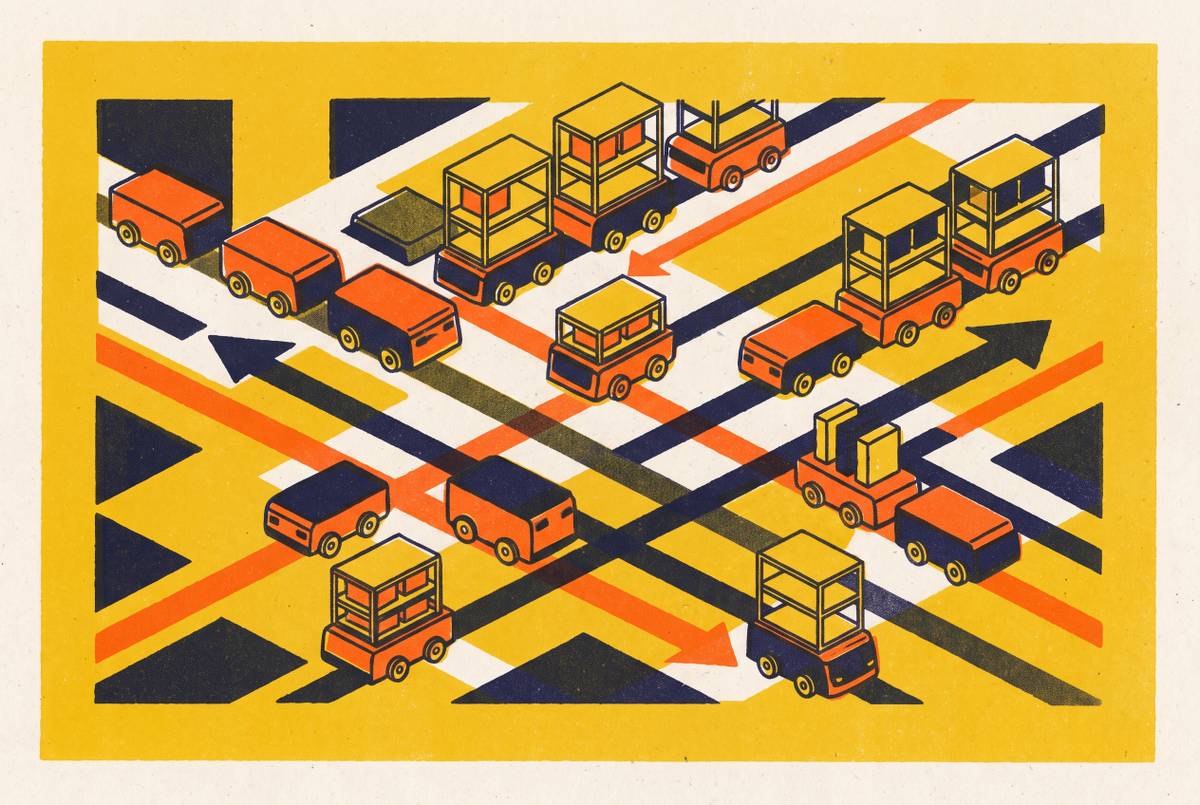
Conveyance and diversion look mechanically different once robots enter the picture. In a grid-based robotic sorting system, robots move across a virtual grid of non-overlapping cells between pick-up workstations and drop-off points, each robot carrying one parcel at a time. The controller has to solve assignment, deciding which robot handles which parcel and which workstation receives it, and path-finding, routing every robot across the grid without a collision, simultaneously, creating a genuinely hard computational problem behind that simple movement, as UC Berkeley research on RSS operations shows.
Coordination extends beyond a single robot's route. Amazon's patented sortation architecture illustrates a logistics management system that orchestrates robot-to-robot handoffs at intermediate locations determined dynamically as the system runs, chaining transfers together in ways a fixed belt physically cannot replicate.
Sorted items finally land at destination lanes or drop-off chutes mapped to delivery routes, order batches, or downstream packing stations. The last stop is where the abstraction of "sortation" becomes something a warehouse worker can pick up and pack.
The software controlling assignment and path-finding makes all of it work. Assignment and path-finding are NP-hard at scale, so the difficulty grows sharply as the fleet grows, and that computational reality is why AI and multi-agent reinforcement learning have become central to how these systems perform, not a feature added for the sales deck.
The main system types
No architecture wins on every dimension. Each one trades throughput ceiling, flexibility, item compatibility, and upfront cost against the others, and the right choice depends on what a given operation actually moves.
Fixed mechanical sorters, cross-belt, tilt-tray, sliding shoe, pop-up, still hold the highest throughput ceiling of any sorter type, which keeps them the right call for parcel hubs pushing enormous, relatively uniform volumes. Their limitation is baked in at installation: footprint, capacity, and routing topology don't move once the concrete is poured. Vendors including Honeywell Intelligrated, Dematic, and Körber are augmenting these fixed systems with AI orchestration layers rather than replacing them outright, using software to sharpen routing accuracy and cut manual intervention. Honeywell's IntelliSort Irregulars Sorter, introduced in April 2026, extends this category to handle non-conveyable parcels, items that defeat traditional belt and tray sorters, and is paired with the Intelligrated Momentum Core warehouse software platform, selling software and sortation as a combined stack.
Grid-based robotic sorting systems have become the most common AMR-based sortation architecture, built around robots navigating a grid of cells between induct workstations and drop-off points. Capacity scales by adding robots, workstations, or drop-off points, with no structural rebuild required, which is the direct answer to the rigidity that defines fixed sorters. That scalability only pays off if the software solves assignment and path-finding well: UC Berkeley research found that integrated flow-based assignment paired with path-finding produces meaningfully higher throughput than zoning or random assignment methods. Trew's TrewSort Swivel Wheel Sorter, which debuted at MODEX 2026, extends the category with an electric mid-rate offering built for operations that need flexibility without paying for a top-tier fixed system. CMES Robotics and Engineering Innovation showed a joint AI vision piece-picking and parcel sorting system at the same event, an example of vision-guided robotics getting built directly into sortation rather than bolted on as a separate subsystem.
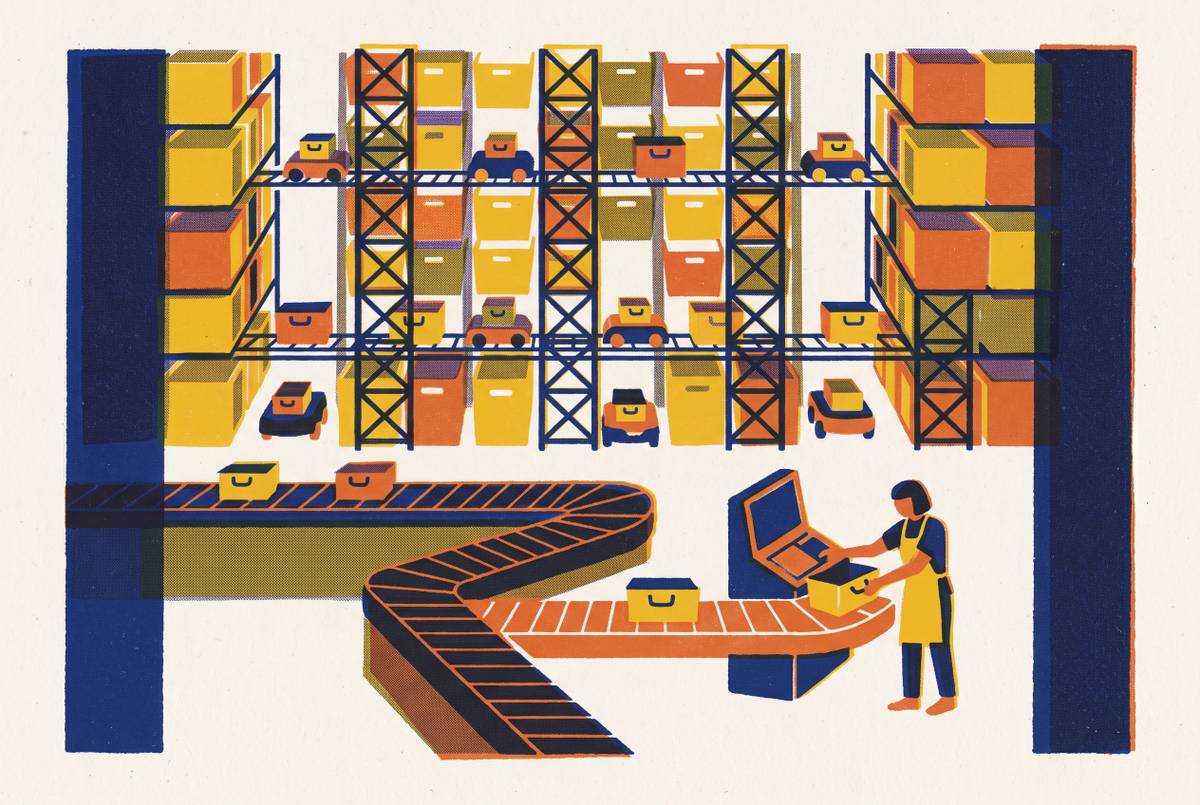
Tote-handling robotic systems, the goods-to-person and grid storage category, have become the dominant architecture in automated order fulfillment centers as of the 2026 Tsinghua University research, and they're built around the tote as the core unit rather than the parcel or the pallet. A typical setup pairs a tote storage area with tote-handling robots and stationary picking workstations: robots bring totes to people instead of routing packages to lanes. Decision-making runs across three layers that have to interact in real time, order assignment to workstations, tote-to-robot matching, and robot path planning. Brightpick's Gridpicker, launched at LogiMAT 2026 on March 24, 2026, adds AI-powered mobile manipulators on top of that transport layer, showing the category picking up autonomous picking capability alongside its existing job of moving totes. Ocado's Customer Fulfillment Centers remain the most cited large-scale proof point: hundreds of robots per facility running on grid systems, AI handling path optimization and collision avoidance, machine learning forecasting demand for inventory placement, and the result is 99.9% order accuracy across tens of thousands of orders per week at a single facility.
Shuttle-based AS/RS with integrated sortation combines high-density storage with automated retrieval, which suits dense SKU profiles such as grocery, where a huge assortment has to come off the shelf fast and get sorted to order. Dematic's June 2026 deployment at Pattison Food Group's grocery fulfillment center in Langley, British Columbia, running RapidPick alongside a Multishuttle system, is the clearest recent proof point for this architecture inside grocery distribution.
Cold-storage-rated mobile shuttles are the newest and smallest category here. LG CNS released its Mobile Shuttle in August 2026, an intralogistics platform rated to run at -15°F, opening frozen and refrigerated environments to AMR-based sortation that standard robotics couldn't previously enter. It's an emerging niche rather than an established deployment pattern, but it closes a gap that every other architecture on this list leaves open.
How orchestration software affects whether hardware investments pay off
Buying robots doesn't buy throughput. The hardware sets a ceiling; the software decides how close the fleet actually gets to it. Assignment and path-finding stay computationally hard no matter how many robots a warehouse owns, and the algorithm chosen to solve them carries direct consequences: UC Berkeley research found that the gap between system-optimal routing and simpler user-equilibrium routing can translate into a meaningful throughput difference in large RSS deployments.
The order-fulfillment layer adds another decision problem on top of routing. Tsinghua University's OLSF-TRS research, published in 2025, describes a unified framework that combines structured combinatorial optimization with multi-agent reinforcement learning to coordinate order, tote, and robot decisions across different hardware setups. On large, high-concurrency systems, that framework cuts total tote movements by more than 30% compared with rule-based approaches. That's a significant efficiency gain: the difference between a system that scales gracefully under peak load and one that grinds down.
Vendors have noticed. Honeywell's April 2026 launch of Intelligrated Momentum Core pairs its own hardware with a software platform explicitly because selling sortation equipment without the orchestration layer to run it has stopped being a viable business. The industry is converging on warehouse execution systems and warehouse management systems as the actual integration point where hardware investments either pay off or don't. The July 2026 consolidation of Intelligrated, Trew, and Transnorm into a single warehouse automation organization under American Industrial Partners signals that the market is moving toward integrated hardware-software providers, not component vendors.
Software is also creeping into tasks that used to require a human eye. Ambi Robotics' AmbiVision, released in March 2026, uses five AI skills, measurement, tracking, reading, inspection, and quality control, to handle item identification work that once slowed throughput or needed a person standing at the line. Operations leaders who evaluate robotic sortation on robots-per-hour and grid dimensions alone are measuring the wrong thing. The orchestration layer is where flexibility, adaptability, and continuous performance improvement actually happen.
Where robotic sortation works in actual deployments
Vendor pitches tend to imply universality. Deployment data tells a narrower story. Full robotic sortation performs best in high-volume, low-variability operations, and the Intralogistics Robotics Survey from MMH found that most deployments meet or exceed their stated business objectives, though satisfaction on cost and time-to-value comes with more caveats.
Even Amazon, running the largest robotic fleet in the industry, treats robots as a complement to people rather than a replacement for them. The company's fulfillment network posted its fastest delivery year on record in 2025 by adding more robots alongside its human workforce, and its next-generation Proteus mobile robotics, shown operating in live UK fulfillment centers in June 2026, still runs as a human-robot collaboration rather than a fully autonomous operation.
Ocado sits at the other end of that spectrum. Its model substitutes robots for human labor explicitly, and it delivers exceptional throughput numbers because of that choice. It has also drawn criticism over workforce displacement, and it carries a different kind of operational risk: leaning entirely on one integrated architecture leaves less room to absorb disruption if any single layer of that system falters. Neither model is simply right or wrong. Each represents a real trade-off between throughput and workforce impact that buyers need to weigh against their own operational priorities and public commitments.
Physical constraints, not budget, turn out to be the biggest obstacle for most operations. The 2026 Intralogistics Robotics Survey found that warehouse physical constraints rank as the most commonly cited barrier, ahead of labor costs and operating costs running above expectations. For a lot of warehouses, the building itself, ceiling height, column spacing, floor flatness, limits what robotic sortation can do long before the price tag does.
Sortation ranks low as a stated pain point, yet it's among the top categories operations plan to invest in, with order and case picking alone leading planned investment at 57%, and that gap suggests some of this adoption is vendor-driven rather than pulled by an acute, diagnosed bottleneck. Buyers who haven't identified their own constraint before shopping for robots risk buying a solution to a problem they don't actually have.
Mid-market operators face a narrower version of the same struggle: access. Systems like AS/RS and high-end sortation demand serious upfront spending on equipment, software, and facility modification, and smaller operations have been slow to adopt largely because that capital bar sits out of reach. AMC Robotics' plan to bring its NovaArm warehouse sorting robot to market in the second half of 2026 is one concrete sign the industry is starting to build cost-scaled, flexible alternatives aimed squarely at that gap.
Subscription-Based Service Models and the Cost Calculus for Smaller Operations
The capital barrier that has kept mid-market warehouses out of robotic sortation is narrowing, and the mechanism behind that shift is subscription pricing. RaaS subscription models are structurally changing who can afford robotic sortation: monthly pricing for robotic picking systems starts under $3,000 per month as of 2026, putting automation within reach for smaller operations.
Robotics-as-a-Service converts a large capital expense into an operating expense, shifts facility-modification risk away from the buyer, and ties the vendor's own incentives to keeping the system running, a fundamentally different commercial relationship than a traditional systems-integration contract. It's a meaningful shift in who can afford this equipment, not yet the industry's dominant commercial model.
New entrants are chasing that cost gap on purpose. AMC Robotics' NovaArm, aiming for commercial availability in the second quarter of 2026, targets mid-market sortation use cases where fixed conveyor infrastructure has always priced smaller operators out. MotionTech's September 2026 move from Europe into the North American market gives buyers outside the tier-one integrator ecosystem another option to evaluate.
Consolidation at the top of the market cuts both ways here. Intelligrated, Trew, and Transnorm merging in August 2026 builds one large, integrated provider, but it also opens space for smaller, faster-moving vendors to compete on flexibility and price in the mid-market. Avatar Robotics' seed round, raised in August 2026 to build industrial infrastructure that blends robotics, remote human operators, and AI-driven autonomy, points toward hybrid human-robot models that could lower the deployment risk for operations not ready to commit to full automation.
Matching System Type to Volume, Mix, and Growth Trajectory
Start with what actually moves through the building, not with what a vendor demo makes look impressive. An operation running high-volume, low-SKU-variability parcel flow, a regional hub pushing uniform boxes to a handful of downstream carriers, still gets the best economics from a fixed mechanical sorter, especially now that AI orchestration layers from vendors like Honeywell Intelligrated, Dematic, and Körber are narrowing the flexibility gap that used to be fixed sortation's biggest weakness.
An operation with fragmented, high-mix order flow, the profile that defines e-commerce, fits a grid-based robotic sorting system better, because capacity scales by adding robots and workstations rather than pouring new concrete. Growth trajectory matters as much as current volume here: a system that scales incrementally protects against both under-building for next year's peak and over-building for a demand curve that never materializes.
Operations centered on piece-level fulfillment, especially anyone running goods-to-person picking, should be evaluating tote-handling robotic systems, the architecture dominant in automated fulfillment centers as of the Tsinghua University research. Grocery and other dense-SKU distribution, where a huge assortment needs to come off the shelf fast, points toward shuttle-based AS/RS, the architecture Dematic proved out at Pattison Food Group's Langley facility. Frozen and refrigerated distribution is the one segment where cold-rated mobile shuttles like LG CNS's Mobile Shuttle now open a door that didn't exist before.
Smaller operations shouldn't treat capital cost as a permanent barrier. RaaS pricing under $3,000 a month and new mid-market entrants like AMC Robotics' NovaArm have genuinely changed what's financially reachable, even if the fit still needs checking against actual volume and mix before signing anything. Whatever the final choice, the physical building deserves as much scrutiny as the hardware spec sheet: warehouse constraints, not price tags, are what most commonly stop robotic sortation projects from delivering what they promised.