AMR vs AGV Navigation in High-Density Warehouses
Crowded aisles expose different failure points in AMRs and AGVs.
AMR vs AGV Navigation in High-Density Warehouses.
Navigation architecture is the real throughput constraint in high-density warehouses
In a high-density warehouse, the navigation architecture affects throughput because congested aisles that make AMR adaptability appealing can also expose it to self-generated gridlock when multiple robots reroute simultaneously. That's a specific kind of physics, not just a bigger version of an open floor plan.
It matters because navigation sits directly on top of the most expensive part of warehouse work.
AMR adaptability and AGV predictability each carry their own density-specific failure modes. Picking between them isn't a choice between an outdated technology and a modern one, it's a choice between two different risk profiles, and each one only shows its true colors once the aisles get crowded. This piece stays focused on that pressure point, navigation behavior under real density, rather than open-floor benchmarks or total cost of ownership taken in isolation. The common framing (AMR good because flexible, AGV good because predictable) obscures what actually happens when robot density rises. Order picking constitutes 50%–65% of operational costs, and the WareRover paper (arXiv 2602.13999) shows navigation inefficiency in dense conditions hits the single largest cost bucket directly arxiv (WareRover paper).
AGV and AMR navigation architecture and its commitments
AGVs follow a fixed physical guide, whether that's magnetic tape, embedded wire, an optical rail, or QR code markers on the floor. When something blocks that path, the vehicle doesn't think its way around the problem. It stops and waits. That's not a software limitation so much as a design decision baked into the concept from the start: the automated guided vehicle traces back to 1950s factory and warehouse floors, and fifty-odd years of refinement made lane-bound pallet flow smoother without ever asking the vehicle to replan on the fly. The path lives in the floor itself, not in code, so changing it means physical downtime, ripping up tape or rerouting wire, not a quick software update.
AMRs work from a different premise. The current generation, largely a post-2015 development, runs on natural-feature SLAM (simultaneous localization and mapping), where the robot builds its own map of the building from onboard LiDAR and vision sensors and updates that map continuously. When the floor changes, a pallet gets dropped, a cart gets left in the wrong spot, the robot replans its route in milliseconds.
LiDAR delivers millimeter-level precision, often under 10mm for systems mapping natural contours, and it holds up well across different lighting conditions, though the hardware costs more upfront and can lose accuracy near glass or other reflective surfaces Warehouse Automation fdatabot.com. Vision-based systems cost less to deploy and can read semantic cues, signage, pallet positions, the general shape of an obstacle, but they can struggle in poor lighting or under strong reflections, and they need a fair amount of onboard compute to keep up Warehouse Automation fdatabot.com.
Strip away the sensor talk and the real divide is about where the intelligence sits. On an AGV, the path logic lives in the infrastructure, tape on the floor, wire in the slab. On an AMR, it lives in onboard compute and fleet software. That single distinction is what decides which one breaks first once the aisles fill up with robots. lips-hci.com notes an emerging direction that combines 3D stereo vision with AI and VSLAM to capture contextual information (colors, shapes, signs), enabling more advanced decision-making than LiDAR point clouds alone.
What high-density conditions do to each navigation model
High density isn't just "a big warehouse." It means vertical storage reaching up several stories, aisles narrow enough that two vehicles can't pass, and enough simultaneous demand that the same corridor gets requested by multiple robots at once.
Under those conditions, AGVs actually hold some real advantages. Lane-bound, predictable flow gives consistent cycle times, and because the vehicles aren't negotiating over shared space, there's no overhead lost to path arbitration. Very Narrow Aisle (VNA) AGVs are often the only automated option that can physically fit into the tight spaces high-density racking demands. At MODEX 2026, Multiway Robotics showed off a VNA AGV rated for 16.5-meter lift heights, 1.75-meter aisle widths, and 8,000-kilogram loads, a demonstration of just how far the fixed-path form factor has been pushed toward extreme density AGV Network PW Consulting.
The catch is what happens the moment something goes wrong. An AGV can't reroute around an obstruction, so a single dropped pallet or stalled vehicle halts the machine in place and backs up everything queued behind it. And as density rises, engineers face a harder physical problem too: cramming enough motors, sensors, power, and compute into a smaller footprint without sacrificing reliability gets genuinely difficult.
AMRs flip that risk profile. A blocked aisle triggers a reroute instead of a full stop, there's no floor prep required to deploy them, and commissioning runs in weeks rather than months. But that adaptability has a ceiling. In genuinely tight spaces where there's no clear alternate path, an AMR can struggle just as much as an AGV, just for a different reason, there's simply nowhere else to go. And when routing isn't managed carefully inside busy aisles, autonomous rerouting itself can create bottlenecks nobody planned for.
The AMR congestion paradox: when dynamic rerouting generates the problem it is meant to solve
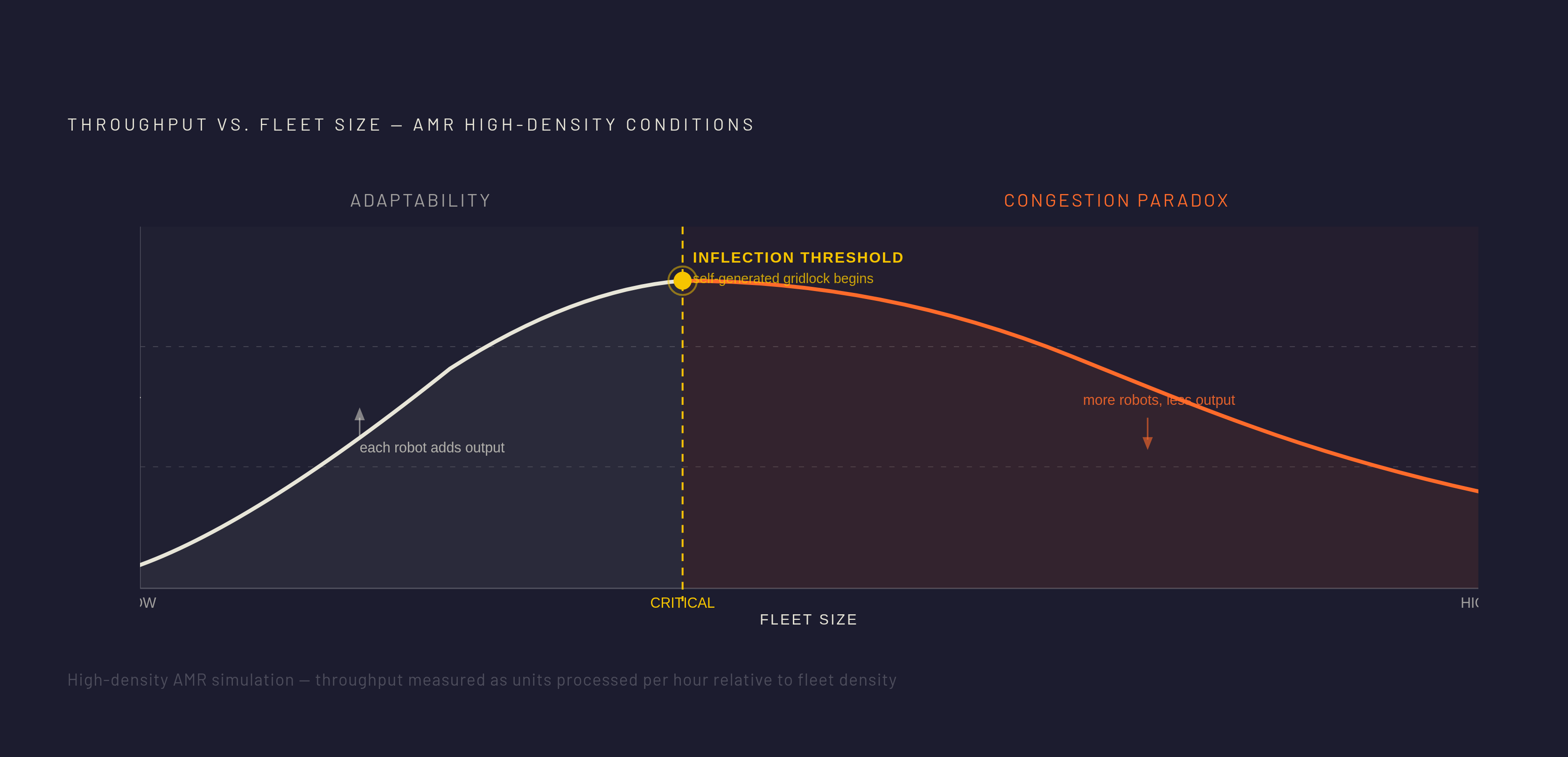
Here's the finding that should give any operations manager pause: in dense, high-volume environments, adding more AMRs to the fleet doesn't reliably produce more throughput. Past a certain fleet size, more robots can mean more congestion, longer wait times, and traffic management that gets harder to reason about, actually dragging efficiency down rather than lifting it.
The mechanism is straightforward once you see it: when several robots independently decide to alter course at the same moment, in the same shared space, they can jam each other up and choke system-wide throughput exactly when the fleet needed to be moving fastest. TGW Group frames this bluntly: letting each vehicle choose its own path is fine at low volume, but at peak throughput that same self-determination becomes a liability, because traffic becomes inevitable, and with it comes a real risk of congestion and handling incidents right when the operation can least afford them.
What follows from that is a strange kind of convergence. Once an operator starts imposing fixed corridors, restricted zones, and prioritized routing sequences on an AMR fleet to keep throughput under control, those restrictions start to look a lot like the very constraints that limit an AGV's freedom of movement in the first place. The gap between the two technologies narrows considerably once density forces both toward some version of managed, rule-bound movement.
At fleet scale, AMR flexibility is a property of the fleet management system governing how all those robots make decisions together. It's a property of the fleet management system governing how all those robots make decisions together. A single AMR navigating an empty aisle is flexible by design. AMR "flexibility" in a high-density fleet is a fleet-management property, not a per-robot property, it depends entirely on how well the orchestration layer governs simultaneous decisions. The technical name for the problem of coordinating that many independent agents without collision or gridlock is Multi-Agent Pathfinding, or MAPF, and it's the subject the rest of this piece has to reckon with.
Multi-Agent Pathfinding: the coordination layer that determines whether density is manageable
That's a meaningful gain, but it only appears when the coordination layer actually works, and the research suggests that's harder than it sounds.
The WareRover paper argues that treating order scheduling and multi-agent pathfinding as isolated sub-problems is a fundamental bottleneck, masking critical dependencies between high-level dispatching and low-level congestion. Real deployments layer on complications that clean theoretical MAPF models tend to wave away: fleets made up of different robot types with different turning radii and speeds, occasional AGV failures, communication lag between robots and the central system, and the need to replan constantly in continuous time rather than in tidy discrete steps.
The paper states that part of the problem is that the tools available to study this haven't matched the complexity of the real thing. No platform bridged that gap before WareRover set out to build one. And the paper's central finding backs up the congestion paradox from the section above: state-of-the-art MAPF algorithms often falter once they're tested against these more realistic, coupled constraints, meaning even well-designed AMR fleets can gridlock if scheduling and navigation aren't optimized together.
For anyone evaluating a fleet purchase, robot count and per-unit autonomy don't tell the whole story. The quality of the coordination software sitting on top, whatever combination of fleet management system, warehouse execution system, and orchestrator is running the show, is the variable that actually decides density's outcome: throughput or gridlock. MAPF governs the coordination of large robot fleets in Robotic Mobile Fulfillment Systems (RMFS), which achieve 2–3× the productivity of manual approaches and are leveraged by Amazon, JD.com, and Cainiao, per the WareRover paper (arXiv 2602.13999) arxiv (WareRover paper).
It matters because navigation sits directly on top of the most expensive part of warehouse work.
Requirements for a well-designed orchestration layer in a high-density mixed fleet
Most large sites don't run one robot type. They run several: counterbalanced pallet movers in one zone, smaller shuttle robots handling sub-assembly work in another, narrow-aisle autonomous forklifts threading through high racking elsewhere. The trap operators fall into is buying each robot class from a different vendor, each with its own dispatch software, which leaves the site with competing traffic rules and nobody holding a single view of where congestion is actually building.
The analysis from flywei.co.uk states that the right architecture is a single orchestrator that speaks VDA 5050 to every robot regardless of navigation class, talking northbound to the warehouse management system and southbound to the LiDAR fleet. Lifting robots and AMR pucks must appear on the same control screen as autonomous forklifts. VDA 5050 matters here specifically because it lets AGVs and AMRs from different suppliers get coordinated under one roof, cutting the vendor lock-in that would otherwise force an operator into a single-brand fleet just to keep traffic management coherent. Fleet management software and the warehouse execution system need to agree on shared traffic rules, or dynamic rerouting starts eating into the hourly throughput numbers the operation is actually being measured against.
It helps to separate deployments into two categories, since in congested aisles, AMR adaptability and AGV predictability each carry density-specific failure modes (the choice is between two different risk profiles, not between modern and legacy technology). These setups are often better served by structured AGVs or by AMRs constrained to behave in AGV-like ways, with orchestration design favoring tighter, more AGV-like traffic governance for system-specific deployments. Solutionable mobile robots, by contrast, act as stand-alone material handling tools that operate across varied parts of a facility, sharing floor space with people, manual forklifts, and staging areas, the kind of role filled by MiR's mobile platforms or K.Hartwall's autonomous tuggers.
Orchestration needs to treat these two cases differently, since the choice is between two different risk profiles. System-specific deployments do better under tighter, more AGV-like traffic governance, while solutionable deployments genuinely need dynamic rerouting to function, but even they require governed corridors once the operation hits peak volume. Research on UK third-party logistics sites backs this up in practice: for a site over 100,000 square feet, the operationally sound answer by 2026 is running a fleet that can flip between fixed-lane behavior and free navigation on the same shift https://flywei.co.uk/news/article/agv-vs-amr-uk-warehouse-comparison-2026/. It's running a fleet that can flip between fixed-lane behavior and free navigation on the same shift, all governed by a single orchestration layer Warehouse Automation fdatabot.com. Two IMR categories from erpsoftwareblog.com shape how orchestration is designed. System-Specific IMRs are engineered as integrated components within tightly managed automation structures, performing specific repetitive tasks in defined zones where traffic patterns are predictable, with structured AGVs or highly constrained AMRs often ideal (examples named in the source include Exotec Skypod, Geek+ P-Series, and Hai Robotics ACR platforms).
Layout stability over time should drive the navigation decision more than robot capability
The honest test for which architecture to buy is how the total cost of ownership plays out over years of real workloads, not the vendor's pitch deck or the sticker price per unit. It's how stable the floor layout will be over the next 36 months AGV Network.
If a site runs the same SKUs down the same lanes from the same goods-in doors year after year, a dedicated distribution center serving a single client, fixed-path navigation holds up fine, and it comes with genuinely lower per-cycle energy use and cheaper safety scanning hardware. That's a real advantage, not a consolation prize for choosing older technology.
But if the floor gets reconfigured more than twice a year, because of new contract wins, seasonal peak overlays, or trial racking layouts being tested out, free navigation becomes the sensible default. The expensive mistake occurs when operators pick AGVs purely because the unit price looked lower on the quote, only to write off the floor infrastructure entirely once a new client demands cross-dock lanes running straight through where the magnetic strips used to be. That's not a hypothetical, it's the exact failure mode fixed-path infrastructure invites when the business changes shape faster than the concrete does.
The timelines back this up. AGV commissioning, including the floor prep work, typically runs 8 to 16 weeks, while AMR commissioning, being software-only, runs 3 to 6 weeks AGV Network fdatabot.com. Neither wins on safety grounds, either. ISO 3691-4:2023 applies equally to AGVs and AMRs, and neither PUWER 1998 nor LOLER 1998 obligations change based on whether a truck is wire-guided or SLAM-guided AGV Network. That removes "AGV is the safer choice" as a real differentiator, because the regulatory bar is the same height either way AGV Network.
The workflow-first principle holds regardless of which way a site leans: don't pick an AMR just because it's the newer technology, match the vehicle's navigation style to the facility's actual traffic density and physical layout. And whatever gets chosen should be judged over a 3-to-5-year horizon, weighing upfront deployment cost against labor savings, maintenance, and how well the fleet scales as the business grows.
A practical decision framework for navigation architecture in high-density conditions
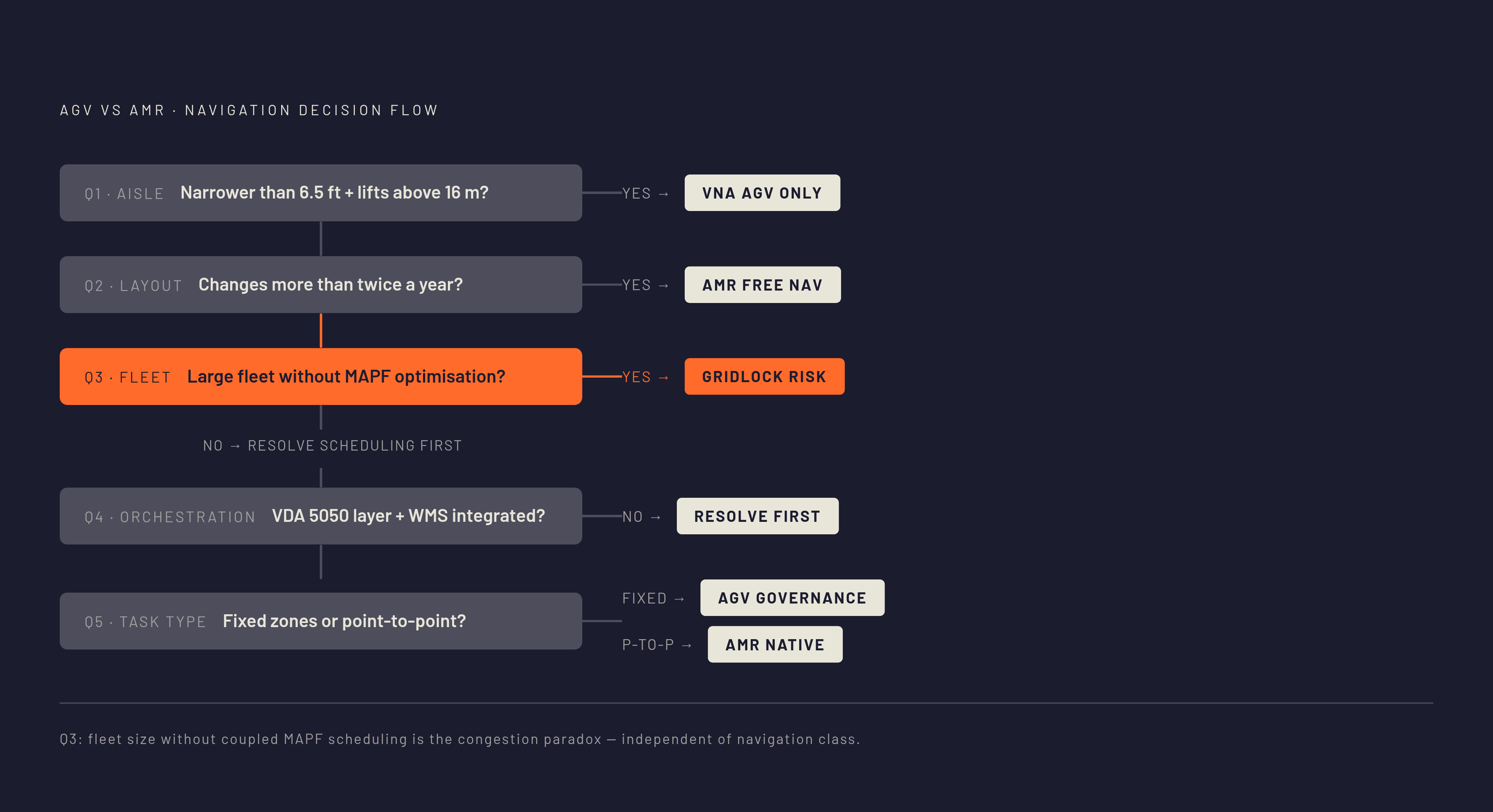
None of this reduces to a vendor comparison chart. It comes down to five questions an operator needs to answer honestly about their own floor.
Start with aisle geometry: does the operation need aisles narrower than 6.5 feet with lift heights above 16 meters?
Next, layout change frequency: how many times a year does the floor actually get reconfigured? More than twice a year favors AMR-class free navigation, while a stable, single-client layout favors AGV predictability.
Third, fleet size and the MAPF risk that comes with it: what fleet size is the operation actually planning to run? Larger AMR fleets need order scheduling and pathfinding optimized together, not just more robots thrown at the problem, or the fleet risks generating its own gridlock.
Without that layer, the congestion paradox appears no matter which navigation class gets purchased.
Fifth and last, task category: is the deployment system-specific, defined zones, predictable traffic, goods-to-person work, or solutionable, point-to-point movement across an active floor shared with people? System-specific work favors constrained, AGV-like governance. Solutionable work favors the AMR's native flexibility. Answer those five questions honestly, and the navigation architecture decision mostly answers itself. If yes, AGV Network indicates the VNA AGV class is the only current automated option at those parameters, as AMR options at equivalent specs are not yet established in the sources. Question 4, orchestration readiness: does the facility have or plan a single orchestration layer (VDA 5050-capable, WMS-integrated) that can govern mixed-fleet traffic? SOURCE PAGES, what the pages behind the outline's links say.
Sources
- AGV vs AMR: The 2026 UK Warehouse Comparison
Provided the single VDA 5050 orchestrator recommendation and the UK 3PL guidance on fleets that switch between fixed-lane and free navigation.
- It Takes Two to Tango: A Holistic Simulator for Joint Order Scheduling and Multi-Agent Path Finding in Robotic Warehouses
Supplied the WareRover findings on coupled order scheduling and MAPF, realistic fleet complications, and RMFS productivity.
- Top 10 Autonomous Mobile Robot Companies in 2026 [Compared] | Fdata Robot
Contributed sensor trade-offs and commissioning timeline comparisons for AGVs and AMRs.
- https://www.warehouseautomation.org/2025/09/11/agv-amr-navigation-systems-floor-based-vs-lidar/
Informed the comparison of LiDAR and vision-based navigation strengths and weaknesses.
- AMRs vs. AGVs: A Dynamics 365 Supply Chain Guide
Supplied the System-Specific versus solutionable IMR categories and examples that shape the orchestration discussion.
- https://www.lips-hci.com/post/why-lidar-free-amrs-are-the-future-of-warehouse-automation
Described the emerging 3D stereo vision, AI and VSLAM approach that captures context beyond LiDAR point clouds.
- https://www.tgw-group.com/en/news/detail/agv-amr-robots-guide/
Provided the argument that self-determined vehicle paths become a liability at peak throughput.