ASRS Unit Load vs Miniload System Selection
Start with your inventory's weight and shape, not the technology you saw at the trade show.
Advertisement
The choice between a unit load and a miniload ASRS gets settled before any engineer walks into the building. It's fixed by what a facility physically stores and retrieves: the weight, the shape, and the handling unit of the inventory itself. Most buyers approach the decision backwards. They get pulled toward a crane configuration or a shuttle architecture they saw on a trade show floor, then work backward to justify it against their operation, when the industry's usual framing (compare crane types, compare shuttle speeds, compare WMS integration depth) has the logic inverted from the start. Technology is what comes out of a load-unit decision, not what goes into one. Unit-load pallet systems took 41.92% of global ASRS revenue in 2025, and GoASRS has documented the pattern behind a lot of poor outcomes in that same market: companies pick a single technology, usually whatever impressed them most recently, without checking it against their actual SKU profile, throughput targets, or growth trajectory, and the result is a system that jams up the moment peak-season volume hits. The rest of this piece works through that load-unit decision first, then shows how building height, throughput, SKU profile, and ROI horizon all fall out of that one variable rather than standing as separate checkboxes to weigh on their own.
What unit load and miniload ASRS are
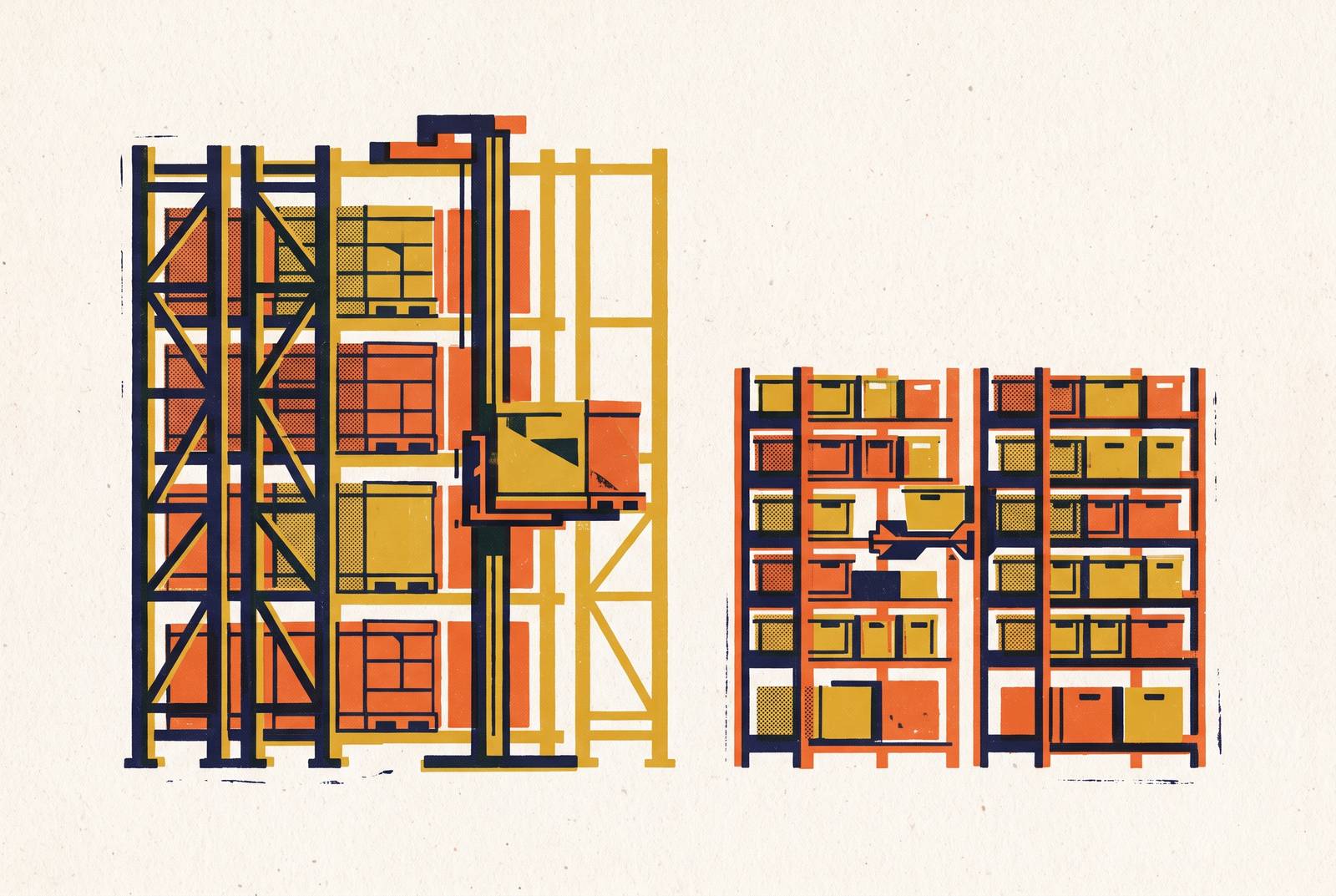
Unit load and miniload systems are built around physically different objects, and nearly every structural feature either system has traces back to the object it was built to move. Unit load ASRS handles pallets and heavy containers, moving them as single large units through the system.
Stacker cranes running on fixed rails handle the aisles in most installations, moving pallets and heavy containers in the 500–2,500+ kg range as HEDA Shelving defines the handling unit, though 2-way and 4-way shuttle systems are also used to move pallets horizontally through deep storage lanes, and some purpose-built facilities are built notably tall. Because the load itself is heavy and dense, these installations can climb to substantial heights, and some purpose-built facilities are constructed notably tall to take full advantage of that fact. This is the natural fit for industries where inventory arrives and leaves in pallet form: bulk distribution, manufacturing raw materials and finished goods, cold storage, and automotive parts.
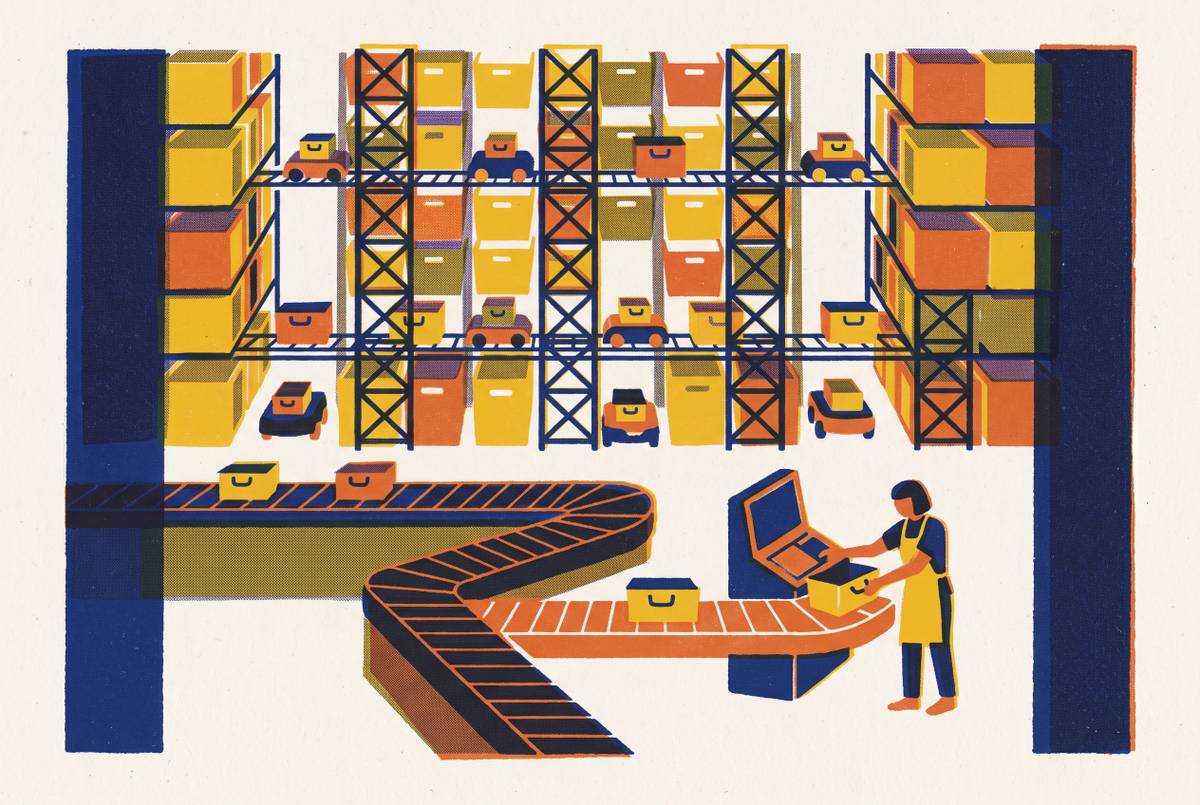
Crane-based stacker systems deliver totes to workstations for picking, gravity flow racks move stock forward passively in a first-in-first-out pattern within picking zones, and the whole arrangement can hold tens of thousands of tote positions inside a relatively compact footprint. Miniload ASRS handles totes, cartons, boxes, and trays rather than pallets, moving smaller units through the same kind of crane-based infrastructure. This is the system built for operations where many different small items need to come out fast and often: e-commerce fulfillment, pharmaceutical distribution, electronics, and high-SKU retail. The point to hold onto here is simple: the handling unit defines the system. Everything else about how these two types of ASRS are built, priced, and operated follows from that single fact.
The handling unit's effect on building height, throughput, and accuracy
Once the handling unit is known, defined by HEDA Shelving as totes, cartons, boxes, and trays under 100 kg (often 50 kg maximum), most of the rest of the system's structural profile follows automatically. Building height, movement speed, and picking accuracy are linked outcomes of a single load-unit decision, not separate variables an operator weighs one against another. They're consequences of the same underlying physics and economics that the load-unit decision already set in motion.
Start with building height. Unit load cranes are built to use extreme vertical space because a pallet's weight and footprint make deep-lane, high-bay storage the most cost-effective way to use available cubic volume, and some unit load installations reach very significant heights as a result. Miniload systems don't need that vertical reach. Their value comes from packing product densely and retrieving it fast, not from stacking product toward the ceiling, so miniload fits comfortably inside a standard warehouse building. That has a direct implication for anyone planning a facility rather than retrofitting one: the building itself isn't a free variable. It either has the clear height to support a unit load system or it doesn't, and that constraint alone can settle the decision before throughput or SKU count even enter the conversation.
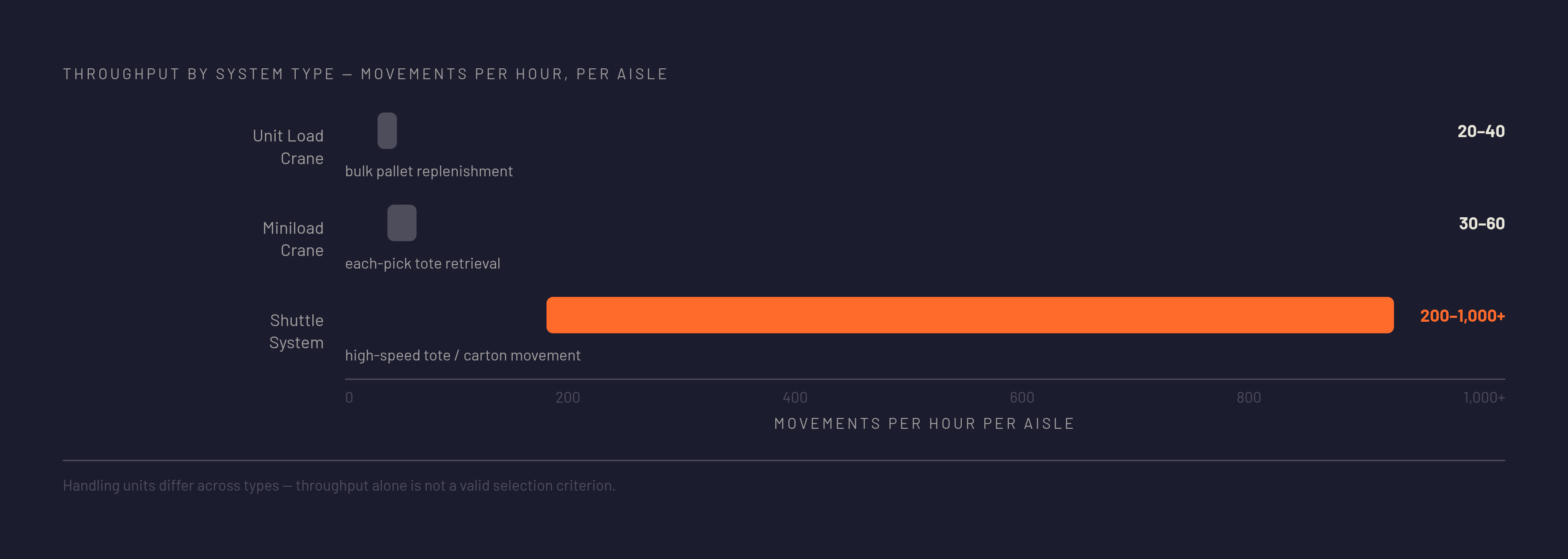
Throughput follows the same logic, though the numbers need careful reading: GoASRS puts unit load cranes at 20–40 pallet movements per hour per aisle and miniload cranes at 30–60 tote movements per hour per aisle. Those figures look close enough to compare directly, but the units underneath them describe entirely different jobs. A tote retrieval supports a single each-pick within a larger order. A pallet retrieval supports a bulk replenishment move that might feed an entire production line or restock an entire section of a store. The two systems are built around fundamentally different physical objects, and every structural feature of each follows from that object.
Accuracy completes the cascade. HEDA Shelving credits miniload systems with better than 99% picking accuracy at the item level, while unit load systems deliver reliable accuracy at the pallet level. That gap sounds larger than it functions in practice for most unit load operations, because a pallet retrieved correctly still has to be broken down into individual units somewhere downstream, and that manual or semi-automated step introduces its own error sources that no crane or shuttle can control. Item-level accuracy matters most where the ASRS itself is the last automated touchpoint before an item ships. Pallet-level accuracy is enough where a picking or repack process still stands between the ASRS and the customer.
SKU count and order profile confirm the right system
If the load unit sets the initial direction, SKU count and order profile are what confirm it, or complicate it.
HEDA Shelving describes this profile as large quantities of low-to-medium SKUs with large individual item volumes, the pattern typical of bulk goods, manufacturing parts, and beverage distribution, where the SKU list stays predictable from one order cycle to the next. The Toyota Oman installation, documented by Nova Intelligent, shows this fit in practice: car parts stored on heavy pallets, retrieved quickly at the pallet level, stored more safely than manual handling allowed, and moved to solve for bulk retrieval speed rather than individual-item picking accuracy.
An operation shows a miniload signal when SKU count runs high, into the tens of thousands of active SKUs, with frequent retrieval of individual items or small batches, and order profiles where a single order might touch dozens of different SKUs at once. GoASRS points to e-commerce fulfillment with large SKU catalogs, pharmaceutical distribution that requires lot tracking and FIFO compliance, electronics warehousing, and spare parts operations as the clearest cases. The JD.com facility in Guangzhou, also documented by Nova Intelligent, shows the fit: thousands of storage bins, high picking accuracy, and a measurable rise in orders filled per day. The problem that installation solved was each-pick throughput across a large catalog, not bulk movement. The rise of e-commerce is, in large part, what created demand for miniload at the scale it now operates. A pallet-based system simply can't serve tote-level retrieval cost-effectively at the order frequencies high-SKU fulfillment now requires.
What matters is what form inventory takes when it leaves the building, and how often it leaves that way, because a facility can receive everything on pallets and still ship almost entirely in eaches. That single distinction changes the answer completely.
That distinction is also where hybrid setups come from. A national retailer might receive inventory almost entirely on pallets, store the bulk of it in a unit load ASRS, then break specific SKUs down and transfer them into a miniload system for each-picking once demand at the individual-unit level justifies it. The load-unit decision doesn't always produce a single answer for an entire facility. Sometimes it produces a split answer, with different zones of the same building running different systems for different parts of the same inventory.
Where industry and sector characteristics lock in the decision
For a large share of operators, the sector they work in settles the load-unit decision well before any internal analysis starts. Physical constraints, regulatory requirements, and labor economics specific to that industry make the call in advance.
Unit load dominates wherever the form of the inventory leaves no real alternative. Cold storage is one clear case: HEDA Shelving points to unit load's resilience in extreme cold as a critical factor for cold-chain operators, and keeping workers out of sustained sub-freezing conditions is both a safety requirement and an operational advantage. Automotive and heavy manufacturing form another: pallets of subassemblies and raw materials are the natural handling unit in those environments, and the Toyota Oman case shows how that fit plays out on the floor. Beverage distribution rounds this out, running high pallet volumes against a predictable, low-SKU catalog, which is precisely the condition unit load systems are built to handle efficiently. Unit load signals a low-to-medium SKU count paired with high volume per SKU, inventory that moves in pallet quantities, and a batch inbound and outbound cadence.
Miniload's growth, meanwhile, is being pushed hard by regulation in pharmaceuticals. The U.S. Drug Supply Chain Security Act and the EU's Falsified Medicines Directive are pushing pharmaceutical distributors toward ASRS platforms that deliver full lot-level traceability and automated first-expiry-first-out inventory management, requirements that crane-based miniload systems are well suited to meet. Pharmaceutical-grade miniload installations can run anywhere from ambient temperature down to -25°C for frozen biologics, using insulated aisle construction and redundant temperature monitoring to hold that range reliably. Labor economics add further weight to both sectors: continued OSHA enforcement under the warehouse National Emphasis Program, which targets ergonomics, walking and working surfaces, and powered industrial vehicle safety, is building the business case for goods-to-person cells that keep workers out of high-traffic aisles. In each of these cases, the industry itself, not an internal throughput study, is what draws the line.
Capital cost structure after the load-unit decision
Cost and return on investment don't decide which system an operation needs. They decide whether the system it needs is affordable at the scale being planned, and the financial picture changes depending on what the operation is actually doing day to day.
GoASRS puts unit load installations at a typical range for installation cost, with per-position costs varying widely depending on configuration, within the broader capital ranges GoASRS establishes for both system types. Miniload installations carry their own substantial upfront investment, running higher than unit load in some configurations and lower in others, depending largely on scale and the level of automation built into the picking workstations.
Return on investment plays out differently depending on the operating context, not on which system type was chosen in the abstract. Miniload systems tend to carry higher ongoing maintenance costs, but they pay back faster in high-turnover, high-SKU environments where labor savings from each-pick automation add up quickly. Unit load systems tend to run lower maintenance costs relative to the volume of product they handle, but the payback stretches out longer wherever pallet turnover is slow or the inventory mix is unpredictable from one period to the next. A full payback calculation has to account for equipment and installation, software and WMS integration, energy use, labor reduction, reduced product damage, and the value of space recaptured elsewhere in the building beyond the price tag on the cranes themselves.
An operator who picks a system on sticker price alone, choosing miniload because the number looks smaller or rejecting unit load because the upfront figure looks large, is optimizing the wrong variable. The load unit determines which system fits the operation. The financial model only tells an operator whether, and when, that system pays for itself.
Shuttle systems and robotic goods-to-person platforms
The crane-based framing of unit load versus miniload holds for most operations, but it has a ceiling. At very high tote throughput, shuttle-based and robotic goods-to-person systems start to outperform traditional miniload cranes by a wide margin, and any buyer weighing these systems needs to know roughly where that ceiling sits.
GoASRS puts shuttle-based systems at several hundred to well over a thousand tote or carton movements per hour per aisle, five to ten times what a traditional miniload crane delivers, and notes that robotic goods-to-person platforms can reach comparably high line rates per station. The scalability argument for shuttles is straightforward: add more shuttles to raise speed, add more racking levels to raise capacity, without being locked into the fixed one-crane-per-aisle ceiling that defines traditional miniload architecture. SNS Insider identifies robotic cube-based storage as the fastest-growing segment of the ASRS market, driven by demand for extremely dense storage paired with flexible goods-to-person operation.
None of this erases the underlying argument this piece has made. Shuttle and robotic systems still sort operations by load unit first: they serve the tote-and-carton side of the market, the same side miniload was built for, just at higher throughput and with a different capital and maintenance profile. An operation moving pallets in bulk still needs unit load capability regardless of how fast a shuttle system can move totes. What shuttles and robotic platforms actually do is raise the ceiling on how much throughput a tote-based operation can extract once it has already determined, correctly, that totes and cartons, not pallets, are its native handling unit.